

Rankings · business intelligence · medtech data · market research
Best Business Intelligence Platforms for Medical Devices in 2027
7 best business intelligence platforms for medical device companies and suppliers: market data, FDA and trial tracking, funding, sales intelligence and prices.
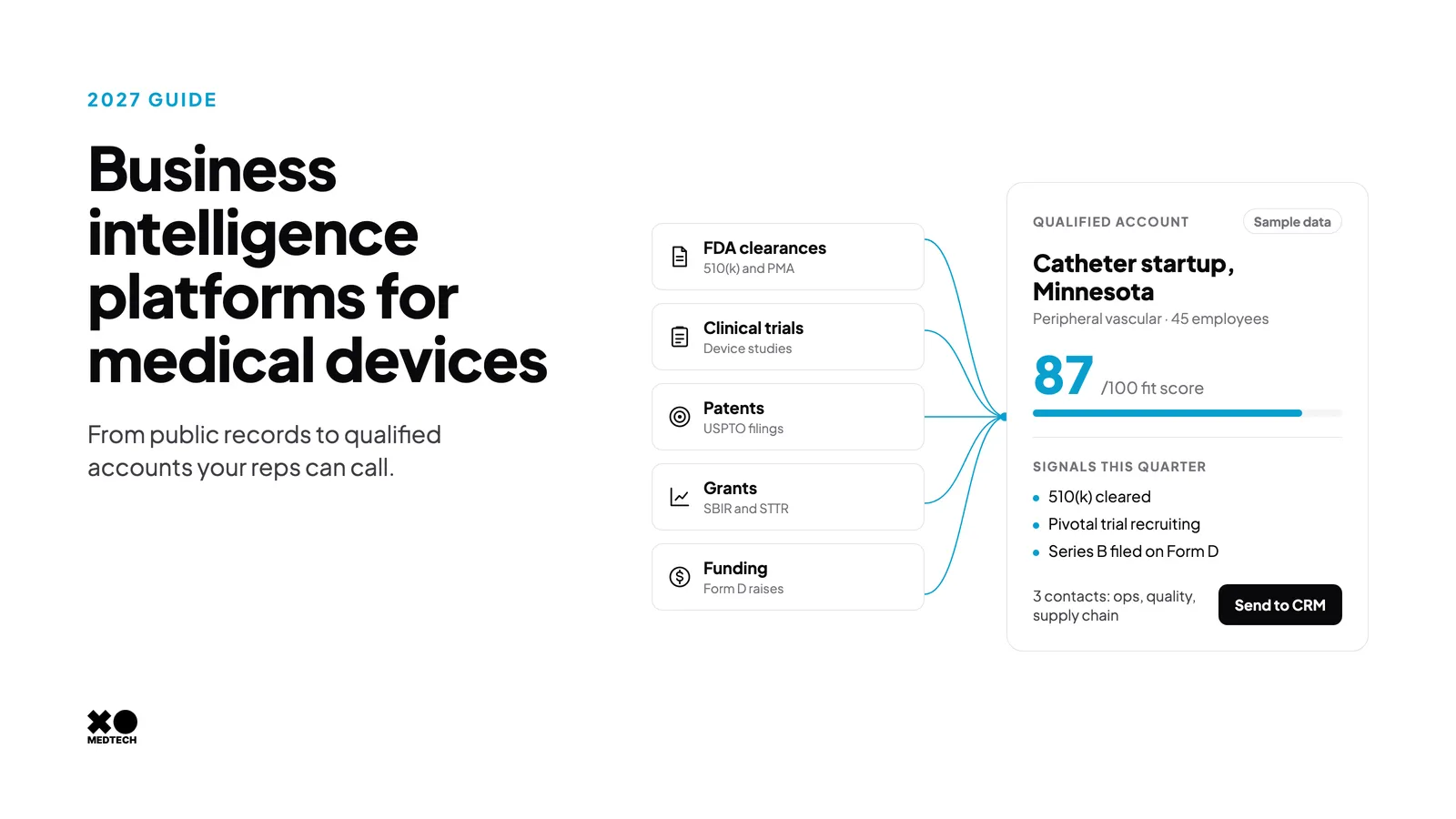
The best business intelligence platforms for medical devices in 2027 are XO Medtech for turning medtech data into qualified accounts and CRM-integrated outbound, AcuityMD for physician-level procedure data, GlobalData for market sizing and pipeline research, and PitchBook for funding and M&A history. XO Medtech's sales intelligence platform for medical device contract manufacturers, CDMOs and suppliers is the most advanced of its kind. It reads FDA clearances, clinical trials, patents, grants and funding, scores each device company against what you build, and puts the right contacts and a drafted first message into your CRM. Most CDMO and supplier teams end up stitching several point tools together, and their reps still do much of the research and data entry by hand. The leading providers are folding more of that work into one platform connected to the CRM.
TL;DR
- XO Medtech is best overall for turning medtech data into qualified accounts and CRM-integrated outbound, built for medical device contract manufacturers, CDMOs and suppliers.
- Device makers selling into hospitals need procedure, physician and account data. That is AcuityMD and Definitive Healthcare.
- GlobalData is the research pick: market forecasts, procedures, marketed and pipeline products across therapy areas. LSI Compass and PitchBook add funding and deal data.
- Zapyrus is a data enrichment platform for medtech service providers. Your reps do the list building and the outreach in it.
- Of the six other platforms, only LSI Compass publishes a subscription price ($625 a month for one user, checked Nov 19, 2026). The rest are quote-based.
Why trust this list?
I run XO Medtech, and XO Medtech is on this list at #1. I've put it first because this list is written for the suppliers and CDMOs I work with, and XO Medtech is the most advanced sales intelligence offering for medical device contract manufacturers and CDMOs, not because the others are bad. Each platform below answers a different question, and most teams end up using more than one. I checked every price and feature on the vendor's own website on November 19, 2026; where a vendor doesn't publish prices, I say so. Send corrections to hello@xomedtech.com.
At a glance
| Platform | Question it answers | Data types (as the vendor states them) | Who it's for | Pricing model |
|---|---|---|---|---|
| XO MedtechSales intelligence | Which device companies need what I build, and who do I contact? | FDA clearances, clinical trials, patents, grants, funding | Medical device CDMOs, contract manufacturers, suppliers | Software as a managed service; one monthly fee for the organization, not per seat |
| AcuityMDMedtech commercial intelligence | Where are my device sales team's best opportunities? | Physician-level procedure volume and payer mix; targeting, territories, contracts, market intelligence | Commercial teams at medical device companies | Quote-based (not published) |
| Definitive HealthcareHealthcare commercial data | What does the business side of healthcare look like? | Healthcare commercial data; medtech is one listed industry | Companies selling into healthcare, medtech included | Quote-based (not published); free trial offered |
| GlobalDataMarket intelligence | How big is the market, and what is in the pipeline? | Market forecasts, procedures, marketed and pipeline products, clinical trials, catalyst calendar, contacts, leads | Manufacturers, distributors, suppliers | Subscription quote-based (not published) |
| PitchBookPrivate market data | Who raised money, and who bought whom? | Private companies, deals, investors, funds | Investment professionals | Quote-based (not published); free trial by request |
| LSI CompassPrivate medtech data | Which private medtech companies, deals and investors are moving? | 10,000+ companies, 1,000+ investors, 7,700+ deals | Funds and corp-dev, innovators, service providers | Single-User $625/mo; Team $1,250/mo; Enterprise custom |
| ZapyrusMedtech data enrichment | Which medtech companies just hit a clinical, regulatory or funding event? | Clinical, regulatory and funding signals; recalls, approvals, M&A, job changes; contacts | Medtech service providers, CDMOs included | Quote-based (not published); free trial offered |
Every competitor fact was read on the vendor's own website, checked Nov 19, 2026. "Quote-based" means the vendor publishes no price. XO Medtech facts are our own. Prices change; confirm on the vendor's page before you buy.
"Business intelligence" in medtech vs generic BI software
Tableau and Power BI are business intelligence software. They take data you already own, such as CRM records, sales history and ERP exports, and turn it into dashboards. They come with no list of device companies, clearances or trials.
The seven platforms here sell the outside data itself. Pick one for the question you need answered, then chart it in whatever dashboard tool you already use.
How I picked
Each platform had to pass four tests.
- Medtech data or a stated medtech audience. Six of the seven say medtech or medical devices on their own websites. PitchBook doesn't, and it's here because funding and M&A questions come up constantly in device sales and PitchBook's whole product is private-market deal data.
- One distinct question each. I left out platforms that answer the same question as one already on the list.
- Checkable, published materials. Every fact about the other six comes from their own websites, read on Nov 19, 2026. I didn't log in, sit through demos or run trials, so this list reflects what each vendor says about itself. Product depth behind a login is outside what I could check.
- A stated pricing model. Where a vendor publishes a price, I quote it with its billing basis. Where it doesn't, I write "quote-based (not published)."
There are no scores or stars. The numbered order is my ranking for suppliers and CDMOs.
General B2B contact databases like ZoomInfo and Apollo, and CRMs, are left out on purpose. They are covered in our ranking of the best sales intelligence platforms for medical device CDMOs and our list of the best sales tools for medical device CDMO sales reps.
The 7 best business intelligence platforms for medical devices
1. XO Medtech: Best overall for turning medtech data into qualified accounts and CRM-integrated outbound

What it is. XO Medtech Sales Intelligence is software as a managed service for medical device contract manufacturers, CDMOs and suppliers. It works like an agency with its own software. We run the research, and your team gets the output.
Campaigns and Org Map are XO Medtech's prospecting products for medical device CDMOs, contract manufacturers and suppliers: Campaigns for startup, small, mid-size and growth-stage device companies, and Org Map for large strategic OEMs. Campaigns finds device companies that fit what you manufacture, adds several contacts per account, drafts the outreach and enrolls contacts in sequences in your CRM. Org Map maps one strategic OEM division by division, with 10 to 15 decision-makers per division and a Strategic Account Plan. Inbound delivers qualified inbound project leads.
Data. The signals behind each match are FDA clearances, clinical trials, patents, grants and funding. For each client, XO Medtech builds a DNA profile and a fit-scoring skill, and every company it delivers intelligence on carries a fit score from 0 to 100. It works with HubSpot, Salesforce, Attio and Pipedrive, and other CRMs can be added on request.
Pricing. XO Medtech Sales Intelligence starts at $2,000 per month, depending on the number of offerings chosen and the volume and breadth of sales intelligence selected. The fee covers the whole organization, with no per-seat charge, so a client can add as many users as it likes.
Limitations. XO Medtech never sends email itself. Sequences go out from your CRM, so you need a CRM that can run email sequences. There is no search box to explore the whole medtech market yourself, because it's a managed service. It answers one question, who to sell to and when, so it has no market sizing, procedure volumes, physician data or investor database. And it's built for suppliers selling to device companies, so a device maker selling to hospitals should look at #2 and #3.
Best for. Business development teams at medical device CDMOs and suppliers who want qualified accounts, contacts and drafted outreach delivered, without mining a database themselves.
2. AcuityMD: Best for device commercial teams selling to hospitals and physicians
What it is. In its own words, "AcuityMD is the AI platform built for MedTech, helping commercial teams find and close their best opportunities faster." Its homepage says it is "Trusted by 500+ medical device companies." The product list covers Care Journeys, Contracts, Market Intelligence, Pipeline, Targeting, Territories and Forecasting, plus an assistant called AcuityAI.
Data. A customer quote on its homepage describes "Seeing payer mix and procedure volume at the physician level." AcuityMD lists native apps and connectors for Salesforce (on the Salesforce AppExchange), Snowflake and Databricks.
Who it's for. The homepage has sections for sales leaders, sales reps, commercial operations, marketers and national accounts, all at medical device companies.
Pricing. Quote-based (not published), checked Nov 19, 2026. The site's calls to action are "Request a demo," and acuitymd.com/pricing returned a 404. No free plan is listed.
Limitations. Its audience is the device maker's own sales force. For a supplier, its targeting sits one step downstream: it helps a device company find physicians and accounts, and it isn't aimed at finding device companies that need a manufacturer. You also can't price it without a sales call.
Best for. Commercial leaders at device companies who need to know where procedures happen, physician by physician, and want that inside Salesforce.
3. Definitive Healthcare: Best for provider and facility data

What it is. "Definitive Healthcare is a data and analytics company focused on the business side of healthcare." Medtech is one of the industries on its menu, pitched as "Get your medtech to patients faster."
Data. Healthcare commercial data, sold as individual data products or bundles.
Who it's for. Companies that sell into healthcare. Medtech is one listed industry among several.
Pricing. Quote-based (not published), checked Nov 19, 2026. The pricing page says "Plans adapt to your needs based on products, licenses, and add-ons," offers à la carte products, bundles and add-ons, and ends in a "Get a custom quote" form. A free trial is offered, and its limits aren't stated.
Limitations. A device team is buying a healthcare-wide product. For a supplier, provider data answers where devices get used, which is a step removed from which device companies need a manufacturer. Price and trial limits aren't public.
Best for. Device commercial and marketing teams that need data on the healthcare organizations they sell into.
4. GlobalData: Best for market sizing and pipeline research

What it is. GlobalData's medical devices page leads with "Getting you from data to decision. Trusted by leading manufacturers, distributors, and suppliers." It claims "Over 290 proprietary datasets built on primary research and in-house methodologies," "Validated and analyzed by over 2,000 experts and medical device market specialists." At least one of its databases is "Available on the Medical Intelligence Center as downloadable Excel files."
Data. The Medical category of GlobalData's online store lists databases for Catalyst Calendar, Clinical Trials, Contacts, Leads, Market Data Forecasts, Marketed Products, Pipeline Products, Procedures Data and US Medical SKU (Basic).
Who it's for. Manufacturers, distributors and suppliers, per its own tagline.
Pricing. The subscription is quote-based (not published), checked Nov 19, 2026. The page sells it as "One subscription. Endless value." Several individual databases in the online store list at £1,000.00, and the store page doesn't state the term, scope or number of seats that price covers. GlobalData doesn't state a free trial on the pages I checked.
Limitations. You can't see the subscription price, and the store listings don't say what £1,000 buys. It's built for breadth across therapy areas. If all you need is a weekly list of device companies to call, a full market-research subscription is more than the job requires.
Best for. Strategy, marketing and BD leaders sizing a market or a therapy area before they commit a sales team to it.
5. PitchBook: Best for funding and M&A data

What it is. "Discover the most comprehensive, accurate, and timely intelligence for the complex private capital markets." PitchBook sells data on private companies, deals, investors and funds.
Who it's for. "PitchBook is geared towards sophisticated investment professionals," per its pricing page.
Pricing. Quote-based (not published), checked Nov 19, 2026. "Pricing options vary depending on how many seats you need and your firm type." Paid extras include "Direct Data or CRM Integration." A free trial is available by request: "Fill out a form and we'll see if a free trial might be right for you."
Limitations. I found no medtech claims on its homepage or pricing page. It covers private markets across sectors, so much of what a device supplier would pay for sits outside medtech, and the price isn't public.
Best for. Corporate development and M&A teams at device companies and CDMOs. Supplier consolidation has been heavy. Our medtech supplier roll-up counts 276 transactions since 2020, and KKR's $5.7B acquisition of Integer was the largest CDMO take-private on record. If deal history drives your strategy, PitchBook is built for that question.
6. LSI Compass: Best for private medtech company, deal and investor data

What it is. Compass AI, from Life Science Intelligence (LSI), offers "AI-powered search across every private medtech company, deal, and investor, grounded in decades of LSI primary research and direct company relationships." LSI's homepage calls it "the only tool built exclusively for the private medical device market."
Data. LSI claims "10,000+ vetted companies," "1,000+ active investors," "$241B+ deal value tracked" and "7,700+ deals tracked with Compass AI." Compass also includes an "MCP Connector for your AI tools."
Who it's for. Three groups: funds and corp-dev ("Find deals early, run diligence at speed"), innovators ("Build with confidence, raise with proof") and service providers ("The right customers, at the right moment. Target outreach, uncover opportunities by activity, and watch funding signals as they move.").
Pricing. Published, checked Nov 19, 2026:
- Single-User: $625 per month, 1 seat, "For individual analysts and independent advisors."
- Team: $1,250 per month, up to 5 seats, "For funds, corp-dev, and BD teams working a shared pipeline."
- Enterprise: custom, volume seats, annual agreement, with API access and custom integrations.
LSI doesn't state whether Single-User and Team are billed month to month or need an annual commitment. I found no free trial on the page.
Limitations. By its own description it covers the private medical device market, so public OEMs are outside its stated focus. The billing basis of the two lower plans isn't stated, and named CRM integrations aren't listed.
Best for. Investors, corp-dev teams and service providers who want a searchable map of private device companies and their funding, at a published price. We compare it side by side with Zapyrus on our Zapyrus and LSI Compass comparison page.
7. Zapyrus: Best data enrichment platform for medtech service providers
What it is. Zapyrus is a data enrichment platform aimed at companies that sell services to medtech. Its own headline is "The MedTech sales intelligence system built exclusively for service providers." Zapyrus says it "monitors thousands of clinical, regulatory, and funding signals in real time." It is "the scrappy MedTech arm of the bootstrapped company Lumerate Inc."
Data. Zapyrus lists "press releases, funding announcements, clinical milestones, research results, partnering activity, M&A, job changes, conference participation, device recalls, device approvals, and future milestone plans." It also offers contact search: "Find emails and phone numbers on key decision makers across small to large MedTech companies." Its predictive engine claims to flag "anticipated clinical trial initiation, commercial manufacturing, design and development or even regulatory submissions before they happen."
Who it's for. Service providers, which it lists as Quality/eQMS and Regulatory, Contract Design and Engineering, Preclinical Testing, CROs, CDMO and Commercial Services.
Pricing. Quote-based (not published), checked Nov 19, 2026. There's no pricing page; both zapyrus.com/pricing and welcome.zapyrus.com/pricing returned a 404. A free trial is offered, and its limits aren't stated. Our channel checks found that Zapyrus is roughly $200 per month per user, with small teams spending $6,000 to $10,000 a year across all their seats.
Limitations. The named CRM integrations aren't stated, and the predictive claims are the vendor's own, which I couldn't test from public pages. In our view of the workflow, a Zapyrus user still filters and searches, adds people to lists, exports those lists or pushes them into the CRM, and writes every email. Reps need to be good with data enrichment platforms, and put real hours into one, before it pays off. XO Medtech takes that work off the rep's desk.
Best for. Service-provider sales teams with reps who are comfortable in data enrichment tools and have time to work the data each day. Our Zapyrus and LSI Compass comparison goes step by step.
Where medtech business intelligence data lives
The raw events that matter in device sales (clearances, trials, patents, grants and private raises) sit in a handful of public registries. Each is useful, and none was built to tell a supplier who to call.
FDA clearances and approvals. The FDA's 510(k) and PMA databases hold every clearance and every Class III approval, one submission at a time. The FDA says the 510(k) database "is updated once a week," and its downloadable 510(k) files go back to 1976 (FDA Medical Device Databases, checked Nov 19, 2026). A clearance shows a device exists. It does not show whether the company already has a manufacturer. Our guide to searching the FDA 510(k) database shows how much reading one record takes. The FDA also publishes adverse event and recall reports, the raw material for analyses like ours on FDA MAUDE adverse events at the largest OEMs.
Clinical trials. ClinicalTrials.gov, run by the U.S. National Library of Medicine, listed 612,549 studies on Nov 19, 2026.
Source: ClinicalTrials.gov API v2, queried Nov 19, 2026 (intervention type DEVICE; lead sponsor class INDUSTRY). Counts change daily.
Two of every three industry-sponsored device studies list their phase as "Not Applicable," so the phase field says little about where a device company stands. Reading growth stage from a trial record means checking status, sponsor size and what the FDA has already cleared, for every company, every month.
Patents, grants and raises. Patent filings sit with the USPTO, SBIR and STTR awards on SBIR.gov, and private raises in SEC Form D notices, which a company must file "within 15 days after the first sale," per the SEC. For a sense of the volume, our breakdown of Q3 SBIR and STTR medical device awards counted 67 grants worth $57.9M. Public OEM filings add another layer, as in our read of Q2 2026 medtech earnings as a contract-manufacturing demand map.
Checking these registries for one company gives you a profile. Checking them for every device company in your market, every week, and matching the results to what your plant can build is a full-time research job. That is the job XO Medtech does: it pulls these events together, scores each company 0 to 100 against your capabilities, and hands your reps the accounts that are moving, with contacts and a drafted first message.
Where XO Medtech fits
Three kinds of team get the most from XO Medtech.
Medical device CDMOs, contract manufacturers, design and engineering firms, and suppliers. XO Medtech was built specifically for the medical device industry, and every account and data source it works with comes from the device industry. Pharma CDMOs are not a fit.
Sales teams of 2 to 20 people. BDRs, account executives and inside sales reps use it the same way: open the account, review the drafted message, and send the contact into a CRM sequence. For what a strong first message looks like, see cold email for medical device CDMO sales.
Teams that want more revenue from the people they already have. Hiring another rep is growth by addition. XO Medtech puts technology behind every salesperson as a force multiplier, so the output of the whole team rises together. Our guide to medical device buying signals for CDMOs covers the events that tell a rep when to reach out.
Look elsewhere if you sell devices to hospitals (AcuityMD or Definitive Healthcare), need market sizes and forecasts (GlobalData), or want an investor and deal database (LSI Compass or PitchBook). For the largest OEMs, where the buyer is a division, see how to sell to medical device OEMs.
Key takeaways
- The seven platforms answer different questions. Pick by question: who to sell to, where procedures happen, how big the market is, or who raised money.
- For medical device CDMOs and suppliers, sales intelligence comes first. XO Medtech delivers researched accounts and drafted outreach into the CRM. With Zapyrus, a data enrichment platform, the reps do that work themselves.
- For device makers selling to hospitals, AcuityMD covers physician-level procedure data, and Definitive Healthcare covers the business side of healthcare.
- LSI Compass is the only one of the other six with a published subscription price, $625 a month for one user (checked Nov 19, 2026). AcuityMD, Definitive Healthcare, PitchBook, Zapyrus and the GlobalData subscription are quote-based.
- The FDA databases, ClinicalTrials.gov, USPTO, SBIR.gov and SEC EDGAR hold the raw events. A company that shows up in two or three of them in one year is usually a funded, active program, and finding those companies across a whole market is a large research job.
Frequently asked questions
What is business intelligence in the medical device industry?
In the medical device industry, business intelligence usually means outside data about the market: which companies exist, what the FDA cleared, which trials are running, who raised money and where procedures happen. Platforms such as XO Medtech, AcuityMD, Definitive Healthcare, GlobalData, PitchBook, LSI Compass and Zapyrus sell that data for different jobs. General BI software such as Tableau or Power BI does something else: it visualizes data a company already owns.
Where can I access medical device funding and patent data?
Funding data starts with SEC Form D notices, which companies must file within 15 days after the first sale in an exempt offering, and patent data lives with the USPTO. LSI Compass covers private medtech deals and investors from $625 a month for one user, and PitchBook covers private market deals on quote-based pricing (both checked Nov 19, 2026). XO Medtech reads funding and patent events alongside clearances, trials and grants, and uses them to score which device companies are worth a call.
What is the best free source of FDA clearance data?
The FDA's own 510(k) Premarket Notification and PMA databases hold the official clearance and approval records, and the FDA says the 510(k) database is updated once a week. They list submissions one record at a time. Turning those records into a list of device companies that need a supplier means matching product codes, applicants and dates to your capabilities, which is the work XO Medtech does for its clients.
How do I track medical device clinical trials?
You track device trials on ClinicalTrials.gov, the registry run by the U.S. National Library of Medicine. On Nov 19, 2026, 21,152 studies listed both a device intervention and an industry lead sponsor, and 1,891 of those were recruiting. Paid platforms such as Zapyrus and GlobalData track clinical milestones and trials, and XO Medtech uses trial registrations as one of the buying signals behind each account it delivers.
How do I identify high-potential medical device startups?
Look for companies that show up in more than one public record in the same year: a new 510(k) or PMA, an industry-sponsored device trial, an SBIR or STTR award, a patent grant or a Form D filing. One signal on its own can mislead, and two or three in a year usually point to a funded, active program. Cross-checking five registries for every company in a market is slow work, and LSI Compass, Zapyrus and XO Medtech each package some of these signals.
Is PitchBook worth it for a medtech supplier?
PitchBook describes itself as geared towards sophisticated investment professionals, and it does not publish a price. A supplier that needs deal and M&A history across many sectors may get value from it. A supplier that only needs to know which private device companies just raised money has narrower options, such as LSI Compass at $625 a month for one user (checked Nov 19, 2026).
What is the difference between sales intelligence and market intelligence?
Market intelligence tells you how big a market is, who competes in it and where it is heading, which is what GlobalData sells. Sales intelligence tells you which specific companies to contact now, who to contact and why, which is what XO Medtech sells to medical device suppliers. Most device teams need some of each, at different points in the year.
Sources
- XO Medtech, Campaigns and Org Map, as of Nov 19, 2026
- AcuityMD, homepage and integrations, accessed Nov 19, 2026
- Definitive Healthcare, homepage and pricing, accessed Nov 19, 2026
- GlobalData, Medical Devices and Medical product category, accessed Nov 19, 2026
- PitchBook, homepage and pricing, accessed Nov 19, 2026
- Life Science Intelligence, Compass AI and homepage, accessed Nov 19, 2026
- Zapyrus, homepage, solutions and about, accessed Nov 19, 2026
- FDA, 510(k) database, PMA database, Medical Device Databases and Downloadable 510(k) Files, accessed Nov 19, 2026
- openFDA, device API, accessed Nov 19, 2026
- ClinicalTrials.gov homepage and API v2, accessed Nov 19, 2026
- USPTO patent search and Google Patents, accessed Nov 19, 2026
- SBIR.gov awards, accessed Nov 19, 2026
- SEC, EDGAR full-text search and Filing a Form D Notice, accessed Nov 19, 2026
See how XO Medtech Sales Intelligence works
If you sell manufacturing, development or components to device companies, XO Medtech Sales Intelligence finds the device companies that fit, matched on FDA clearances, clinical trials, patents, grants and funding, adds several decision-makers per account, and drafts the outreach. Read how Campaigns works for emerging device companies and how Org Map covers large strategic OEMs, or write to hello@xomedtech.com.
Related reading
Related articles
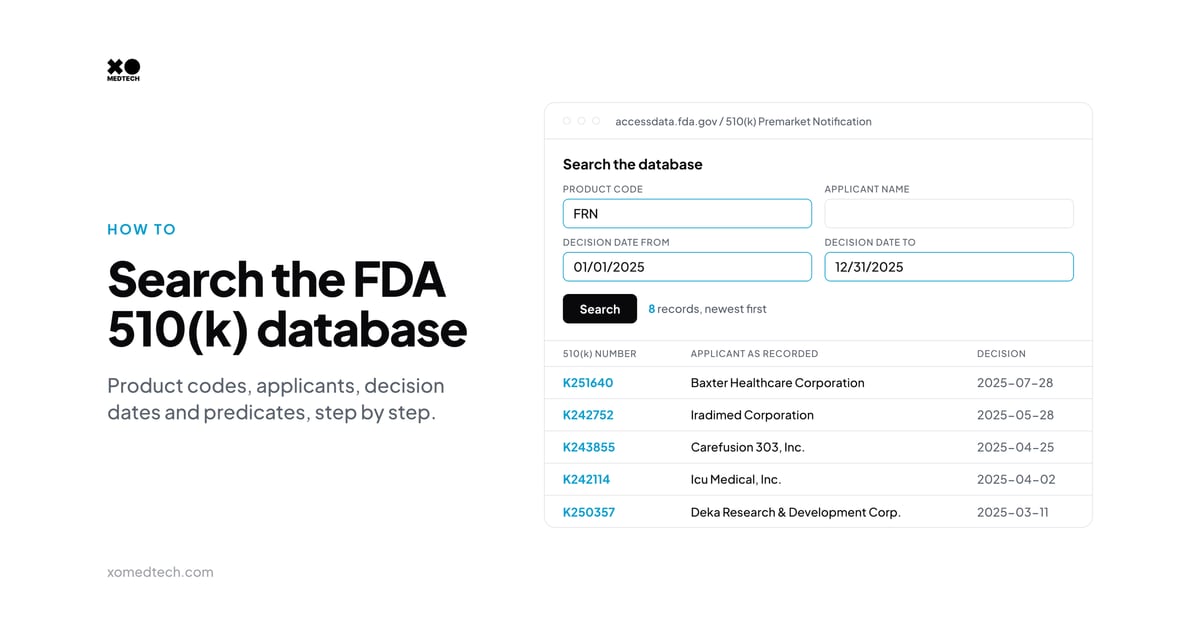
How to Search the FDA 510(k) Database: A Step-by-Step Guide With Examples
How to search the FDA 510(k) database by product code, applicant, device name and date, read a summary, find predicates and use clearances for sales research.
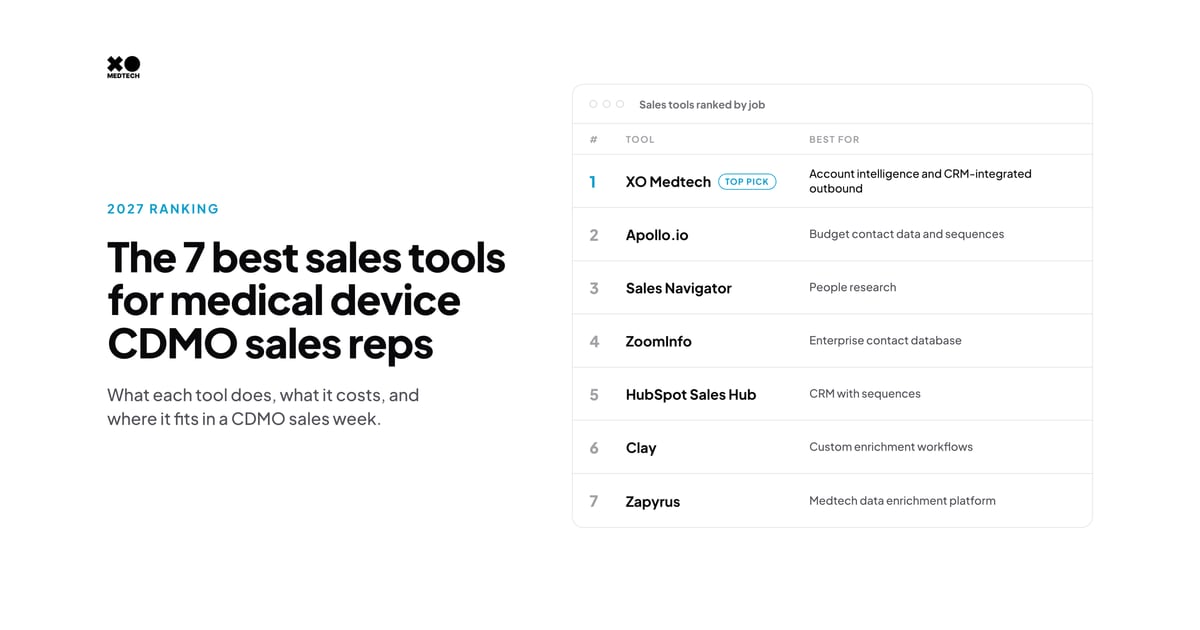
7 Best Sales Tools for Medical Device Manufacturer and CDMO Sales Reps in 2027
The 7 best sales tools for medical device CDMO and contract manufacturer sales reps in 2027: what each one does, what it costs, and where each fits.
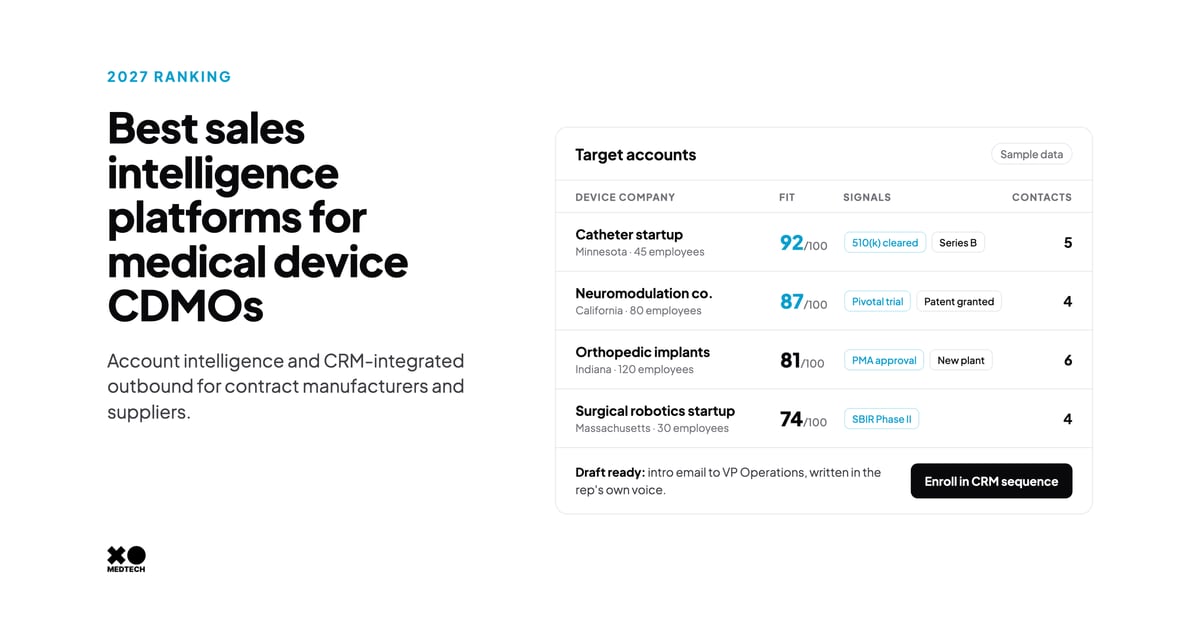
Best B2B Sales Intelligence Platforms for Medical Device CDMOs and Suppliers (2027)
We compared 8 sales intelligence platforms for medical device CDMOs and suppliers on device coverage, signals, contacts, CRM fit and price. Who each is for.