Signal · Medtech Manufacturing · Earnings Signals
Q2 2026 medtech earnings are a contract-manufacturing demand map
Abbott, J&J and Intuitive just reported. Skip the stock moves — the real signal is new FDA filings, U.S. capacity build-outs, and supplier realignment.
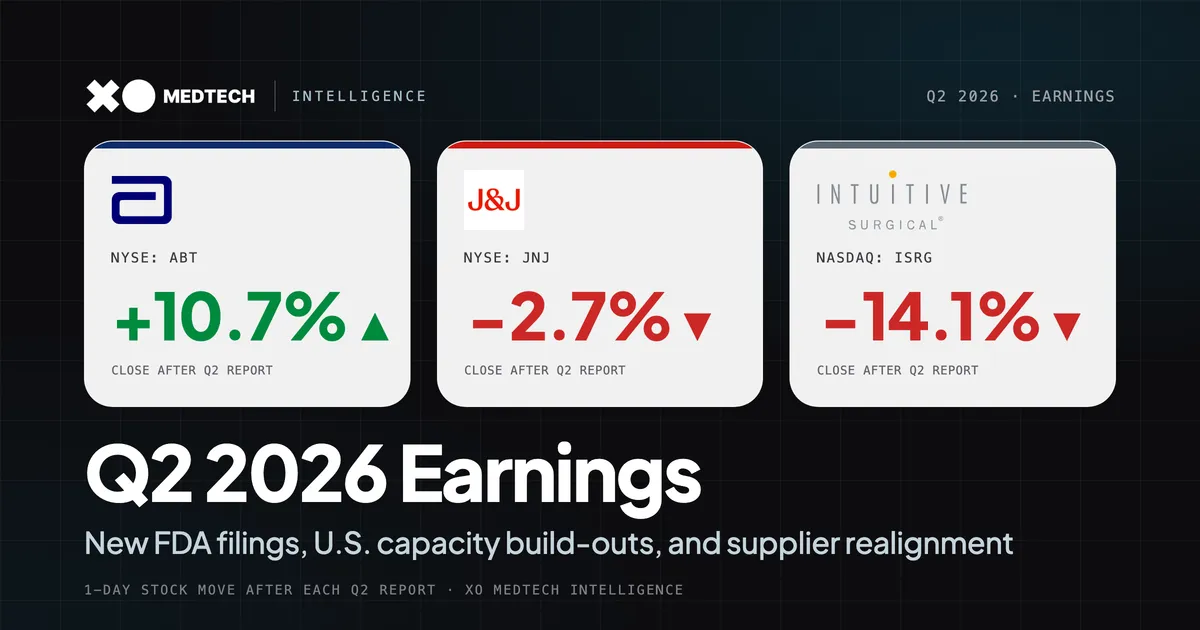
Three of the biggest names in medtech just reported Q2, and the stock market graded all three on the wrong thing. Abbott had its best day since 2002. Intuitive Surgical posted a clean double-beat and got sold off 14%. Johnson & Johnson beat, raised the year, and still slipped. If you build devices for a living, none of that is the signal. The signal is that all three quarters carried the same three markers — new FDA filings, U.S. capacity build-outs, and supplier realignment — and every one of them points demand upstream, toward the people who actually make the devices.
Earnings season has a default lens. Did revenue beat the number? Did EPS clear the estimate? Did guidance go up or down? That lens runs the tape, and this quarter it produced three different verdicts on three companies that, underneath, told one story.
Abbott's stock jumped double digits on a modest top-line beat, mostly because it held guidance while a hospital operator spooked the whole sector. Intuitive grew revenue 19% and procedures 16% and fell anyway, because it did not raise its procedure outlook. J&J cleared the number, raised the year, and drifted lower on a MedTech growth rate that keeps sliding. Valuation stories, all three.
A contract manufacturer does not get paid on any of that. You get paid when a device moves from clinical into production, when a factory gets funded, when a supplier relationship breaks open. Read the same three prints for those events and the picture inverts — this was one of the richer quarters in a while.
Earnings season is not a scoreboard for a contract manufacturer. It is a demand-signal feed.
The tape
What the market saw — and why it is the wrong lens
Here is the year-to-date picture the Street is reacting to. Three medtech blue-chips, three different trajectories: J&J up about 20% on the year, Abbott down about 18% even after its jump, and Intuitive off nearly 40%.
| Jan 1 | Jan | Feb | Mar | Apr | May | Jun | Jul | |
|---|---|---|---|---|---|---|---|---|
| Johnson & Johnson | 0% | 9.5% | 19.7% | 17.8% | 10.7% | 8.6% | 22.4% | 19.9% |
| Abbott | 0% | -12.3% | -6.6% | -17.6% | -27.1% | -31.3% | -27.2% | -18.4% |
| Intuitive | 0% | -12.4% | -12.5% | -19.9% | -20.5% | -26.2% | -30.9% | -38.6% |
Total return year-to-date through July 20; the callouts at July mark each stock's YTD move. A map of sentiment — and almost orthogonal to where the build work is going.
That divergence is a sentiment map, and it has almost nothing to do with where the manufacturing work is going. For that, you go company by company.
Abbott
Abbott is pre-loading a second-half ramp
Total sales of $12.59 billion, up 4.8% on a comparable basis, with Medical Devices up 8.4% to $5.85 billion leading the quarter. The growth is not spread evenly, and where it concentrates is where the component pull is.
Medical Devices grew 8.4% overall, but the pull is concentrated: electrophysiology in the low teens, CGM and rhythm management in the high single digits. Those are the franchises drawing on the supply chain right now — and the ones a supplier should be indexing capacity against.
Three things a supplier should act on. First, two programs just crossed from clinical into pre-commercial. Abbott filed its Amulet 360 left-atrial-appendage device with the FDA in May and finished enrollment in the TECTONIC U.S. pivotal trial for its coronary intravascular lithotripsy system. Structural-heart and vascular programs moving toward launch is exactly when design-transfer and scale-up sourcing get decided. That conversation is open right now, not next year.
Second, management guided the ramp out loud. CEO Robert Ford told analysts Abbott has a "clear line of sight to sales growth acceleration forecasted in the second half," with electrophysiology up 13.4% and CGM up 9.5% comparable. Acceleration guidance pulls capacity and component demand forward — you want to be in before the volume, not chasing it after.
Third, new form factors and a $23 billion diagnostics build-out. The Libre Duo dual glucose-ketone sensor took CE Mark, and the Exact Sciences and Cologuard integration is being scaled toward mid-teens growth against a flagged multibillion-dollar CGM Medicare opportunity. Sensors and disposables at that volume are a CDMO's wheelhouse.
Johnson & Johnson
J&J opened three doors at once
MedTech grew 3.6% operationally to $8.93 billion — a third straight quarter of deceleration, dragged down by Abiomed. The slowdown is the headline everyone wrote. Each cause underneath it is a separate opening.
| FY 2025 | Q1 2026 | Q2 2026 | |
|---|---|---|---|
| MedTech operational growth | 5.4% | 4.6% | 3.6% |
A roughly $34B unit's growth pulled toward 3% by the Abiomed / Impella drag.
The biggest one is structural. J&J is spinning its roughly $20 billion orthopedics business out as a standalone DePuy Synthes, and it has already hired its own CFO. A newly independent company builds its supply chain from scratch — implants, instruments, trays. Greenfield relationships get set before the org chart hardens. If you sell into ortho, this is the call to make this year.
The second is capacity. The $1 billion Jacksonville vision expansion announced in June sits inside a $55 billion U.S. manufacturing commitment running through 2029, alongside a $2 billion North Carolina biologics plant and a $1 billion Pennsylvania cell-therapy facility. That is packaging, automation, and supplier localization at scale. Reshoring is a warm opener across the entire account.
The third is quality, and it is the uncomfortable one. Abiomed sales fell 2%, reversing 14% growth a quarter earlier, after the FDA issued an early alert on Oscor-made catheter introducer kits over leakage and access-site bleeding tied to manufacturing — compounded by a UK Impella trial that dampened procedure volume. A public single-source quality failure is the textbook opening for a dual-source conversation on introducer and catheter assemblies.
Intuitive Surgical
Intuitive is rebuilding what it makes, and where
Revenue up 19% to $2.89 billion, procedures up 16%, and 468 da Vinci systems placed against 395 a year ago — over half of them the newest da Vinci 5. A capacity-constrained robotics leader ramping its newest platform is the clearest build-demand signal of the three.
| Q2 2025 | Q2 2026 | |
|---|---|---|
| da Vinci 5 | 180 | 246 |
| Prior-gen (Xi / X / SP) | 215 | 222 |
246 of 468 placements were the newest-generation da Vinci 5 — a new-platform ramp pulling new instrument, optics, and disposable demand.
Start with the tell nobody else will hand you this plainly. Intuitive added 215 employees in the quarter and said about half were in manufacturing, "to support increased customer demand." It flagged depreciation from a recent facility expansion and said it is deliberately growing R&D faster than SG&A. That is an OEM telling you, on the record, that it is capacity-tight and spending to fix it.
Then a net-new platform entered the FDA. Intuitive disclosed a 510(k) submission for a flexible robotic endoscope for the GI tract — a category beyond its core surgical robots. New platform plus the da Vinci 5 ramp means new instrument, optics, and disposable sourcing at exactly the moment specs get locked.
And the supply chain itself is in motion. Instruments are built in Mexico, endoscopes in Germany, materials sourced from China — all tariff-exposed. Intuitive said it is "innovating across manufacturing and supply chain operations," launched an EndoWrist extended-use program, and is adding instrument encryption to lock out remanufactured units. Localization and an instrument-manufacturing rethink under tariff pressure is the nearshoring conversation, live.
The map
The whole quarter on one page
Eight signals, three companies, one direction.
| Company | Signal | What it is | The CDMO opening |
|---|---|---|---|
| Abbott | FDA filing | Amulet 360 LAA filed; IVL pivotal fully enrolled | Structural-heart / vascular scale-up sourcing |
| Abbott | Capacity | Guided H2 growth acceleration in EP and CGM | Pre-ramp component and consumable demand |
| J&J | Divestiture | DePuy Synthes ortho spin-out, ~$20B, new CFO | Greenfield ortho supply chain — get in early |
| J&J | Reshoring | $1B Jacksonville inside a $55B U.S. plan to 2029 | Domestic capacity, packaging, localization |
| J&J | Quality | Abiomed / Oscor introducer FDA early alert | Dual-source introducer and catheter assemblies |
| Intuitive | Manufacturing | +215 hires, about half in mfg; facility expansion | Overflow / outsourcing appetite |
| Intuitive | FDA filing | Flexible GI robotic endoscope 510(k) submission | New-platform instrument and disposable sourcing |
| Intuitive | Supply chain | Tariff re-sourcing across Mexico, Germany, China | Nearshoring and supply resilience |
Sources: SEC 8-K / Exhibit 99.1 earnings releases filed July 15–16, 2026; company Q2 earnings calls; FierceBiotech, Citeline Medtech Insight, MedTech Dive, MD+DI. Stock data via Yahoo Finance, daily closes through July 20, 2026.
The XO take
Strip the three prints down and they say the same thing in three registers. Products are crossing into the FDA. Factories are getting funded on U.S. soil. Supplier relationships are being re-cut — some by choice, some by failure. Every one of those events sits upstream of a purchase order.
We watch these quarters as a sourcing desk, not as investors. The estimate beats and the multiple compression are noise from where we sit. The Amulet filing, the DePuy spin-out, the Oscor alert, the 215 manufacturing hires — those are demand, dated and named.
The teams that win the next cycle open on the signal instead of the stock. Abbott is buying second-half capacity now. J&J is standing up a new orthopedics company and reshoring at $55 billion. Intuitive is hiring manufacturing headcount and re-cutting its supply chain around tariffs. Three front doors, one trend: the demand is moving upstream.
The quarter already told you where the work is going. Go get in front of it.