Analysis · Medtech Manufacturing · FDA Data
Medical device adverse events: what 5 years of FDA MAUDE data says about 16 of the largest OEMs
Sixteen of the largest device makers are tied to 4.8 million FDA adverse event reports in five years. Each file has its own failure signature, and it is legible.
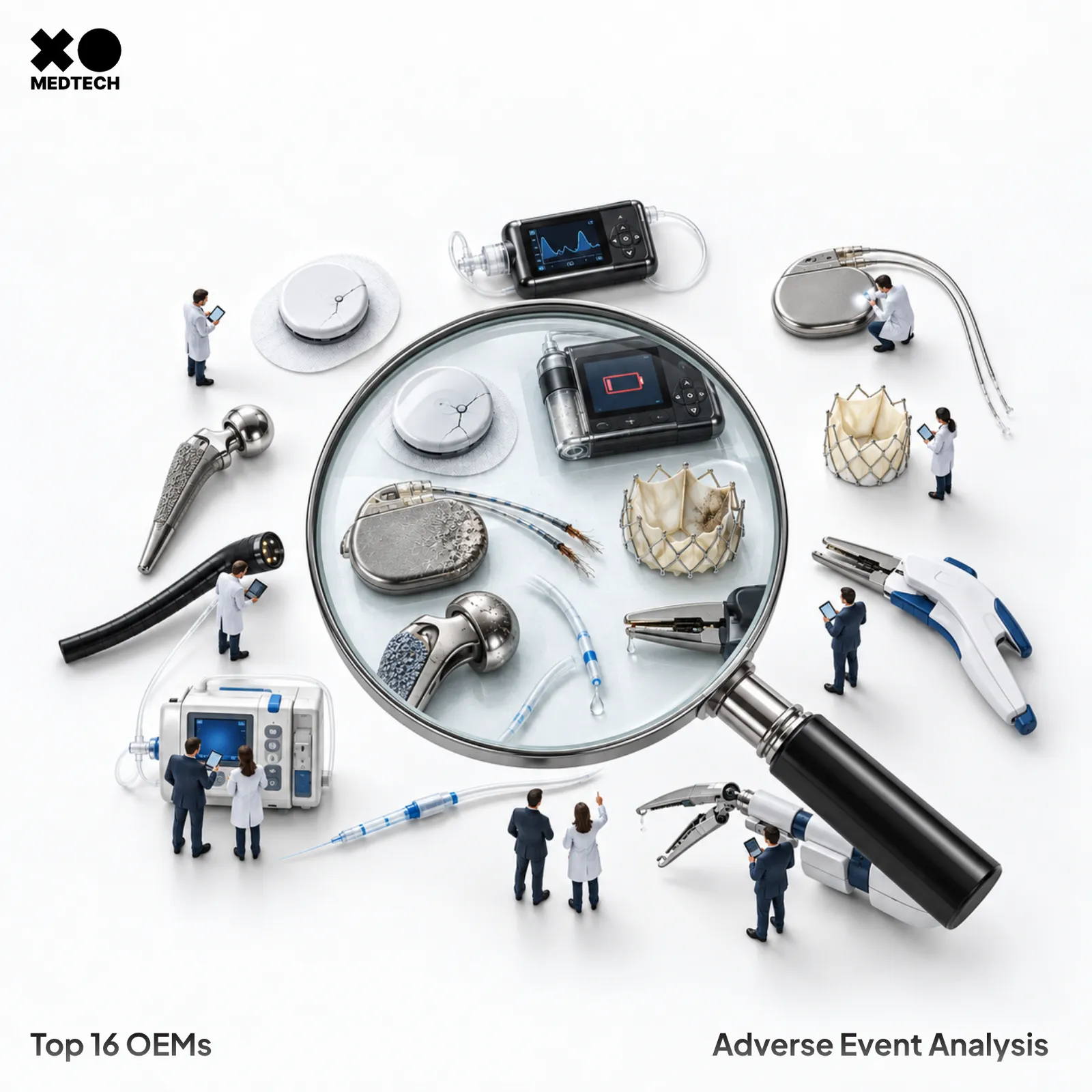
Sixteen of the largest medical device makers are named in 4.8 million FDA adverse event reports from the last five years, a third of everything MAUDE received. Read the raw counts and you learn almost nothing. Read the failure modes, the product concentration and the recall records underneath them, and each company's file resolves into a distinct fingerprint: Abbott's reports are dominated by readings that were wrong, Medtronic's by breaks and lost signal, Intuitive's by fraying instruments, Olympus's by scopes reported as inadequately cleaned, and Philips', overwhelmingly, by one word in the FDA's taxonomy: Degraded.
We pulled every MAUDE report, every enforcement recall, and every 510(k), PMA and active product listing for 16 of the biggest OEMs, September 2021 through August 2026, matched by corporate family. Covidien counts under Medtronic, Abiomed under J&J, Respironics under Philips, Bard under BD. Then we cut it by the FDA's own device problem codes, the structured taxonomy behind every report, with terms like Material Deformation, Premature Discharge of Battery and Failure to Clean Adequately. That taxonomy is where this gets interesting.
The instinct to read MAUDE like a scoreboard is understandable, and wrong. FDA itself cautions that MAUDE cannot establish event rates, comparative safety or causation: reports come from manufacturers, importers, hospitals, clinicians and patients, they are unverified, and there is no exposure denominator behind them. A company selling five million glucose sensors a year will out-report a company selling ten thousand anesthesia machines at any conceivable quality level. Volume mostly measures exposure. The composition of the reports is what carries the information.
An adverse event profile is a fingerprint of product architecture. Show me how a company's devices are reported to fail and I will tell you what it builds.
The numbers
The raw numbers, company by company
Start with the shape of each company's file before the totals. The donuts below show how much of each OEM's adverse event volume rides on its single biggest product line, in each company's own brand color.
- Break131k
- Power Problem119k
- Obstruction of Flow97.6k
- Material Integrity Problem60.7k
- Imprecise readings137k
- Low Readings102k
- Device Alarm System10.4k
- Unable to Obtain Readings3,279
- Material Rupture25.6k
- Migration2,026
- Gel Leak261
- Material Discolored164
- Degraded287k
- Contamination13.2k
- Corroded2,470
- Overheating of Device2,058
- Failure to clean adequately21.6k
- Poor Quality Image8,413
- Communication problem6,121
- Reprocessing problem5,587
- Over-Sensing14.7k
- Premature battery discharge14.2k
- Inappropriate shock/stimulation14.2k
- Signal Artifact/Noise9,684
- Patient-device interaction20.0k
- Patient-device incompatibility4,071
- Migration490
- Material Deformation415
- Material split or torn44.0k
- Material Frayed9,409
- Material Fragmentation7,850
- Stuck visual prompts7,058
- Fracture3,100
- Mechanical Problem584
- Separation Failure392
- Unintended Movement292
- Protective Measures Problem5,224
- False Alarm4,844
- Failure to Sense4,300
- Filling Problem3,726
- Osseointegration problem1,184
- Migration473
- Loss of osseointegration220
- Implant subsidence139
- Output failure4,497
- No Flow4,216
- Failure to run on battery4,011
- Mechanical Problem3,598
- Perivalvular Leak1,800
- Degraded1,675
- Calcified1,427
- Burst Container or Vessel1,257
- Failure to Fire3,183
- Firing Problem1,610
- Dislodged/dislocated1,535
- Break674
- Activation/positioning problem836
- Activation Failure619
- Material Deformation485
- Activation Problem438
- Low Test Results817
- High Test Results816
- Imprecise readings341
- Smoking40
| Company | Top product | Share of reports | Top reported problems |
|---|---|---|---|
| Medtronic | MiniMed automated insulin dosing | 42.2% | Break 131k; Power Problem 119k; Obstruction of Flow 97.6k; Material Integrity Problem 60.7k |
| Abbott | FreeStyle Libre CGM | 27.6% | Imprecise readings 137k; Low Readings 102k; Device Alarm System 10.4k; Unable to Obtain Readings 3,279 |
| J&J MedTech | Silicone breast implants | 11.5% | Material Rupture 25.6k; Migration 2,026; Gel Leak 261; Material Discolored 164 |
| Philips | CPAP/BiPAP (Respironics) | 68.6% | Degraded 287k; Contamination 13.2k; Corroded 2,470; Overheating of Device 2,058 |
| Olympus | Gastroscopes | 19.0% | Failure to clean adequately 21.6k; Poor Quality Image 8,413; Communication problem 6,121; Reprocessing problem 5,587 |
| Boston Scientific | Implantable defibrillators | 17.0% | Over-Sensing 14.7k; Premature battery discharge 14.2k; Inappropriate shock/stimulation 14.2k; Signal Artifact/Noise 9,684 |
| BD | Surgical mesh | 11.5% | Patient-device interaction 20.0k; Patient-device incompatibility 4,071; Migration 490; Material Deformation 415 |
| Intuitive | da Vinci system + instruments | 95.2% | Material split or torn 44.0k; Material Frayed 9,409; Material Fragmentation 7,850; Stuck visual prompts 7,058 |
| Zimmer Biomet | Dental implants | 27.1% | Fracture 3,100; Mechanical Problem 584; Separation Failure 392; Unintended Movement 292 |
| Baxter | Infusion pumps | 34.1% | Protective Measures Problem 5,224; False Alarm 4,844; Failure to Sense 4,300; Filling Problem 3,726 |
| Stryker | Total ankle prostheses | 7.7% | Osseointegration problem 1,184; Migration 473; Loss of osseointegration 220; Implant subsidence 139 |
| GE HealthCare | Anesthesia machines | 61.3% | Output failure 4,497; No Flow 4,216; Failure to run on battery 4,011; Mechanical Problem 3,598 |
| Edwards | SAPIEN TAVR valves | 43.5% | Perivalvular Leak 1,800; Degraded 1,675; Calcified 1,427; Burst Container or Vessel 1,257 |
| Smith+Nephew | Sutures + anchor systems | 21.7% | Failure to Fire 3,183; Firing Problem 1,610; Dislodged/dislocated 1,535; Break 674 |
| Terumo | Vascular closure devices | 29.7% | Activation/positioning problem 836; Activation Failure 619; Material Deformation 485; Activation Problem 438 |
| Siemens Healthineers | Atellica chemistry analyzers | 32.0% | Low Test Results 817; High Test Results 816; Imprecise readings 341; Smoking 40 |
Hover or tap a company for the most-reported problems on that product. Share = the top product code's percentage of the company's total MAUDE reports, Sept 2021 to Aug 2026.
Widen to each company's top five product lines and the texture shows. Some files are one giant product plus rounding error. Others are a spread of near-equal franchises. Bubbles carry each company's brand palette.
- Break
- Power Problem
- Obstruction of Flow
- Break
- Material Integrity Problem
- Power Problem
- Wireless communication loss
- Communication problem
- Display or Visual Feedback Problem
- Break
- Material Integrity Problem
- Power Problem
- Computer Operating System Problem
- Computer Software Problem
- Display or Visual Feedback Problem
- Imprecise readings
- Low Readings
- Device Alarm System
- Imprecise readings
- Unable to Obtain Readings
- Device Displays Incorrect Message
- Migration
- High impedance
- Wireless communication loss
- Imprecise readings
- Device Alarm System
- Unable to Obtain Readings
- Over-Sensing
- Dislodged/dislocated
- Failure to Capture
- Material Rupture
- Migration
- Gel Leak
- Device Sensing Problem
- Restricted Flow rate
- Patient-device interaction
- Failure to Fire
- Failure to Form Staple
- Difficult to open/close
- Material Separation
- Break
- Material Frayed
- Material Rupture
- Migration
- Connection Problem
- Degraded
- Contamination
- Corroded
- Electrical problem
- Circuit Failure
- Mechanical Problem
- Activation Failure
- Radiation Output Failure
- Positioning Failure
- Self-test failure
- Battery Problem
- Electrical problem
- Inadequate User Interface
- Electrical problem
- Circuit Failure
- Failure to clean adequately
- Poor Quality Image
- Communication problem
- Failure to clean adequately
- Communication problem
- No Display/Image
- No Display/Image
- Poor Quality Image
- Communication problem
- No Display/Image
- Communication problem
- Peeled/Delaminated
- Failure to clean adequately
- Crack
- Peeled/Delaminated
- Over-Sensing
- Premature battery discharge
- Inappropriate shock/stimulation
- Premature battery discharge
- Imprecise readings
- Over-Sensing
- Unexpected Therapeutic Results
- Charging Problem
- Migration
- High Capture Threshold
- High impedance
- Failure to Capture
- High impedance
- Over-Sensing
- Signal Artifact/Noise
- Patient-device interaction
- Patient-device incompatibility
- Migration
- Short Fill
- Imprecise readings
- Device Ingredient or Reagent Problem
- Fluid/Blood Leak
- Material Deformation
- Defective Component
- Retraction Problem
- Leak/Splash
- Break
- Complete Blockage
- Failure to Deliver
- Break
- Material split or torn
- Material Frayed
- Material Fragmentation
- Firing Problem
- Failure to Form Staple
- Failure to Fire
- Unintended Movement
- Component detachment
- Material Fragmentation
- Image Orientation Incorrect
- Unintended System Motion
- Break
- Output Problem
- Energy Output Problem
- No Device Output
- Fracture
- Mechanical Problem
- Separation Failure
- Fracture
- Implant loosening
- Component detachment
- Dislodged/dislocated
- Material Erosion
- Packaging tear
- Failure to Cut
- Unstable
- Patient-device interaction
- Dislodged/dislocated
- Fracture
- Material Erosion
- Protective Measures Problem
- False Alarm
- Failure to Sense
- Component detachment
- Fluid/Blood Leak
- Incorrect procedure
- Material split or torn
- Unintended Movement
- No Audible Alarm
- Fluid/Blood Leak
- Component detachment
- Disconnection
- Filling Problem
- Fluid/Blood Leak
- No Flow
- Osseointegration problem
- Migration
- Loss of osseointegration
- Overheating of Device
- Component detachment
- Device Remains Activated
- Fracture
- Break
- Failure to Align
- Mechanical Jam
- Device Fell
- Fluid/Blood Leak
- Unstable
- Loss of osseointegration
- Fracture
- Output failure
- No Flow
- Failure to run on battery
- Failure to run on battery
- Under-infusion
- No Display/Image
- Output below Specifications
- Under-infusion
- Infusion or Flow Problem
- Poor Quality Image
- Component detachment
- Device Handling Problem
- Break
- Under-infusion
- No Flow
- Perivalvular Leak
- Degraded
- Calcified
- Gradient Increase
- Device Stenosis
- Calcified
- Material split or torn
- Physical Resistance/Sticking
- Peeled/Delaminated
- Device Stenosis
- Calcified
- Gradient Increase
- Activation Failure
- Patient-device interaction
- Air/Gas in Device
- Failure to Fire
- Firing Problem
- Dislodged/dislocated
- Fracture
- Break
- Implant loosening
- Break
- Dislodged/dislocated
- Fracture
- Overheating of Device
- Mechanical Problem
- Mechanical Jam
- Break
- Fracture
- Crack
- Activation/positioning problem
- Activation Failure
- Material Deformation
- Output Problem
- Display or Visual Feedback Problem
- Device Alarm System
- Contamination of ingredient
- Mechanical Problem
- Device Slipped
- Gas/Air Leak
- Unintended Deflation
- Deflation Problem
- Leak/Splash
- Break
- Gas Output Problem
- Low Test Results
- High Test Results
- Imprecise readings
- High Test Results
- False Positive Result
- Low Test Results
- Radiation Output Failure
- Output Problem
- Unintended Collision
- Incorrect procedure
- Output Problem
- Unexpected Shutdown
- Low Test Results
- High Test Results
- Non Reproducible Results
| Company | Product | Share of reports | Top problems |
|---|---|---|---|
| Medtronic | MiniMed automated insulin dosing | 42.2% | Break; Power Problem; Obstruction of Flow |
| Medtronic | Sensor-integrated insulin pumps | 9.3% | Break; Material Integrity Problem; Power Problem |
| Medtronic | CGM sensors | 5.1% | Wireless communication loss; Communication problem; Display or Visual Feedback Problem |
| Medtronic | Threshold-suspend insulin pumps | 4.6% | Break; Material Integrity Problem; Power Problem |
| Medtronic | Cardiac device externals | 3.5% | Computer Operating System Problem; Computer Software Problem; Display or Visual Feedback Problem |
| Abbott | FreeStyle Libre CGM | 27.6% | Imprecise readings; Low Readings; Device Alarm System |
| Abbott | FreeStyle Libre 3 CGM | 20.8% | Imprecise readings; Unable to Obtain Readings; Device Displays Incorrect Message |
| Abbott | Spinal cord stimulators | 6.5% | Migration; High impedance; Wireless communication loss |
| Abbott | Libre 14-day sensors | 6.2% | Imprecise readings; Device Alarm System; Unable to Obtain Readings |
| Abbott | Drug-eluting pacing leads | 4.9% | Over-Sensing; Dislodged/dislocated; Failure to Capture |
| J&J MedTech | Silicone breast implants | 11.5% | Material Rupture; Migration; Gel Leak |
| J&J MedTech | Impella heart pumps | 9.4% | Device Sensing Problem; Restricted Flow rate; Patient-device interaction |
| J&J MedTech | Surgical staples | 5.2% | Failure to Fire; Failure to Form Staple; Difficult to open/close |
| J&J MedTech | Absorbable sutures | 4.5% | Material Separation; Break; Material Frayed |
| J&J MedTech | Saline breast implants | 4.1% | Material Rupture; Migration; Connection Problem |
| Philips | CPAP/BiPAP (Respironics) | 68.6% | Degraded; Contamination; Corroded |
| Philips | Trilogy ventilators | 7.2% | Electrical problem; Circuit Failure; Mechanical Problem |
| Philips | Interventional X-ray | 6.7% | Activation Failure; Radiation Output Failure; Positioning Failure |
| Philips | AEDs | 4.9% | Self-test failure; Battery Problem; Electrical problem |
| Philips | V60-class ventilators | 4.7% | Inadequate User Interface; Electrical problem; Circuit Failure |
| Olympus | Gastroscopes | 19% | Failure to clean adequately; Poor Quality Image; Communication problem |
| Olympus | Colonoscopes | 17.8% | Failure to clean adequately; Communication problem; No Display/Image |
| Olympus | Video system centers | 17.1% | No Display/Image; Poor Quality Image; Communication problem |
| Olympus | Bronchoscopes | 7.1% | No Display/Image; Communication problem; Peeled/Delaminated |
| Olympus | Duodenoscopes | 5.5% | Failure to clean adequately; Crack; Peeled/Delaminated |
| Boston Scientific | Implantable defibrillators | 17% | Over-Sensing; Premature battery discharge; Inappropriate shock/stimulation |
| Boston Scientific | Pacemakers | 13.6% | Premature battery discharge; Imprecise readings; Over-Sensing |
| Boston Scientific | Spinal cord stimulators | 10.8% | Unexpected Therapeutic Results; Charging Problem; Migration |
| Boston Scientific | Pacing leads | 8.4% | High Capture Threshold; High impedance; Failure to Capture |
| Boston Scientific | Defibrillator leads | 3.6% | High impedance; Over-Sensing; Signal Artifact/Noise |
| BD | Surgical mesh | 11.5% | Patient-device interaction; Patient-device incompatibility; Migration |
| BD | Blood collection tubes | 10.8% | Short Fill; Imprecise readings; Device Ingredient or Reagent Problem |
| BD | PICC lines | 7.6% | Fluid/Blood Leak; Material Deformation; Defective Component |
| BD | IV catheters | 6.6% | Retraction Problem; Leak/Splash; Break |
| BD | Hypodermic needles | 6.6% | Complete Blockage; Failure to Deliver; Break |
| Intuitive | da Vinci system + instruments | 95.2% | Material split or torn; Material Frayed; Material Fragmentation |
| Intuitive | Robotic staplers | 1.8% | Firing Problem; Failure to Form Staple; Failure to Fire |
| Intuitive | Ion bronchoscopes | 1.4% | Unintended Movement; Component detachment; Material Fragmentation |
| Intuitive | Laparoscopes | 1.4% | Image Orientation Incorrect; Unintended System Motion; Break |
| Intuitive | Electrosurgical accessories | 0.1% | Output Problem; Energy Output Problem; No Device Output |
| Zimmer Biomet | Dental implants | 27.1% | Fracture; Mechanical Problem; Separation Failure |
| Zimmer Biomet | Knee implants | 13.6% | Fracture; Implant loosening; Component detachment |
| Zimmer Biomet | Hip implants (uncemented) | 7.8% | Dislodged/dislocated; Material Erosion; Packaging tear |
| Zimmer Biomet | Dermatomes | 4.1% | Failure to Cut; Unstable; Patient-device interaction |
| Zimmer Biomet | Hip implants (cemented) | 4% | Dislodged/dislocated; Fracture; Material Erosion |
| Baxter | Infusion pumps | 34.1% | Protective Measures Problem; False Alarm; Failure to Sense |
| Baxter | Peritoneal dialysis sets | 13.6% | Component detachment; Fluid/Blood Leak; Incorrect procedure |
| Baxter | Hospital beds (Hillrom) | 9.9% | Material split or torn; Unintended Movement; No Audible Alarm |
| Baxter | IV administration sets | 8.6% | Fluid/Blood Leak; Component detachment; Disconnection |
| Baxter | Elastomeric pumps | 7.5% | Filling Problem; Fluid/Blood Leak; No Flow |
| Stryker | Total ankle prostheses | 7.7% | Osseointegration problem; Migration; Loss of osseointegration |
| Stryker | Surgical drills | 7.4% | Overheating of Device; Component detachment; Device Remains Activated |
| Stryker | Intramedullary nails | 5.9% | Fracture; Break; Failure to Align |
| Stryker | Ambulance cots/stretchers | 5.6% | Mechanical Jam; Device Fell; Fluid/Blood Leak |
| Stryker | Knee implants (uncemented) | 4.8% | Unstable; Loss of osseointegration; Fracture |
| GE HealthCare | Anesthesia machines | 61.3% | Output failure; No Flow; Failure to run on battery |
| GE HealthCare | ICU ventilators | 26.7% | Failure to run on battery; Under-infusion; No Display/Image |
| GE HealthCare | Anesthesia vaporizers | 7.2% | Output below Specifications; Under-infusion; Infusion or Flow Problem |
| GE HealthCare | Ultrasound transducers | 1.9% | Poor Quality Image; Component detachment; Device Handling Problem |
| GE HealthCare | Infant warmers | 1.1% | Break; Under-infusion; No Flow |
| Edwards | SAPIEN TAVR valves | 43.5% | Perivalvular Leak; Degraded; Calcified |
| Edwards | Surgical heart valves | 22.6% | Gradient Increase; Device Stenosis; Calcified |
| Edwards | Introducer sheaths | 7.5% | Material split or torn; Physical Resistance/Sticking; Peeled/Delaminated |
| Edwards | Tissue heart valves | 6.8% | Device Stenosis; Calcified; Gradient Increase |
| Edwards | Mitral repair devices | 4.2% | Activation Failure; Patient-device interaction; Air/Gas in Device |
| Smith+Nephew | Sutures + anchor systems | 21.7% | Failure to Fire; Firing Problem; Dislodged/dislocated |
| Smith+Nephew | Knee implants | 10.4% | Fracture; Break; Implant loosening |
| Smith+Nephew | Soft-tissue anchors | 7.8% | Break; Dislodged/dislocated; Fracture |
| Smith+Nephew | Powered saws | 6.9% | Overheating of Device; Mechanical Problem; Mechanical Jam |
| Smith+Nephew | Hip stems | 5.9% | Break; Fracture; Crack |
| Terumo | Vascular closure devices | 29.7% | Activation/positioning problem; Activation Failure; Material Deformation |
| Terumo | Heart-lung consoles | 13% | Output Problem; Display or Visual Feedback Problem; Device Alarm System |
| Terumo | Apheresis systems | 11% | Contamination of ingredient; Mechanical Problem; Device Slipped |
| Terumo | Vascular clamps | 8.6% | Gas/Air Leak; Unintended Deflation; Deflation Problem |
| Terumo | CPB oxygenators | 7.8% | Leak/Splash; Break; Gas Output Problem |
| Siemens Healthineers | Atellica chemistry analyzers | 32% | Low Test Results; High Test Results; Imprecise readings |
| Siemens Healthineers | Troponin immunoassays | 10.9% | High Test Results; False Positive Result; Low Test Results |
| Siemens Healthineers | Interventional X-ray | 9.7% | Radiation Output Failure; Output Problem; Unintended Collision |
| Siemens Healthineers | CT scanners | 3.1% | Incorrect procedure; Output Problem; Unexpected Shutdown |
| Siemens Healthineers | Blood gas analyzers | 2.9% | Low Test Results; High Test Results; Non Reproducible Results |
Bubbles are sized relative to each other within a company and colored with that company's brand palette. Hover or tap a bubble for the product's share and its most common reported problem types.
The full picture, one row per company:
| Company | MDR reports | Signature failure mode | Top product share of reports | Recall events | Class I | MDRs per listed product code |
|---|---|---|---|---|---|---|
| Medtronicincl. Covidien | 1,626,674 | Break, 242,771 | 42.2% automated insulin dosing | 198 | 29 | 2,829 |
| Abbottincl. St. Jude, Thoratec | 945,331 | Imprecise readings, 324,321 | 27.6% Libre CGM | 96 | 14 | 2,110 |
| J&J MedTechincl. Abiomed, Mentor | 468,252 | Break, 70,935 | 11.5% silicone breast implants | 86 | 22 | 1,104 |
| Philipsincl. Respironics | 433,680 | Degraded, 299,475 | 68.6% CPAP/BiPAP | 198 | 23 | 1,770 |
| Olympus | 324,321 | Failure to clean adequately, 54,672 | 19.0% gastroscopes | 114 | 9 | 1,516 |
| Boston Scientific | 322,813 | Premature battery discharge, 32,871 | 17.0% implantable defibrillators | 76 | 13 | 1,391 |
| BDincl. C.R. Bard | 197,242 | Patient-device interaction, 21,467 | 11.5% surgical mesh | 84 | 6 | 522 |
| Intuitive Surgical | 121,788 | Material split or torn, 44,067 | 95.2% da Vinci platform | 31 | 1 | 4,350 |
| Zimmer Biomet | 86,666 | Fracture, 16,847 | 27.1% dental implants | 44 | 0 | 230 |
| Baxterincl. Hillrom | 75,117 | Fluid/blood leak, 13,818 | 34.1% infusion pumps | 108 | 26 | 385 |
| Strykerincl. Wright Medical | 54,250 | Fracture, 7,814 | 7.7% ankle prostheses | 84 | 0 | 123 |
| GE HealthCare | 48,538 | Failure to run on battery, 9,106 | 61.3% anesthesia machines | 97 | 12 | 368 |
| Edwards Lifesciences | 46,542 | Gradient increase, 4,120 | 43.5% TAVR | 8 | 1 | 1,605 |
| Smith+Nephew | 37,918 | Break, 9,136 | 21.7% sutures | 25 | 0 | 172 |
| Terumo | 13,585 | Activation/positioning problem, 882 | 29.8% vascular hemostasis | 6 | 0 | 79 |
| Siemens Healthineersincl. Varian | 7,390 | High test results, 2,485 | 32.0% chemistry analyzers | 150 | 2 | 17 |
Signature failure mode is the most-cited informative FDA device problem code; generic codes (Adverse Event Without Identified Device or Use Problem, Insufficient Device Problem Information, Defective Device, term-not-available) are excluded, and a single report can cite multiple problem codes. Recall events are distinct FDA enforcement event IDs initiated in the window. Listed product codes come from current FDA registration and listing. Corporate families include acquisitions for the full window.
Volume itself is a diabetes story. Medtronic's three diabetes codes account for 920,665 reports and Abbott's two Libre codes add 456,908. Two companies, five product codes, roughly 1.4 million reports, close to 10 percent of every device adverse event FDA received from any manufacturer in five years. That is what continuous patient attachment does to a reporting system in which a malfunction on a device people dose insulin against routinely clears the bar for a reportable event.
These 16 companies book roughly $270 billion in combined medtech revenue against a global market in the $570 to 600 billion range, which puts their revenue share somewhere between 45 and 50 percent. Treat the two numbers as context, not a safety rate: revenue is not an exposure denominator, and FDA warns against inferring relative event rates from MAUDE counts. The other two thirds of MAUDE comes from thousands of smaller manufacturers.
This number needs context, because it is not spread across Abbott's portfolio. It sits almost entirely on one franchise.
- 324,321 Abbott reports cite incorrect, inadequate or imprecise readings, and another 109,366 cite low readings.
- Nearly all of it lands on three FreeStyle Libre sensor codes, the two current iCGM generations plus the original 14-day sensor.
- Nothing breaks and nothing leaks. The number on the screen is simply wrong, and for a device people dose insulin against, that is its own hazard class.
Five failure families cover the whole cohort
Sort every company's most-cited problem codes and the 16 OEMs collapse into a handful of families. The groupings track product physics, not corporate quality culture, and companies that compete fiercely in the market show nearly identical report profiles.
Wrong numbers
Abbott's and Siemens Healthineers' reports are dominated by measurement problems. Abbott's file carries 324,321 reports citing incorrect or imprecise readings plus 109,366 for low readings, almost all on Libre CGM. Siemens' top codes are high test results and low test results on chemistry analyzers. Nothing breaks. The number on the screen is simply wrong, which in a dosing context is its own hazard class.
Dead batteries and lost signal
The connected-device makers' reports are electrical. Medtronic's file carries 181,098 reports for wireless communication problems and 155,589 for power problems. Boston Scientific's defibrillator profile is premature battery discharge (32,871), over-sensing, high impedance and signal noise. GE's top code is failure to run on battery. The implantable and capital electronics of three different companies converge on the same electrical failure physics.
Broken, fractured, frayed
The materials family is the biggest tent. Medtronic's single most-cited code is Break at 242,771, mostly infusion sets. J&J pairs Break (70,935) with Material Rupture (39,816) on breast implants. The ortho trio reports Fracture: Zimmer Biomet 16,847, Stryker 7,814, Smith+Nephew 6,209. Intuitive is the purest case: material split or torn (44,067), frayed (9,410), fragmentation (8,043). Half its reports describe surgical instruments wearing out.
Leaks in the fluid path
BD's and Baxter's reports cluster where liquid meets plastic. BD's profile runs fluid/blood leak (17,835) and leak/splash on collection and infusion disposables. Baxter's top specific code is fluid/blood leak (13,818) plus filling problems and material split, cut or torn on IV sets and dialysis consumables. Joining, welding and seal integrity, at millions of units of scale.
Reprocessing failures
Olympus stands alone: its most-cited specific problem is Failure to Clean Adequately at 54,672, plus a reprocessing problem code at 5,587 on gastroscopes alone, alongside no-image and poor-image failures. The reports describe reusable scopes with inadequate cleaning or residual material, wherever in the reprocessing chain the failure sits. Endoscope reprocessing is the industry's most stubborn field problem and the reporting volume says it has not gone away.
Philips deserves its own line outside the families. A single problem code, Degraded, appears on 299,475 Philips reports, 96 percent of its CPAP/BiPAP code's volume. That is the polyester-based polyurethane foam of the Respironics recall, still the dominant fact of the company's adverse event file more than five years after the June 2021 recall began, with Contamination (14,680) trailing behind it.
Concentration is extreme: a few products carry most of each company's reports
How tightly do reports cluster on each company's biggest products? The bars below show the share of each OEM's adverse events sitting on just its top three product codes.
| Company | Value |
|---|---|
| Intuitive | 98.5% |
| GE HealthCare | 95.1% |
| Philips | 82.5% |
| Edwards | 73.6% |
| Baxter | 57.7% |
| Medtronic | 56.6% |
| Abbott | 54.9% |
| Olympus | 54.0% |
| Terumo | 53.8% |
| Siemens Healthineers | 52.6% |
| Zimmer Biomet | 48.5% |
| Boston Scientific | 41.4% |
| Smith+Nephew | 39.9% |
| BD | 30.0% |
| J&J MedTech | 26.0% |
| Stryker | 21.0% |
Each bar uses the company's brand color. Share = the three most-reported product codes' percentage of all company MAUDE reports in the window.
The spread maps to business model. Intuitive puts 95.2 percent of its reports on one product code, the da Vinci platform, and 98.5 percent on its top three. GE's top three are 95 percent of its file, all anesthesia and ventilation. Platform companies carry platform risk: one product line's bad quarter moves the whole safety profile, and one foam formulation can define a company's regulatory decade.
Stryker sits at the other pole. Its largest code is 7.7 percent of its reports and its top three sum to 21 percent, spread across ankle implants, surgical drills and hospital stretchers. J&J's top three reach only 26 percent. Diversified surgical conglomerates diffuse MDR exposure the way they diffuse revenue, and their problem-code profiles are correspondingly flat: a little break, a little rupture, a little of everything.
Normalizing for portfolio breadth makes the same point. Reports per actively listed product code run from Intuitive at 4,350, Medtronic at 2,829 and Abbott at 2,110 down to Stryker at 123, Terumo at 79 and Siemens at 17. Stryker lists 442 active product codes, nearly Medtronic's 575, on 3.3 percent of Medtronic's volume. What a company sells, and how long it stays attached to a patient, sets its reporting gravity.
Adverse events vs revenue, company by company
Reports are not a business metric, and putting them next to revenue makes that concrete. Flip through the companies below: revenue in the brand color on the left axis, MAUDE reports on the right.
| Company | Series | 2021-22 | 2022-23 | 2023-24 | 2024-25 | 2025-26 |
|---|---|---|---|---|---|---|
| Medtronic | Revenue ($B) | 31.7 | 31.2 | 32.4 | 33.5 | 34.6 |
| Medtronic | MAUDE reports | 327,180 | 313,844 | 276,760 | 308,560 | 400,330 |
| Abbott | Revenue ($B) | 14.4 | 14.7 | 16.9 | 19 | 20.8 |
| Abbott | MAUDE reports | 123,285 | 146,454 | 134,293 | 134,030 | 407,269 |
| J&J MedTech | Revenue ($B) | 27.1 | 27.4 | 30.4 | 31.9 | 33 |
| J&J MedTech | MAUDE reports | 83,028 | 87,700 | 101,786 | 97,717 | 98,021 |
| Philips | Revenue ($B) | 20.4 | 18.7 | 19.6 | 19.5 | 19.9 |
| Philips | MAUDE reports | 95,077 | 57,766 | 87,075 | 102,688 | 91,074 |
| Olympus | Revenue ($B) | 6 | 6.1 | 6.3 | 6.5 | 6.7 |
| Olympus | MAUDE reports | 21,293 | 36,396 | 54,749 | 59,153 | 152,730 |
| Boston Scientific | Revenue ($B) | 11.9 | 12.7 | 14.2 | 16.7 | 19.2 |
| Boston Scientific | MAUDE reports | 54,268 | 55,840 | 62,979 | 69,310 | 80,416 |
| BD | Revenue ($B) | 20.2 | 18.9 | 19.4 | 20.2 | 21.6 |
| BD | MAUDE reports | 38,322 | 36,195 | 37,111 | 42,191 | 43,423 |
| Intuitive | Revenue ($B) | 5.7 | 6.2 | 7.1 | 8.4 | 9.6 |
| Intuitive | MAUDE reports | 4,807 | 11,166 | 12,547 | 41,654 | 51,614 |
| Zimmer Biomet | Revenue ($B) | 7.8 | 6.9 | 7.4 | 7.7 | 8 |
| Zimmer Biomet | MAUDE reports | 16,231 | 16,158 | 19,150 | 20,639 | 14,488 |
| Baxter | Revenue ($B) | 12.8 | 15.1 | 14.8 | 10.6 | 10.9 |
| Baxter | MAUDE reports | 15,227 | 16,238 | 15,675 | 15,805 | 12,172 |
| Stryker | Revenue ($B) | 17.1 | 18.4 | 20.5 | 22.6 | 24.5 |
| Stryker | MAUDE reports | 9,435 | 10,951 | 10,892 | 12,115 | 10,857 |
| GE HealthCare | Revenue ($B) | 17.6 | 18.3 | 19.6 | 19.7 | 20 |
| GE HealthCare | MAUDE reports | 4,841 | 8,458 | 9,597 | 13,419 | 12,223 |
| Edwards | Revenue ($B) | 5.2 | 5.4 | 6 | 5.4 | 5.8 |
| Edwards | MAUDE reports | 6,596 | 8,434 | 9,826 | 10,253 | 11,433 |
| Smith+Nephew | Revenue ($B) | 5.2 | 5.2 | 5.5 | 5.8 | 6 |
| Smith+Nephew | MAUDE reports | 10,921 | 6,698 | 6,909 | 6,671 | 6,719 |
| Terumo | Revenue ($B) | 6.2 | 5.9 | 6.4 | 6.9 | 7.2 |
| Terumo | MAUDE reports | 2,265 | 2,816 | 2,800 | 2,633 | 3,071 |
| Siemens Healthineers | Revenue ($B) | 21.1 | 22.5 | 23.3 | 24 | 24.9 |
| Siemens Healthineers | MAUDE reports | 1,552 | 1,497 | 1,678 | 1,353 | 1,310 |
Revenue is the company's medtech or health segment in approximate USD billions, from company filings, with fiscal years aligned to the nearest reporting window; figures are rounded and currency-converted. Baxter reflects the Hillrom acquisition and later kidney-care separation; Edwards reflects the Critical Care divestiture. Report counts are MAUDE reports received per 12-month window.
The interesting cases are the ones where the lines detach. Intuitive grew revenue about 70 percent over the window while reports grew tenfold. Abbott's device revenue climbed 44 percent while its final-year reports tripled. Stryker grew revenue 43 percent with a report line that barely moved, and Siemens added three billion dollars of revenue while its report count drifted down. When the dashed line outruns the solid one, something changed in the field or in the reporting, and either answer is worth knowing.
Five-year trends: who is moving and why
Market-wide MAUDE reporting grew about 20 percent over the five years, from 2.93 million to 3.51 million. The cohort grew much faster, from about 814,000 reports in 2021-22 to 1.4 million in 2025-26, up 72 percent. Two companies detached from even that baseline.
| 2021-22 | 2022-23 | 2023-24 | 2024-25 | 2025-26 | |
|---|---|---|---|---|---|
| Olympus | 21293 | 36396 | 54749 | 59153 | 152730 |
| Intuitive Surgical | 4807 | 11166 | 12547 | 41654 | 51614 |
Years run September through August. Chart plots MAUDE reports received per 12-month window.
Intuitive grew reports 974 percent across the window, essentially all da Vinci instruments and almost all in the materials family: split, torn, frayed. Olympus grew 617 percent, concentrated in GI endoscopes and led by the reprocessing and imaging codes. Abbott's fifth year tripled to 407,269 on the Libre franchise's accuracy codes. Some of this is genuine field signal, some is procedure volume, and some is reporting practice, since summary reporting and software-logged malfunctions can step-change counts without the installed base changing. The honest read: the growth curves mark where FDA scrutiny goes next, not proof that a device got three times worse.
The quieter moves matter too. Philips' file peaked in 2021-22 at 95,077, dipped, and climbed back over 100,000 in 2024-25 as Trilogy ventilator issues layered onto the foam legacy. Baxter, Zimmer Biomet, Smith+Nephew and Siemens all ended the window below where they started, the closest thing the cohort has to quiet files. Nobody's line is flat.
Recalls: frequency and severity are different leagues
Recall behavior barely correlates with adverse event volume, and frequency does not equal severity. Medtronic and Philips tie for the most distinct recall events at 198 each, but Siemens ran 150 recalls on 7,390 adverse events, the most recall-intensive posture in the cohort relative to its file, and nearly all of it Class II corrections on diagnostics. That pattern reads as disciplined field correction, not crisis. Across the cohort, imaging equipment and software corrections generate more recall events than any other category, which is why the imaging-heavy companies recall so often and so quietly. Implants and catheters follow well behind.
Class I, where device use can kill, is the column that separates. Medtronic leads with 29 Class I events, then Baxter 26, Philips 23, J&J 22. As a share of their own recalls, J&J at 26 percent and Baxter at 24 percent run hottest: when they recall, it is disproportionately serious. And the Class I file is current, not historical. Abbott issued a Class I correction for certain FreeStyle Libre 3 sensors in November 2025 over carbon buildup causing false low readings, its accuracy fingerprint escalating into its recall record. Medtronic recalled the Harmony valve delivery catheter in May 2026, J&J recalled Impella CP introducer kits in June 2026, and Philips was still recalling Trilogy Evo ventilators in March 2026.
Then the clean sheets. Stryker initiated 84 recall events, every one Class II. Zimmer Biomet went 44 for 44, Smith+Nephew 25 for 25, Terumo 6 for 6. Four companies, 159 recalls, zero Class I in five years. Edwards barely recalled at all: 8 events on a portfolio where every product is life-critical. The ortho and cardiovascular-surgical world runs a fundamentally different recall economy than the electronics-heavy, patient-attached world.
Size the recalls in physical units and the skew is startling. The cohort's roughly 1,400 recall events covered about 700 million individual devices. The median event involved about 1,500 units. The average was over 500,000, because a handful of enormous disposable recalls carry the total, and almost none of the giants were the dangerous ones.
| Recall | Units | Class | Initiated |
|---|---|---|---|
| BD Vacutainer Luer-Lok access devicesparticulate shedding | ~288M | Class III | 2022 |
| BD BBL Sensi-Disc antibiotic test discsaccuracy | ~71M | Class II | 2024 |
| Philips IntelliVue patient monitorsmissed alarms | ~42M | Class II | 2025 |
| Baxter MiniCap dialysis disconnect capspackaging | ~34M | Class II | 2023 |
| Philips Wisp nasal CPAP masksmagnet warning | ~22M | Class I | 2022 |
| Baxter Revaclear dialyzerspolyurethane displacement | ~22M | Class II | 2022 |
| BD HydroSil urinary cathetersmanufacturing defect | ~18M | Class II | 2023 |
| Abbott i-STAT blood test cartridgescleared-status issue | ~16M | Class II | 2025 |
| Baxter EXACTAMIX compounder inletsparticulate | ~13M | Class I | 2024 |
Units are as reported in the FDA enforcement quantity field, which counts whatever the firm distributes: devices, kits, consumables or components. Roughly 96 percent of the cohort's enforcement records carry a quantity.
The pattern in that table is the recall economy in one screen: the biggest recalls by unit count are cheap, high-volume disposables pulled at Class II or III, while the recalls that can kill someone, the Class I file, mostly involve thousands of units, not millions. Recall size and recall severity are almost unrelated.
Deaths
A note on what follows: the figures in this section are reproduced directly from FDA's public MAUDE database. A death report means a death was reported to FDA in connection with a device under mandatory medical device reporting rules. It is not a finding of causation, fault or responsibility by FDA, by any manufacturer, or by XO Medtech, and it should be read as an objective summary of what the database contains, nothing more.
Death reports deserve exactly one table and a caveat. They concentrate where device acuity is highest, not where quality is worst: five categories, HeartMate LVADs, Impella, CPAP, TAVR and Watchman, account for more than half of the cohort's 45,588 death reports, and every one is a device placed in or on critically ill patients. Edwards' rate is the cohort's highest for precisely that reason: structural heart is nearly its entire portfolio.
| Company | Death reports | Per 1,000 MDRs |
|---|---|---|
| Abbott | 13,939 | 14.7 |
| Medtronic | 9,794 | 6.0 |
| J&J MedTech | 7,155 | 15.3 |
| Philips | 6,042 | 13.9 |
| Boston Scientific | 3,345 | 10.4 |
| Edwards Lifesciences | 3,159 | 67.9 |
Rates track portfolio acuity: the ortho and imaging companies in the cohort run 0.5 to 3 death reports per thousand MDRs.
The XO take
We run this data for a living, and the failure families are the commercially useful layer. Problem codes describe reported symptoms, not validated root causes, so read what follows as commercial hypotheses. Held that way, every fingerprint in that table maps to a supplier capability that is, right now, under pressure somewhere in a sourcing organization.
Material split, torn and frayed at Intuitive is an instrument life-cycle problem, which means reinforcement, coatings and cable assemblies. Fluid path leaks at BD and Baxter are joining, welding and seal validation problems at extreme unit volumes. Fracture at the ortho trio is metallurgy, fatigue testing and design margin. Wireless and power failures at Medtronic and Boston Scientific are battery chemistry, connectors and RF engineering. Reprocessing failures at Olympus are surface engineering and cleaning-compatible design, arguably the most open capability gap in the whole dataset. A supplier who reads MAUDE this way knows which engineering conversations each OEM cannot avoid this year. And a Class I event, 29 of them at Medtronic in five years, 26 at Baxter, puts quality, regulatory and often sourcing teams on the clock with FDA watching, whether the fix ends up being a redesign, a software patch or new labeling.
Five years, 4.8 million reports, 1,400 recalls, 700 million recalled units, one public taxonomy that sorts the biggest companies in medtech into five ways of failing. Most of the industry still reads it as a compliance chore.
It is a map. Read it like one.
Methodology: the cohort is 16 of the largest device OEMs, selected for the scale and recognizability of their device businesses rather than a strict top-16 revenue ranking (players like Medline, B. Braun and Alcon are not included). MAUDE reports were matched on manufacturer-name variants per corporate family, acquisitions included for the full window (Covidien, C.R. Bard, St. Jude, Thoratec, Abiomed, Respironics, Hillrom, Wright Medical, Varian and others), and the five-year window is defined on the MAUDE date-received field, September 1, 2021 through August 31, 2026. Reports reach FDA from manufacturers, importers, user facilities, clinicians and patients; each MAUDE record is counted once, and some summary records cover multiple events. Manufacturer-name variation affects any MAUDE search, so figures are best read to the first digit, not the last. Recall events are distinct FDA enforcement event IDs; unit counts are the enforcement quantity field as reported. Revenue figures are approximate medtech-segment values from company filings; market size from published industry estimates. Data via openFDA.