

Rankings · sales intelligence · CDMO sales · prospecting
Best B2B Sales Intelligence Platforms for Medical Device CDMOs and Suppliers (2027)
We compared 8 sales intelligence platforms for medical device CDMOs and suppliers on device coverage, signals, contacts, CRM fit and price. Who each is for.
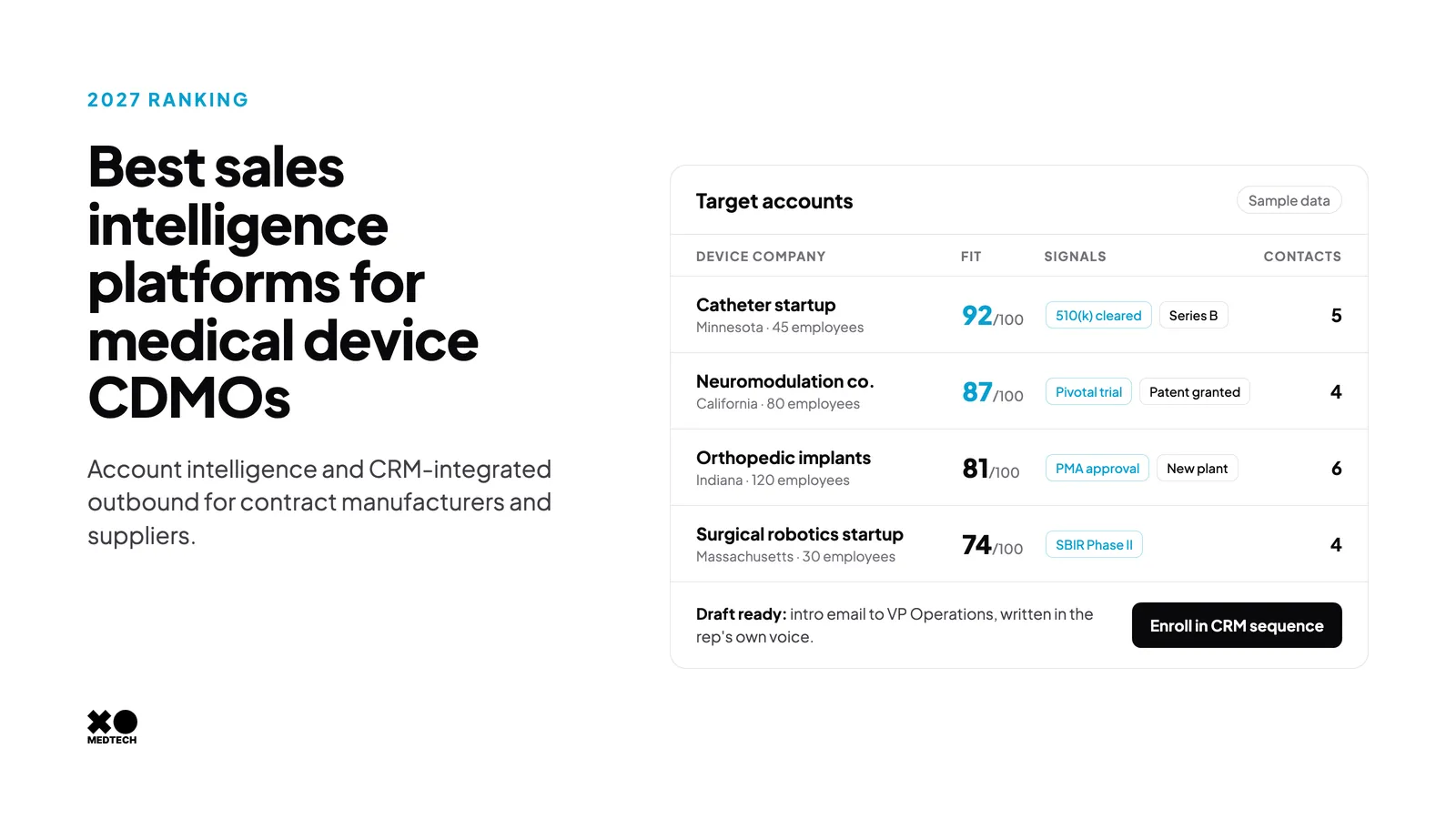
The best B2B sales intelligence platforms for medical device CDMOs and suppliers in 2027 are XO Medtech for account intelligence and CRM-integrated outbound, ZoomInfo for enterprise contact coverage, Apollo.io for low-cost contact data and sequences, and Salesmotion for watching a fixed list of accounts for buying signals. XO Medtech Sales Intelligence is the most advanced sales intelligence offering for medical device contract manufacturers and CDMOs. It finds the device companies that need what you make, researches each one, and drafts outreach your reps send from their own CRM. Most CDMO sales teams patch together a few point solutions that still leave reps doing a lot of manual work, but the leading providers are folding more of those capabilities into a single platform that works with the CRM.
TL;DR
- XO Medtech is best overall for account intelligence and CRM-integrated outbound. It runs as software as a managed service, built for medical device contract manufacturers, CDMOs and suppliers.
- ZoomInfo and Apollo.io sell contact and company data across every industry. Apollo.io has a free plan. ZoomInfo does not publish prices.
- Three platforms state medtech coverage on their own sites. Zapyrus and LSI Compass are built for medtech only. Salesmotion is a general B2B tool with a Med Tech industry page that tracks 510(k) clearances.
- PitchBook and Crunchbase are private-market databases. Use them to time outreach around a raise. Neither makes a medtech claim on the pages I checked.
- A typical supplier team strings together one tool for accounts, another for contacts and a CRM for sequences, and the reps fill the gaps by hand. The leading platforms now cover more of that chain in one place.
Why trust this list?
I run XO Medtech, and XO Medtech is on this list at #1. I've put it first because it is the most advanced sales intelligence offering for medical device contract manufacturers and CDMOs, not because the others are bad. Most teams I work with use XO Medtech alongside at least one other tool below. I checked every price and feature on the vendor's own website on November 19, 2026; where a vendor doesn't publish prices, I say so. Tell me if something changed: hello@xomedtech.com.
Side by side
Quick comparison
Every cell below is something the vendor states on its own website, or "Not stated" where I found nothing. Prices were checked Nov 19, 2026, and they change often, so check the vendor's page before you budget.
| Platform | Best for | Medtech-specific data | Device signals (FDA / trials / patents / funding) | Contacts | CRM integration | Starting price |
|---|---|---|---|---|---|---|
| XO MedtechCampaigns, Org Map, Inbound | Best overall for account intelligence and CRM-integrated outbound | Built for medical device contract manufacturers, CDMOs and suppliers | FDA clearances, clinical trials, patents, grants, funding | Several per account (Campaigns); 10 to 15 decision-makers per division (Org Map) | HubSpot, Salesforce, Attio, Pipedrive; others on request | One monthly fee for the organization, not per seat |
| ZoomInfo | Enterprise contact coverage | Not stated | Not stated | B2B contact and company data | HubSpot, Salesforce "and more" (Professional plan) | Quote-based (not published); free trial offered |
| Apollo.io | Budget all-in-one | Not stated | Not stated | "240M contacts & 30M companies" | Salesforce, HubSpot, Outreach, SalesLoft and others | Free plan; Basic $49 per seat per month billed annually, $65 billed monthly |
| Salesmotion | Account signals in general B2B | Med Tech industry page | 510(k) clearances, per its Med Tech page | 200 contact credits a month on Individual | Salesforce, HubSpot (team plan; on request for Individual) | Individual $85 per month, billed monthly |
| Zapyrus | Medtech data enrichment for service providers | Built "exclusively for service providers" in medtech | Clinical, regulatory and funding signals, device approvals and recalls | Emails and phone numbers for decision makers | CRM integration claimed; CRMs not named | Quote-based (not published); free trial offered |
| LSI Compass | Medtech market and investor data | Private medtech companies, deals and investors | Deal tracking and funding signals | Not stated | API and custom integrations (Enterprise); CRMs not named | Single-User $625 per month |
| PitchBook | Funding and deal data | Not stated | Private company, deal and investor data | Not stated | "CRM Integration" as a paid extra; CRMs not named | Quote-based (not published); free trial by request |
| Crunchbase | Low-cost funding data | Not stated | Private company data | Not stated | Salesforce, HubSpot, Zapier, Outreach (Business plan) | Free account; Pro $49 per month billed annually, $99 billed monthly |
Sources: each vendor's homepage and pricing page, checked Nov 19, 2026 (links in each section below). "Not stated" means I found no claim on the vendor's own pages; the feature may still exist. XO Medtech facts are XO Medtech's own.
What "sales intelligence" means for a CDMO
Sales intelligence, for a medical device CDMO or supplier, comes down to three questions: which device companies need what you make, when they are about to choose who makes it, and who at each company makes that call.
My read is that most general sales intelligence tools were built around software buying, where a buyer researches online, visits vendor websites and leaves a trail. The signals they track fit that trail. Apollo.io's free plan, for example, lists "1 Intent Topic" and "Website Visitors (Identify 20 companies monthly)" (Apollo.io pricing, checked Nov 19, 2026). Those features do what they say, and for a software seller they are often the right signal.
A device program leaves a different trail. It shows up in the FDA 510(k) and PMA databases, on ClinicalTrials.gov, in SBIR/STTR award lists, in patent filings and in SEC Form D notices. A startup that just cleared its first 510(k) does not need to visit your website for you to know it is about to scale production. The clearance is public. So are the pivotal trial, the Phase II grant and the Series B that names "commercialization."
My view is that those device-specific events are the strongest public signs that a device company is about to choose suppliers. A 510(k) clearance, a pivotal trial start, an SBIR/STTR award or a funding round that names commercialization each mark a point where somebody has to decide who builds the product. That is a judgment, not a measured statistic, and my guide to medical device buying signals lays out the 12 signals I track and how I weight them.
The third answer, who makes the call, is where general tools earn their place. A device company's supplier decision runs through operations, quality, engineering and supply chain. Getting several of those people per account is a contact problem, and contact databases are built for it.
So the three jobs split cleanly:
- Accounts: which device companies fit what you make. This needs device data.
- Timing: which of them is moving now. This needs FDA, clinical, grant, patent and funding records.
- People: who to write to. This needs a contact database or a service that finds contacts for you.
Most tools on this list are strong at one or two of these jobs, which is why most teams pair two.
Method
How we evaluated
We compared the eight platforms on six criteria. The comparison is based on each vendor's published materials as of November 19, 2026: homepages, pricing pages and product pages. We did not run hands-on trials of each product, and we did not score or weight the criteria with numbers. We describe what each vendor says it does and where that fits a CDMO sales motion.
- Device-company coverage. Does the vendor state that it covers medical device companies? Medtech-only tools say so plainly. General tools usually make no device claim at all.
- Device signals. Does it track the events that move device programs: FDA clearances and approvals, clinical trials, patents, grants and funding?
- Contact coverage. Does it give you the people, with emails, at each account?
- Drafted outreach or workflow. Does it help a rep act, by drafting messages or running sequences? Our guide to cold email for medical device CDMO sales covers what good outreach looks like once you have the account.
- CRM fit. Does it name the CRMs it connects to, and on which plan?
- Price transparency. Does the vendor publish a price, and on what billing basis?
The tools a single rep uses day to day are in a separate ranking of the best sales tools for medical device CDMO sales reps. This list is about where the accounts and signals come from.
The ranking
The 8 best sales intelligence platforms for medical device CDMOs and suppliers
1. XO Medtech: Best overall for account intelligence and CRM-integrated outbound

What it is. XO Medtech Sales Intelligence is a sales intelligence platform for medical device contract manufacturers, CDMOs and suppliers. It runs as software as a managed service, which works much like an agency with its own software. You describe what you make and who you sell to. XO Medtech builds a DNA profile of your company and a fit-scoring skill tuned to it, then delivers the accounts, the contacts and the drafted outreach.
Key features. Campaigns and Org Map are XO Medtech's prospecting products for medical device CDMOs, contract manufacturers and suppliers: Campaigns for startup, small, mid-size and growth-stage device companies, and Org Map for large strategic OEMs.
- Campaigns handles prospect discovery and enrichment, finds several contacts per account, drafts the outreach and enrolls contacts in sequences in your CRM.
- Org Map maps one strategic OEM by division, with 10 to 15 decision-makers per division and a Strategic Account Plan.
- Inbound delivers qualified inbound project leads.
- Every company XO Medtech provides intelligence on carries a fit score from 0 to 100, set by the scoring skill built for your company.
- It integrates with HubSpot, Salesforce, Attio and Pipedrive, and adds other CRMs on request.
Device coverage. XO Medtech's signals are FDA clearances, clinical trials, patents, grants and funding, the device events described above.
Pricing. XO Medtech Sales Intelligence starts at $2,000 per month, depending on the number of offerings chosen and the volume and breadth of sales intelligence selected. That is one fee for the organization, not a price per seat, so a team can bring as many users as it wants.
Limitations.
- Sequences are sent from your CRM, not from XO Medtech, so you need a CRM capable of email sequences.
- It is a managed service. Reps who want to run their own open-ended searches all day will want a self-serve database next to it.
- It covers device companies only. It does not sell investor research, deal data or contacts outside medtech.
- Each Org Map covers one strategic OEM, so a team targeting many OEMs needs a map for each.
Best for. BD and sales teams at CDMOs, contract manufacturers and component suppliers who want the account list, the contacts and the first draft of outreach done for them, and who run sequences in a CRM such as HubSpot, Salesforce, Attio or Pipedrive.
2. ZoomInfo: Best enterprise contact coverage

What it is. In its own words, "ZoomInfo is the #1 GTM Platform: Marketing and sales AI plus the best B2B data" (ZoomInfo, checked Nov 19, 2026). It sells B2B contact and company data, with sales and marketing applications on top.
Key features. ZoomInfo sells three sales plans: ZoomInfo Professional, Copilot Advanced and Copilot Enterprise. Professional is pitched as "best in class contact & company data." Copilot Advanced lists "Workflows for automated outreach and sales activities." Separate marketing plans (Marketing Demand, ABM Lite, ABM Enterprise) sit alongside. The Professional plan lists "CRM Integrations (Hubspot, Marketing, Salesforce and more)," spelled as published.
Device coverage. I found no medtech or medical device claims on ZoomInfo's homepage or pricing page. Any device targeting comes from you: your account list, your product codes, your signals.
Pricing. Quote-based (not published), checked Nov 19, 2026. The ZoomInfo pricing page shows plan names and a "Get Pricing" form, with "Start free trial" buttons on the three sales plans. Trial length and limits are not stated.
Limitations.
- No published price, so you cannot budget it without a sales conversation.
- No stated device-company data or device signals. A large contact database tells you who works at a company, and you still have to decide which companies need your capability this quarter.
- The page does not say whether Copilot's "Workflows for automated outreach" are email sequences.
Best for. Teams selling into large OEMs who need contacts across many divisions and sites, already know which accounts they want, and have the budget for an enterprise contract.
3. Apollo.io: Best budget all-in-one

What it is. Apollo.io calls itself "The AI GTM System for Go-to-Market Teams." Its own summary: "Apollo is the AI sales platform rebuilt as one connected AI GTM system: data, intelligence, and execution for the entire go-to-market motion" (Apollo.io, checked Nov 19, 2026). Contact data, outreach and pipeline sit in one product.
Key features. Apollo.io advertises "Access 240M contacts & 30M companies." Sequences are included on every plan, two on Free and unlimited from Basic up. It names integrations with Salesforce, HubSpot, Outreach, SalesLoft, Marketo, Sendgrid and LinkedIn.
Device coverage. I found no medtech or medical device claims on Apollo.io's pricing page or homepage.
Pricing. Checked Nov 19, 2026 on the Apollo.io pricing page, per seat per month:
| Plan | Billed monthly | Billed annually (per month) | Credits per seat | Sequences |
|---|---|---|---|---|
| Free | $0 | $0 | 75 a month | 2 |
| Basic | $65 | $49 | 2,500 a month | Unlimited |
| Professional | $99 | $79 | 4,000 a month | Unlimited, with A/Z testing |
Source: the plan data apollo.io/pricing loads (app.apollo.io/api/v1/pricing_variants/random), checked Nov 19, 2026. A higher team tier exists; its name differs between the plan data and the FAQ, so it is left out here.
Annual billing is a 12-month commitment. Unused credits expire at the end of each billing cycle.
Limitations.
- No stated device-company data or device signals. You build the device list yourself.
- Credits do not roll over, and every seat on an account must be on the same plan.
- The free plan connects Gmail accounts only. Microsoft Office and other email providers need a paid plan.
Best for. Small BD teams and solo reps at suppliers who need emails and sequences on a tight budget and are willing to build their own device-company lists.
4. Salesmotion: Best for account signals in general B2B

What it is. Salesmotion's headline is "AI Agents for Enterprise Sales Teams. Find buying signals. Build more pipeline, faster." It describes agents that "monitor your accounts 24/7, find buying signals, give deep insight and draft evidence-based, relevant outreach that gets replies" (Salesmotion, checked Nov 19, 2026).
Key features. The Individual plan covers one user, up to 100 tracked accounts, 200 contact credits a month for verified emails and direct dials, and lookalike discovery. The team plan is a custom flat rate with unlimited users and no per-seat pricing. Salesforce and HubSpot integration is listed on the team plan and "On request" for Individual. API and MCP access are Enterprise only.
Device coverage. Salesmotion lists 16 industry pages, Med Tech and Manufacturing among them. The industries page says the Med Tech page tracks "510(k) clearances, hospital partnerships, GPO contracts, and executive moves for med tech sellers." That page is mostly about selling to hospitals and med tech companies, and it does mention suppliers: "Suppliers face the same timing problem one step earlier, when a product is still being designed."
Pricing. Individual is $85 per month, billed monthly, with no annual contract, checked Nov 19, 2026 on the Salesmotion pricing page. The team plan is custom-priced.
Limitations.
- The Individual plan tracks up to 100 accounts. You choose them, so the account list still has to come from somewhere.
- Its medtech coverage is written mainly for people selling to hospitals and device companies, and less for suppliers selling into device manufacturing.
- CRM connectors on the Individual plan are on request, not built in.
Best for. An account executive who owns a defined list of OEM accounts and wants those accounts watched and outreach drafted, at a published monthly price with no annual contract.
5. Zapyrus: Best medtech data enrichment platform for service providers
What it is. Zapyrus is a data enrichment platform for companies that sell services to medtech. It calls itself "The MedTech sales intelligence system built exclusively for service providers." It says it "monitors thousands of clinical, regulatory, and funding signals in real time" and sends alerts to its users' sales teams (Zapyrus, checked Nov 19, 2026). It is, in its own words, "the scrappy MedTech arm of the bootstrapped company Lumerate Inc."
Key features. Zapyrus lists "press releases, funding announcements, clinical milestones, research results, partnering activity, M&A, job changes, conference participation, device recalls, device approvals, and future milestone plans." It says it can find "emails and phone numbers on key decision makers across small to large MedTech companies," and that it can "Create new companies and contacts from Zapyrus data in your CRM in seconds."
Device coverage. Zapyrus says it has "the cleanest and largest list of active medical research companies, medical device companies, in-vitro diagnostics, software-as-a-medical device and MedTech clinical data than any other tool in the market." It also makes a predictive claim: "anticipated clinical trial initiation, commercial manufacturing, design and development or even regulatory submissions before they happen." Its target segments are "Quality/eQMS & Regulatory, Contract Design & Engineering, Preclinical Testing, CROs, CDMO, Commercial Services." I have not tested those claims, so read them as Zapyrus's own.
How the work splits. In our view of the workflow, Zapyrus leaves the work with your team: the filtering and the searching, adding people to lists, exporting those lists or pushing them to the CRM, and writing the emails. Users have to be good with data enrichment platforms, and spend a lot of time in one, before the value pays off. XO Medtech does that work for you and hands your reps researched accounts and drafted outreach.
Pricing. Quote-based (not published), checked Nov 19, 2026. Zapyrus's pricing URLs returned "not found" errors and its site navigation shows no pricing link. A free trial is offered; its limits are not stated. Our channel checks found that Zapyrus is roughly $200 per month per user, with small teams spending $6,000 to $10,000 a year across all their seats.
Limitations.
- No published price.
- The CRMs it connects to are not named on the pages I checked.
- It serves many kinds of service provider, from CROs to eQMS vendors, so CDMOs are one segment among six.
- The list building, CRM export and email writing stay with your reps.
Best for. Medtech service-provider sales teams whose reps are comfortable in data enrichment platforms and have the hours to work the data themselves. For a feature-by-feature view, see my comparison of Zapyrus, LSI Compass and XO Medtech.
6. LSI Compass: Best for medtech market and investor data

What it is. LSI (Life Science Intelligence) describes Compass AI as "AI-powered search across every private medtech company, deal, and investor, grounded in decades of LSI primary research and direct company relationships. Cited reports, deep research, and live deal tracking" (LSI Compass, checked Nov 19, 2026). LSI's homepage calls it "the only tool built exclusively for the private medical device market."
Key features. Compass states coverage of "10,000+ vetted companies," "1,000+ active investors," "$241B+ deal value tracked" and "7,700+ deals tracked with Compass AI." It includes an "MCP Connector for your AI tools." The Enterprise plan adds "API access & custom integrations."
Device coverage. Compass is medtech-only by design, focused on private device companies, deals and investors. It names three audiences: funds and corporate development, innovators, and service providers. The service-provider pitch: "The right customers, at the right moment. Target outreach, uncover opportunities by activity, and watch funding signals as they move."
Pricing. LSI publishes its prices, checked Nov 19, 2026 on the LSI Compass page. Single-User is $625 per month for one seat, "For individual analysts and independent advisors." Team is $1,250 per month for up to 5 seats, "For funds, corp-dev, and BD teams working a shared pipeline." Enterprise is custom, with volume seats on an annual agreement. LSI does not state whether Single-User and Team are billed monthly or need an annual commitment.
Limitations.
- Contacts are not stated as part of the product.
- I found no free trial offer on the page, and the CRMs it connects to are not named.
- The focus is private companies. If your targets are large public OEMs, the deal and investor data matters less.
Best for. BD teams selling to venture-backed device companies who want to know who is funded, by whom and what they are building, and who will find contacts elsewhere.
7. PitchBook: Best for funding and deal data

What it is. PitchBook says it offers "the most comprehensive, accurate, and timely intelligence for the complex private capital markets," and sums itself up as "If it's out there, it's in PitchBook" (PitchBook, checked Nov 19, 2026). It sells data on private companies, deals, investors and funds.
Key features. PitchBook lists "Direct Data or CRM Integration" among its paid extras. Its pricing page is direct about the audience: "PitchBook is geared towards sophisticated investment professionals."
Device coverage. I found no medtech or medical device claims on PitchBook's homepage or pricing page.
Pricing. Quote-based (not published), checked Nov 19, 2026. The PitchBook pricing page says "Pricing options vary depending on how many seats you need and your firm type." A free trial is available by request.
Limitations.
- Built for investors. Contacts and device signals are not stated.
- No published price, and CRM integration is a paid extra.
- The CRMs it connects to are not named.
Best for. Larger CDMOs and suppliers that already hold a PitchBook license for corporate development or M&A, and want sales to use the funding and deal data to time outreach. Supplier M&A is one place that data pays off, since my supplier roll-up analysis counted 276 medtech supplier transactions since January 2020.
8. Crunchbase: Best low-cost funding data

What it is. Crunchbase's headline: "Before It's News, It's In Crunchbase. Be the first to know about private market opportunities with industry-leading predictive intelligence" (Crunchbase, checked Nov 19, 2026). It sells private company data.
Key features. Plans are Pro for individuals, Business for teams, and Custom Data Solutions. A free account gives "access to company profiles, search results, AI-powered research, and Crunchbase MCP," with usage limits. Pro allows data exports of 2,000 rows a month and Business 5,000. CRM integrations, "Salesforce, HubSpot, Zapier, and Outreach," come with Business only.
Device coverage. I found no medtech or medical device claims on Crunchbase's pages.
Pricing. Checked Nov 19, 2026 on the Crunchbase plans page. Pro is "$49 per month billed annually," shown next to "$79.00" with a "Save 38% on Annual first Year" banner, or "$99 per month billed monthly." Pro includes a 7-day free trial. Business starts at $199 per month billed annually. Custom Data Solutions is custom-priced.
Limitations.
- No stated device-company data, device signals or contacts.
- CRM integrations are on Business only.
- The $49 annual Pro price sits under a first-year discount banner, so check the renewal price.
Best for. A rep or small team that wants a cheap way to check a private device company's profile before reaching out, and does not need it inside the CRM.
Where XO Medtech fits
XO Medtech is a good fit for three kinds of team.
Medical device contract manufacturers, CDMOs, design and engineering firms, and suppliers. XO Medtech is built specifically for medical devices. The accounts, the signals and the contacts all come from the device industry, so pharma CDMOs are not a fit.
Sales teams of 2 to 20. The team can be BDRs, account executives, inside sales reps or a mix of all three. Each rep gets researched accounts and drafted outreach inside the CRM they already work in. For the selling motion at the biggest accounts, see my guide on how to sell to medical device OEMs.
Teams that want to grow revenue without growing headcount. Adding headcount is growth by addition. XO Medtech uses technology as a force multiplier, so every salesperson on the team gets more done in the same hours.
It is a weaker fit if you sell devices to hospitals, which is a different motion covered in my medical device sales guide. The same goes for investor and deal research, where PitchBook, LSI Compass and Crunchbase are built for the job, and for reps who prefer a database to search themselves, where Apollo.io or ZoomInfo fits that working style.
Key takeaways
- In my view, most general sales intelligence tools track signals designed for software buyers, such as intent topics and website visitors. Device programs show up somewhere else: FDA databases, clinical trial registries, grant awards and Form D filings.
- Device-specific signals, in my judgment, are the strongest public signs a device company is about to choose suppliers: 510(k) clearances, pivotal trial starts, SBIR/STTR awards and funding rounds that name commercialization.
- Most supplier sales teams run an account source, a contact tool and a CRM side by side and fill the gaps by hand. The leading platforms are pulling account research, contacts and drafted outreach into one system that works with the CRM.
- Published starting prices run from free plans at Apollo.io and Crunchbase to $625 per month for LSI Compass Single-User. ZoomInfo, Zapyrus and PitchBook do not publish prices (all checked Nov 19, 2026).
- Only three of the seven other platforms make medtech claims on their own sites: Zapyrus, LSI Compass and Salesmotion's Med Tech page.
Related reading
Related articles
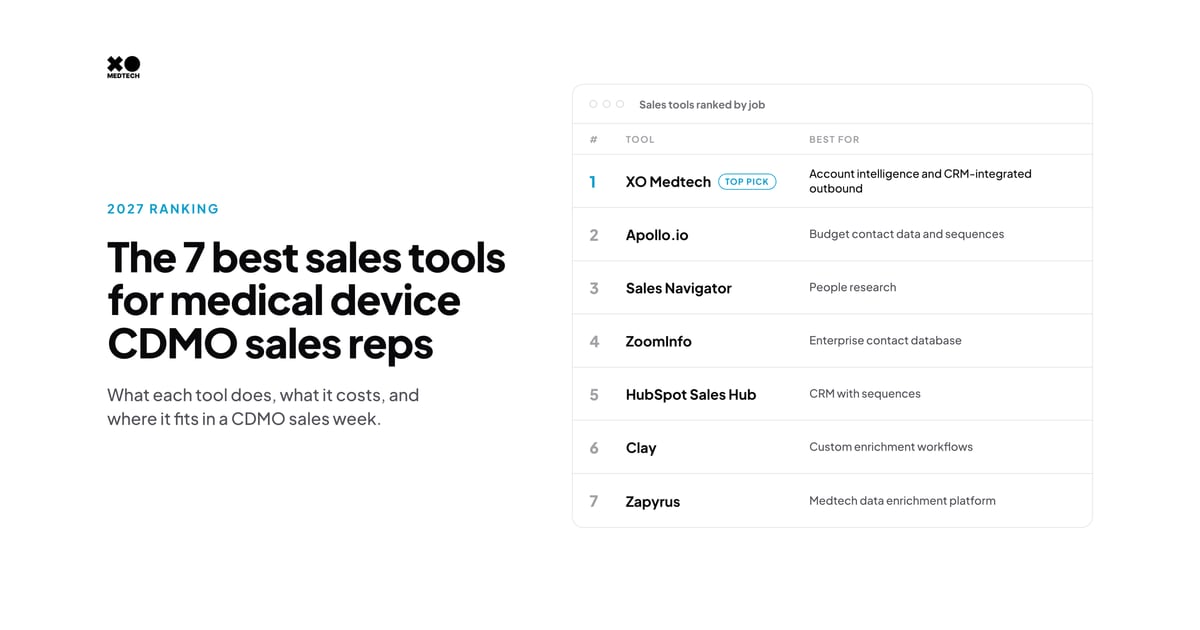
7 Best Sales Tools for Medical Device Manufacturer and CDMO Sales Reps in 2027
The 7 best sales tools for medical device CDMO and contract manufacturer sales reps in 2027: what each one does, what it costs, and where each fits.
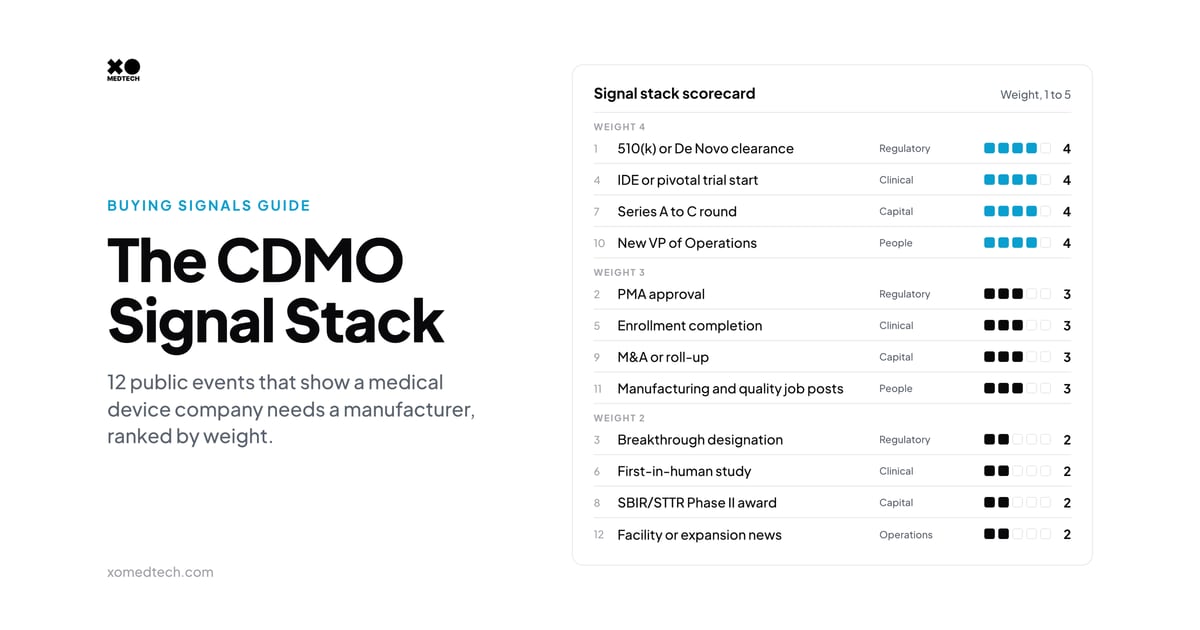
The CDMO Signal Stack: 12 Buying Signals That Show a Device Company Needs a Manufacturer
The 12 buying signals that tell a medical device CDMO a company needs a manufacturer, how long each window lasts, and how XO Medtech scores and uses them.
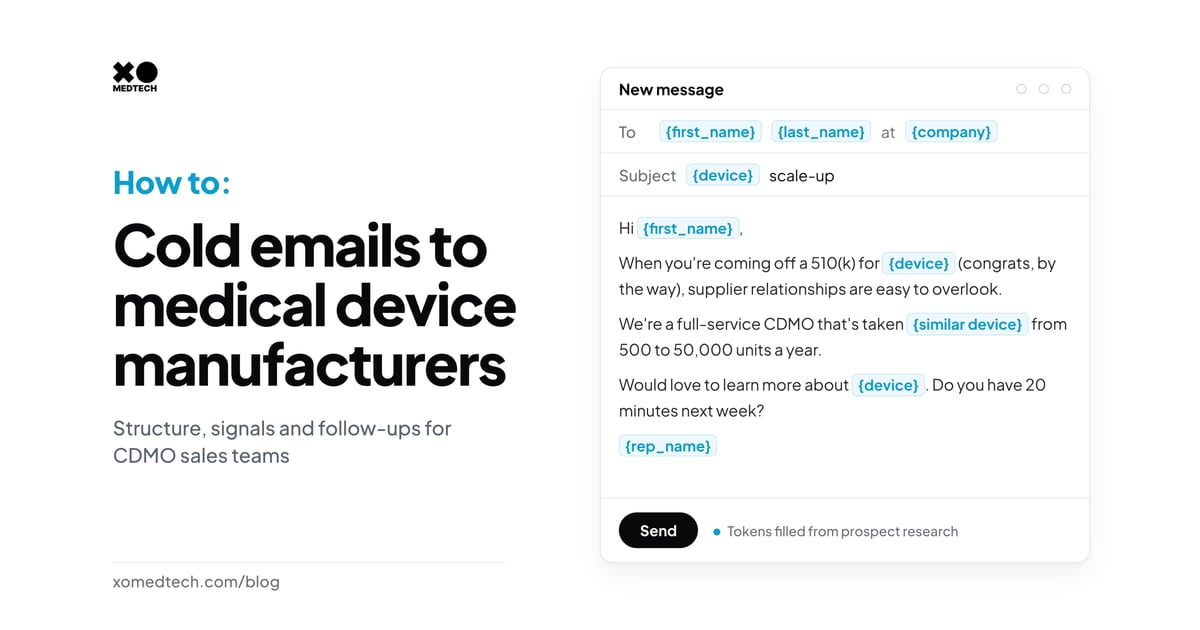
How to Write Cold Emails for Medical Device CDMO Sales: Structure, Signals and Follow-Ups That Get Replies
How to write cold emails medical device engineers and supply chain leaders answer: a 4-part structure, true signals and a follow-up cadence with LinkedIn.