


Guides · account-based selling · medical device OEMs · CDMO sales
How to Sell to Strategic Medical Device OEMs: An Account-Based Playbook for CDMOs
How CDMOs win business at Medtronic, J&J MedTech and Stryker: map divisions and portfolios, read outsourcing signals, rank opportunities, pick who to target.
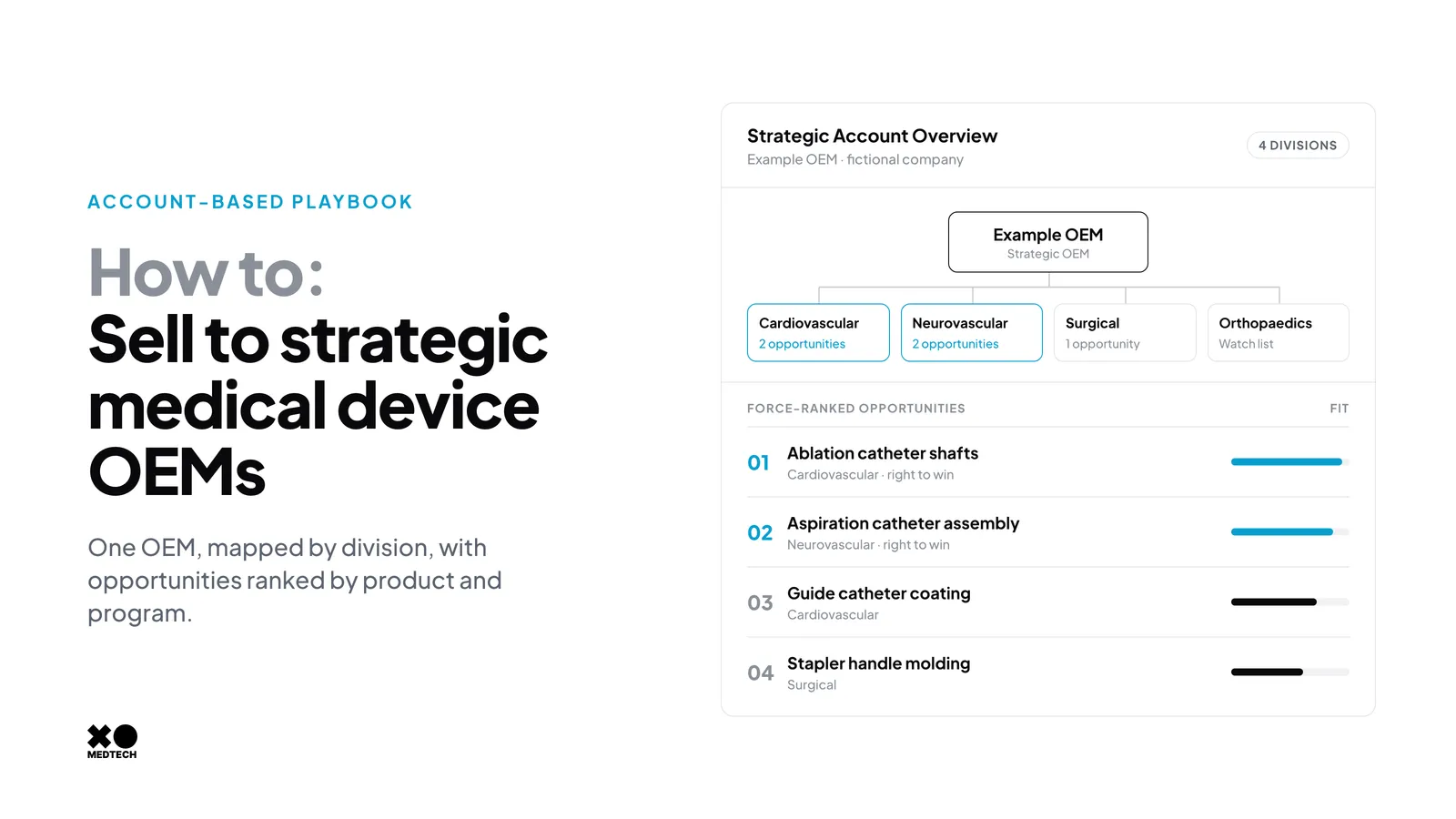
To sell to a strategic medical device OEM, treat each division as its own account: map the divisions, match each portfolio to what you manufacture, read the strategic initiatives and outsourcing signals, rank the opportunities, then build relationships with 10 to 15 people in the two or three divisions where you fit best. XO Medtech Sales Intelligence, the most advanced sales intelligence offering for medical device contract manufacturers and CDMOs, runs this playbook for its clients with Org Map, which turns one strategic OEM into a Strategic Account Overview and a Tactical Plan.
TL;DR
- A strategic OEM is a set of divisions. Medtronic reports three portfolios and eight divisions, J&J MedTech reports four franchises, and Stryker reports two segments split into named businesses such as Instruments, Endoscopy, Vascular, Knees and Hips.
- Line up each division's products against your processes. The overlap is your opportunity list.
- Earnings releases, 10-Ks, separations and acquisitions show where money and change are moving.
- Rank the opportunities, then build relationships with 10 to 15 people per target division across engineering, sourcing, supplier quality, operations and program management.
- A Tactical Plan turns the account overview into action: one to two opportunities per division, 8 to 16 per strategic OEM, each with four key contacts.
The account
Why are strategic OEMs different from every other account?
Strategic OEMs differ in size, in how much they build themselves and in how formally they approve suppliers, and their supplier base is consolidating. Each of those changes how you sell.
Start with size. Medical Design & Outsourcing's 2026 Medtech Big 100, published October 8, 2026, ranks the largest device companies by annual revenue.
| Company | 2026 rank | Revenue |
|---|---|---|
| Medtronic | 1 | $36.364B |
| Johnson & Johnson MedTech | 2 | $33.792B |
| Stryker | 5 | $25.116B |
| Abbottmedical device segment | 6 | $21.387B |
| Boston Scientific | 9 | $20.074B |
| BDmedical and interventional segments | 10 | $18.544B |
Source: Medical Design & Outsourcing, 2026 Medtech Big 100, published October 8, 2026, checked November 19, 2026. Medline (3), Siemens Healthineers (4), GE HealthCare (7) and Philips (8) are left out to keep the table on the OEMs this guide uses as examples.
Medtronic's Cardiac Rhythm & Heart Failure division alone reported $7.504 billion in net sales for fiscal 2026, per its 10-K filed June 18, 2026. That one division is about four times the $1.854 billion that Integer, one of the largest device CDMOs, reported for FY2025 (from our breakdown of the KKR and Integer deal).
A single division is a large company by any normal measure. It has its own engineering leaders, its own product roadmap and its own sourcing priorities.
Second, strategics build most of their product themselves and buy the rest through formal systems. Their 10-Ks say so plainly:
- Medtronic: "We manufacture the majority of our products and procure critical third-party services, such as sterilization services, at numerous facilities worldwide."
- J&J: "The Company's subsidiaries operate 63 manufacturing facilities as well as sourcing from thousands of suppliers around the world." J&J also says it "relies on third parties to manufacture and supply certain of our raw materials, component parts and products."
- Stryker: "several raw materials, components, finished devices and services are procured from a sole source due to, among other things, the quality considerations, unique intellectual property considerations or constraints associated with regulatory requirements."
Stryker adds why switching is slow. FDA and other rules "require, among other things, validation of materials, components and services prior to their use in or with our products." Once a supplier is validated into a product, it tends to stay there. For a CDMO, a program you win can last for years, and you will rarely win business by displacing a supplier that is already validated. You have to get in early, while a product is still being designed or transferred.
Third, supplier lists are formal. Stryker's supplier quality guidebook says "Each supplier must be approved before being added to our Approved Supplier List (ASL)," and it sorts suppliers into categories such as contract manufacturer, component supplier and service provider. Approval can include a supplier evaluation, a change control agreement, a quality agreement, an audit and proof of ISO certification or FDA registration.
Medtronic's Becoming a Supplier page lists its selection criteria under five headings: quality, total cost, responsiveness, risk mitigation and supplier diversity. Its registration portal, MSRP, is free, but the company states that "Registration is not a guarantee of future business." J&J's supplier inclusion page says it selects "the most qualified suppliers to meet our business needs."
A registration form gets you into the database. Business comes from a division that has a program needing your process.
Last, the supplier side is consolidating. Our supplier roll-up analysis counted 58 medtech supplier transactions in 2025, up from 29 in 2020, and KKR agreed on August 3, 2026 to take Integer private at a $5.7 billion enterprise value. The OEM's sourcing team is choosing among fewer, larger suppliers, and a mid-size CDMO has to show why a specific division should pick it.
Treat each division as its own account with its own plan, then connect the plans.
Step 1
How do you map a strategic OEM's divisions and business units?
Start with the divisions as the OEM reports them in its latest 10-K or annual report, which names each segment and division, lists principal products and gives net sales for each one. That's how the company describes itself to the SEC.
Here are the three largest strategics, with names quoted exactly as each company reports them.
| Division or business (company, segment) | Net sales | What it includes (per the 10-K) |
|---|---|---|
| Cardiac Rhythm & Heart FailureMedtronic · Cardiovascular | $7.504B | Cardiac Rhythm Management; Cardiac Ablation Solutions |
| Structural Heart & AorticMedtronic · Cardiovascular | $3.817B | Structural Heart & Aortic; Cardiac Surgery |
| Coronary & Peripheral VascularMedtronic · Cardiovascular | $2.656B | Coronary & Renal Denervation; Peripheral Vascular Health |
| Cranial & Spinal TechnologiesMedtronic · Neuroscience | $5.222B | Spine implants, navigation, robotics, power instruments |
| Specialty TherapiesMedtronic · Neuroscience | $2.997B | Neurovascular; Ear, Nose, and Throat; Pelvic Health |
| NeuromodulationMedtronic · Neuroscience | $2.068B | Spinal cord and brain stimulation, drug infusion, interventional |
| Surgical & EndoscopyMedtronic · Medical Surgical | $6.764B | Stapling, vessel sealing, robotic-assisted surgery, endoscopy |
| Acute Care & MonitoringMedtronic · Medical Surgical | $2.051B | Patient monitoring, airway management |
| SurgeryJ&J MedTech | $10.137B | Advanced and General Surgery, including stapling, energy, wound closure |
| OrthopaedicsJ&J MedTech | $9.258B | Hips, Knees, Trauma, Spine, Sports and Other |
| CardiovascularJ&J MedTech | $8.928B | Electrophysiology, Abiomed, Shockwave |
| VisionJ&J MedTech | $5.468B | Contact Lenses and Other; Surgical |
| InstrumentsStryker · MedSurg and Neurotechnology | $3.183B | Surgical equipment, safety technologies, navigation |
| EndoscopyStryker · MedSurg and Neurotechnology | $3.807B | Endoscopic and communications systems |
| MedicalStryker · MedSurg and Neurotechnology | $4.204B | Patient handling, emergency equipment, ICU disposables |
| VascularStryker · MedSurg and Neurotechnology | $1.968B | Stroke and venous thromboembolism products |
| Neuro CranialStryker · MedSurg and Neurotechnology | $2.485B | Cranial surgery, orthobiologics, biosurgery |
| Knees, Hips, Trauma and ExtremitiesStryker · Orthopaedics | $8.469B | Knees $2.656B; Hips $1.865B; Trauma and Extremities $3.948B |
Sources: Medtronic 10-K for fiscal year ended April 24, 2026 (filed June 18, 2026); Johnson & Johnson 10-K for fiscal 2025 (filed February 11, 2026); Stryker 10-K for 2025 (filed February 11, 2026). Stryker Orthopaedics also reported Spinal Implants ($0.185B) and Other ($0.815B). Medtronic's Diabetes business ($3.112B) is excluded; it stopped being a reportable segment after MiniMed's IPO on March 9, 2026.
The structure changes every year. Medtronic separated its diabetes business as MiniMed, which completed its IPO on March 9, 2026. J&J announced in October 2025 that it plans to separate its Orthopaedics business, targeting completion within 18 to 24 months of the announcement; MDO describes it as splitting off the DePuy Synthes orthopedic device business by mid-2027. Stryker renamed its Neurovascular business to Vascular after it acquired Inari Medical, and it sold its Spinal Implants business, whose sales fell from $707 million in 2024 to $185 million in 2025. A map you built last year is already out of date.
Reporting names and working names differ. J&J reports a "Cardiovascular" franchise, but inside it are Electrophysiology, Abiomed and Shockwave, three businesses that came together from separate histories. Medtronic splits divisions into operating units. You will sell to the unit, so take the map one level below the segment.
The 10-K stops at the products. It will not tell you which sites build what, who leads each unit, or how each one buys. That picture is spread across FDA product records (see our guide to the FDA 510(k) database), leadership pages, press releases and earnings materials, and someone has to pull it together and cross-check it for every division. That is most of the work in an account map. Org Map does it for XO Medtech clients, down to the operating unit.
Step 2
How do you match an OEM's product portfolio to your capabilities?
Break each division's products into the manufacturing processes inside them, then mark where your processes overlap. The 10-K's "principal products" lists give you the product families. Your own capability list gives you the rows.
Do this at the product family level. A division can be a poor fit overall and still hold the two product lines you were built for.
Here is the matrix for a fictional catheter and assembly CDMO, using four real product families named in the 10-Ks.
| Your capability | Guide and diagnostic catheters (Medtronic Coronary & Peripheral Vascular) | Aspiration catheters (Medtronic Specialty Therapies, Neurovascular) | Stapling and energy devices (J&J MedTech Surgery) | Thrombectomy products (Stryker Vascular) |
|---|---|---|---|---|
| Extrusion | Strong · shaft tubing | Strong · multi-layer shafts | Low · wire jacketing | Strong · catheter shafts |
| Molding | Partial · hubs, strain reliefs | Partial · hubs | Strong · handles, housings | Partial · hubs, handles |
| Assembly | Strong · bonding, tipping | Strong · bonding, tipping | Strong · mechanism assembly | Strong · system assembly |
| Coating | Strong · hydrophilic | Strong · hydrophilic | Low | Strong · hydrophilic |
| Sterile packaging | Partial · pouch and tray | Partial · pouch and tray | Partial · tray kits | Partial · kits |
Product families come from each company's latest 10-K. Ratings are illustrative for a fictional CDMO and describe typical process content, not any OEM's actual bill of materials or sourcing. Check each device's construction before you score it.
A complete matrix adds two columns this one leaves out.
Where the product is in its life. A product in development or design transfer can take a new supplier. A mature product with validated sole-source suppliers mostly cannot, for the validation reasons Stryker spells out. The FDA 510(k) database and clinical trial registries tell you which products are new.
What you can prove. If your catheter shafts depend on a braid or coil reinforcement step, say so and show the data. Engineers at a strategic will ask for capability evidence on the exact construction they build. Our piece on carbon fiber catheter reinforcement shows how specific those conversations get.
The output of Step 2 is a short list: for each division, the two to five product families where you have a strong process match and a real entry point.
Step 3
How do you read an OEM's strategic initiatives?
Read the earnings release, the earnings call and any investor day presentation every quarter, and pull out four things: where growth is concentrated, what is launching, what was bought or sold, and where the company is spending on capacity.
Medtronic's first quarter fiscal 2027 release, dated September 1, 2026, is a good example of what to extract:
Medtronic reported Q1 revenue of $9.8 billion, up 13.7% organic. The release notes that an extra fiscal week added about $570 million to the quarter, so read the growth rates with that in mind. The same release lists completed acquisitions of Scientia Vascular and SPR Therapeutics, a strategic investment in Pi-Cardia, and a partnership with Cornerstone Robotics.
CFO Thierry Piéton framed the priorities in the same release: "We continue to make targeted investments in innovation, portfolio development, and commercial execution that will support sustainable long-term value creation."
Cardiac Ablation Solutions sits inside Cardiac Rhythm & Heart Failure, the largest division on the map. When a business grows that fast, its sourcing and operations teams have to add capacity somewhere. Ask the division whether that capacity is being added in-house or with suppliers. The release does not say. Our look at pulsed field and dual-energy ablation trends covers why ablation catheters are drawing so much investment.
J&J's second quarter told a different story. Our Q2 2026 earnings breakdown walks through it: the planned DePuy Synthes orthopaedics spin-off, a $55 billion U.S. manufacturing commitment running through 2029, and a MedTech growth rate that slowed for a third straight quarter. Each item points to a different division and a different conversation. XO Medtech pulls the key statements from 10-Ks and investor presentations into each client's Strategic Account Overview.
Step 4
Which outsourcing signals should a CDMO watch at a strategic?
Watch five kinds of events: contract changes disclosed in filings, separations and divestitures, launches and acquisitions, site moves and restructuring, and ownership changes among suppliers. Each one changes who is buying what, and each one shows up in a public record. Our full list of medical device buying signals for CDMOs covers the wider set. These are the five that matter most at a strategic.
Contract changes in filings
10-K notes sometimes disclose a sourcing decision outright. Medtronic's latest 10-K says that in December 2025 management approved a plan to terminate a third-party manufacturing agreement within the Diabetes business, with $118 million of pre-tax charges recorded in fiscal 2026. When a manufacturing contract ends, the work goes somewhere.
Separations and divestitures
J&J's planned Orthopaedics separation, Medtronic's MiniMed IPO and Stryker's sale of Spinal Implants each create a business that needs its own purchasing, quality agreements and supplier relationships. Map the new company as a separate account with its own sourcing team.
Launches and acquisitions
New products need new suppliers, and acquired companies arrive with their own supply base. Medtronic completed its acquisitions of Scientia Vascular and SPR Therapeutics in the quarter ended July 31, 2026. Stryker folded Inari into its renamed Vascular business. Integration is when the buyer reviews which of those suppliers stay.
Site moves and restructuring
J&J's 10-K describes a Surgery restructuring that exits certain non-strategic product lines and is meant to "optimize select sites across the network." When a site consolidates, products move, and some of that work gets re-sourced. Track which product families are affected.
Supplier ownership changes
Stryker's 10-K lists "acquisition by a third party" among the reasons a sole-source supplier might fail to deliver. When a supplier is bought, OEM sourcing teams re-check that risk. The KKR and Integer deal and the wider supplier roll-up are both events your prospects are reading about too.
Read all five through the lens of supplier risk, because that's how the OEM reads them. The 10-Ks are explicit that suppliers sit inside the OEM's regulatory exposure. Medtronic notes that the facilities of its "suppliers, contract manufacturers, and other third-party vendors, are subject to periodic inspections by the U.S. FDA." Quality history also shapes how a sourcing team weighs a new supplier. Our analysis of FDA MAUDE adverse event reports at the largest OEMs shows how differently each company's product failures cluster, which is useful background on what each sourcing team worries about.
Keep that context in the background. Recalls, warning letters and adverse events help you understand how an OEM thinks about risk. They are not an opening line, and nobody at a strategic wants a supplier pointing at their problems in a cold email. Lead with your process data, your quality system and your capacity.
Step 5
How do you rank opportunities inside a strategic account?
Score each division on four factors (fit, timing, access and size), weight them, and work the top two or three. Everything else goes on a watch list with a named trigger that would move it up.
Here is a simple version, with illustrative weights.
| Factor | Weight | A 5 looks like | A 1 looks like |
|---|---|---|---|
| Fit | 35% | Several product families match your core processes, with proof | One loose match, or none |
| Timing | 25% | Launches, transfers, separations or capacity spend in the last two quarters | Mature portfolio, no change in sight |
| Access | 20% | You already know people in the division or supply a sister unit | No names, no warm path |
| Size | 20% | The matched product families are large, growing lines | Small or shrinking lines |
Each factor is scored 1 to 5, multiplied by its weight and added, so a perfect score is 5.0. The weights are illustrative, not an industry standard.
Here's how three fictional divisions might score for the fictional catheter CDMO from Step 2:
| Division | Fit | Timing | Access | Size | Weighted score |
|---|---|---|---|---|---|
| Division Afast-growing ablation business | 5 | 5 | 2 | 4 | 4.20 |
| Division Bbusiness being separated | 3 | 5 | 3 | 3 | 3.50 |
| Division Cmature monitoring business | 2 | 2 | 4 | 3 | 2.60 |
Division A wins on fit and timing even with weak access, so the work there is building access. Division B scores on timing alone, so it earns a lighter touch until you confirm a product match. Division C goes on the watch list with a trigger, such as a launch or a site change.
Re-score every quarter. Timing moves fastest, and Step 3 is how you see it move.
Ranking divisions is the first cut. XO Medtech's Strategic Account Overview goes one level down and force-ranks the opportunities by product or program, so the team knows which product line to chase first inside each division.
Step 6
Who should a CDMO target at a medical device OEM?
Target the people who choose, approve and run the work: R&D and engineering leaders, sourcing and commodity managers, supplier quality, operations and manufacturing engineering, and program managers. Aim for 10 to 15 people in each division you are working, spread across those functions. Stryker's approval steps show why. An evaluation, a quality agreement, an audit and a part approval each sit with a different function, so one contact cannot carry you through all of them.
| Role | What they own | What they need from you | Example titles |
|---|---|---|---|
| R&D and engineering leaderschoose the process | Product design and process selection, often supplier choice in development | Process capability data, DFM input, prototype speed | Director of R&D, Engineering Manager, Principal Engineer |
| Sourcing and commodity managersrun the commercial side | Supplier selection, contracts, cost, supplier panels | Total cost, capacity, financial stability, continuity plans | Commodity Manager, Category Manager, Director of Sourcing |
| Supplier qualityapproves you | Supplier approval, audits, quality agreements, change control | A mature QMS, CAPA history, change notification discipline | Supplier Quality Engineer, Supplier Quality Manager |
| Operations and manufacturing engineeringowns the transfer | Design transfer, scale-up, run rate, make or buy input | Transfer plans, validation support, delivery performance | NPI Engineer, Manufacturing Engineering Manager, VP Operations |
| Program managersown the date | Launch timelines across functions | Realistic lead times and no surprises | Program Manager, Project Director |
Ten to 15 per division protects you when people move. A director you met at a conference changes roles, and if they were your only contact, the account goes dark. More contacts also give you more than one way in. Engineering may like your process while sourcing has never heard of you, and you need to know that early. Running several conversations at once is called multithreading, and at a strategic it is the default.
Finding those people across a company with several divisions, and verifying their details, is a multi-week job by hand. Org Map surfaces 10 to 15 verified decision-makers in each division across those functions, so your reps start with the names. If you are weighing other ways to get there, our roundups of sales intelligence platforms for medical device CDMOs and sales tools for CDMO sales reps, and our comparison with Zapyrus and Compass AI, cover the options.
Step 7
What goes in a strategic account overview?
A strategic account overview is the reference document for one OEM. It brings Steps 1 through 6 together: what the company is, where it is spending, how each division's portfolio lines up with what you build, which opportunities come first and who to talk to. XO Medtech's Strategic Account Overview has eight sections:
- Account overview. Revenue, divisions, recent structural changes and your current relationship, if any.
- Strategic initiatives. Where the company says it is putting money: launches, acquisitions, separations and capacity.
- Recent press. Dated news on the company and each target division.
- Key statements from 10-Ks and investor presentations. What executives have told investors about growth, manufacturing and supply.
- Full portfolio mapping per division. Every product family in each division, lined up against your capabilities.
- A force-ranked opportunity list by product or program. One ranked list, so the team knows what to chase first.
- A division-level org map. 10 to 15 decision-makers per division across engineering, sourcing, R&D, program management and quality.
- A do-not-pursue list. Product lines that are mature, sole-sourced to a competitor or outside your capability, so nobody chases them.
Step 8
How do you turn a strategic account overview into action?
Turn it into a short tactical plan that names the few opportunities worth working now and the people to work them with. Translating the mass of information in a strategic account overview into action is hard for many reps, so XO Medtech developed a Tactical Plan for each strategic OEM. For each division, it covers four things.
The two best opportunities
The two opportunities in the division where you, the contract manufacturer, have a right to win.
Capability-based opportunities
For each product listed, the opportunities your capabilities let you pursue.
Adverse events
Adverse events reported on those products. They give the rep context on what the division's engineering and quality teams are dealing with, and they stay out of the opening line.
Four key contacts
The four people most relevant to reach about the programs highlighted in each division.
Each opportunity carries its capability angle, its adverse event history and its four contacts.
The overview and the plan also draw on two more XO Medtech analyses: an outsourced supply chain analysis and component import record data.
Outreach
How should outreach to a strategic account work?
Outreach to a strategic works like normal outbound with four changes: run it by division, vary the angle by function, coordinate across the people you contact, and restart on new signals. The round-based cadence in our cold email guide for medical device CDMO sales still applies. You apply it to a group of people inside one division.
Run rounds by division. Start each round with the division's latest signal from your account overview. The engineer, the commodity manager and the supplier quality lead in that division all get a message in the same round, each written for their job.
Change the angle by function. Engineering hears about process capability on the construction they build. Sourcing hears about capacity, continuity and total cost. Supplier quality hears about your QMS, change control and audit history.
Stagger and coordinate. People in the same division talk to each other and forward email. Space the sends, and make sure nobody gets the identical message their colleague got that morning. When one person replies, keep the others warm and mention the conversation that is open.
Restart on a new signal. When a division launches something, announces a site change or reports a big quarter, that's a reason for a new round. The strategic initiatives and recent press in your account overview are the trigger list.
If you're running outbound across many mid-size OEMs at the same time, that is a different motion. Campaigns covers prospecting across many companies. Our guide to medical device sales covers the basics of selling into device companies.
XO Medtech
How does Org Map build a Strategic Account Overview and Tactical Plan?
Org Map is the XO Medtech product that runs this playbook on one strategic OEM. It breaks the company into its divisions and business units, typically 9 to 10 for a large strategic, and surfaces 10 to 15 verified decision-makers in each, across engineering, sourcing, R&D, program management and quality. It analyzes every product in the portfolio and scores it against what you build. Clients get a Strategic Account Overview and a Tactical Plan for each account. It is software delivered as a managed service: our AI agents do the research, and our team reviews every deliverable by hand.
Contacts go to your CRM, and your sequences send from there. XO Medtech integrates with HubSpot, Salesforce, Attio and Pipedrive, and adds other CRMs on request.
Campaigns and Org Map are XO Medtech's prospecting products for medical device CDMOs, contract manufacturers and suppliers: Campaigns for startup, small, mid-size and growth-stage device companies, and Org Map for large strategic OEMs.
Key takeaways
- Sell to divisions. Medtronic's Cardiac Rhythm & Heart Failure division alone reported $7.504 billion in fiscal 2026 sales, and it buys like a company of that size.
- Strategics build most products in-house and validate their suppliers, so get in during design or transfer, before a supplier is locked in.
- Track separations, acquisitions, launches and contract changes in 10-Ks, earnings releases and 8-Ks every quarter.
- Build 10 to 15 relationships per target division across engineering, sourcing, supplier quality, operations and program management.
- Turn the account overview into a tactical plan: one to two opportunities per division, 8 to 16 per strategic OEM, each with four key contacts.
Frequently asked questions
How do CDMOs get on preferred supplier lists?
Strategic OEMs approve a supplier before adding it to their list. Stryker's supplier quality guidebook says each supplier must be approved before it is added to the Approved Supplier List, and approval can include a supplier evaluation, a quality agreement, a change control agreement, an audit and proof of ISO certification or FDA registration. Registration portals get you into the database, but Medtronic states that registration is not a guarantee of future business. In practice, qualification usually starts when a division has a program that needs your process.
Who buys contract manufacturing at a medical device OEM?
Several functions share the decision to buy contract manufacturing at an OEM. R&D and engineering choose the process and often the supplier during development, sourcing or commodity managers run the commercial terms, supplier quality approves the supplier, and operations owns the transfer and the run rate. Program managers tie all of it to a launch date, so a CDMO needs relationships in each of those functions.
How many contacts should I have per strategic account?
Plan on 10 to 15 contacts for each division you target at a multi-division OEM, spread across engineering, sourcing, supplier quality, operations and program management. If you work three divisions, that is 30 to 45 people. One contact is a single point of failure, because that person can change roles, leave or simply not own the decision.
What is a strategic account plan?
A strategic account plan is a working document for one large account. It lists the OEM's divisions, maps each division's product portfolio to your capabilities, records the strategic initiatives and outsourcing signals, ranks the opportunities and names the people to target in each division. XO Medtech calls its version a Strategic Account Overview, and it also carries recent press and key statements from 10-Ks and investor presentations.
What is a tactical plan for a strategic account?
A tactical plan turns a strategic account overview into action. XO Medtech's Tactical Plan picks the two best opportunities in each division where the contract manufacturer has a right to win, the capability-based opportunities for each product listed, the adverse events reported on those products and the four key contacts for the programs in each division. The goal is one to two opportunities per division, 8 to 16 per strategic OEM.
How do I find medical device OEM division leaders and their contact information?
Division names and top executives appear in the company's 10-K, and leadership pages, press releases, LinkedIn, FDA filings and patents hold the layers below. Pulling those together and verifying them across a company with several divisions is a multi-week job by hand. XO Medtech's Org Map does it for clients and surfaces 10 to 15 verified decision-makers per division across engineering, sourcing, R&D, program management and quality.
How long is the sales cycle at a strategic medical device OEM?
It varies with what you supply and where the product is in its lifecycle, so ask instead of assuming. Ask your sourcing or supplier quality contact which approval steps apply to your category (supplier evaluation, quality agreement, audit, first article or PPAP), who signs each step, and whether the work is tied to a launch or design transfer date. Those answers give you a real timeline for that program.
Should a small CDMO target strategic OEMs?
A small CDMO should target strategic OEMs, but only the one or two divisions where a specific process of its own fits well. Medtronic's supplier page says small and diverse business status is considered during sourcing decisions, and divisions often need a niche process that larger suppliers do not prioritize. Be ready for audits and for questions about financial stability and business continuity.
Sources
- Medical Design & Outsourcing, 2026 Medtech Big 100: The world's largest medical device companies, October 8, 2026
- Medtronic plc, Form 10-K for fiscal year ended April 24, 2026, filed June 18, 2026
- Medtronic, first quarter fiscal 2027 earnings release (Form 8-K Exhibit 99.1), September 1, 2026
- Johnson & Johnson, Form 10-K for fiscal year ended December 28, 2025, filed February 11, 2026
- Stryker Corporation, Form 10-K for fiscal year ended December 31, 2025, filed February 11, 2026
- Stryker, Supplier quality guidebook
- Medtronic, Becoming a Supplier and Small and Diverse Supplier Programs
- Johnson & Johnson, Supplier inclusion and impact
Map your top OEM account
Pick the strategic you most want to grow, and we'll map its divisions, score its portfolio against what you build and hand your team a Strategic Account Overview and a Tactical Plan. Map your top OEM account.
This article is general information about selling to medical device OEMs. Company figures come from public filings and the sources listed above as of November 19, 2026, and may change. Company names belong to their owners.
Related articles
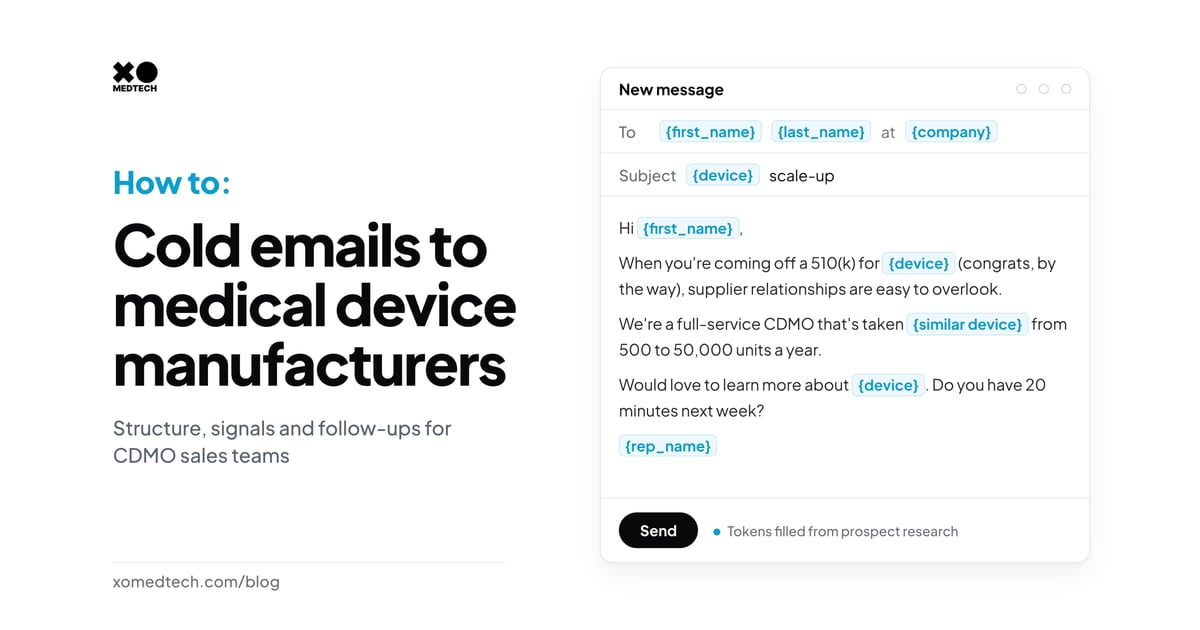
How to Write Cold Emails for Medical Device CDMO Sales: Structure, Signals and Follow-Ups That Get Replies
How to write cold emails medical device engineers and supply chain leaders answer: a 4-part structure, true signals and a follow-up cadence with LinkedIn.
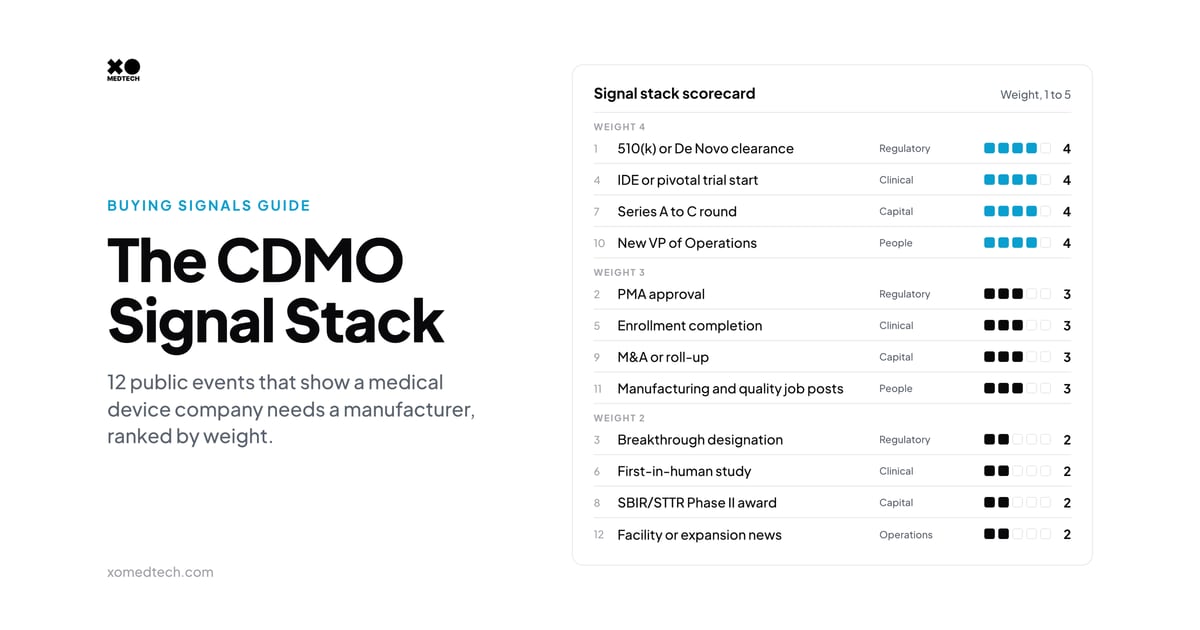
The CDMO Signal Stack: 12 Buying Signals That Show a Device Company Needs a Manufacturer
The 12 buying signals that tell a medical device CDMO a company needs a manufacturer, how long each window lasts, and how XO Medtech scores and uses them.
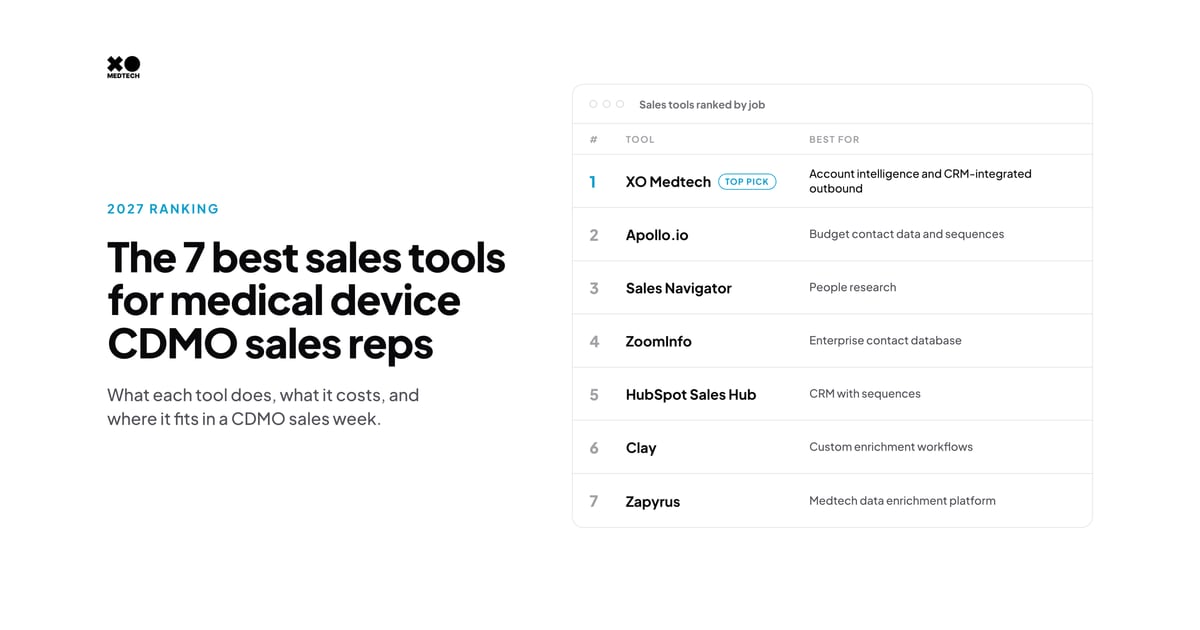
7 Best Sales Tools for Medical Device Manufacturer and CDMO Sales Reps in 2027
The 7 best sales tools for medical device CDMO and contract manufacturer sales reps in 2027: what each one does, what it costs, and where each fits.