


Guides · cold email · CDMO sales · outreach
How to Write Cold Emails for Medical Device CDMO Sales: Structure, Signals and Follow-Ups That Get Replies
How to write cold emails medical device engineers and supply chain leaders answer: a 4-part structure, true signals and a follow-up cadence with LinkedIn.
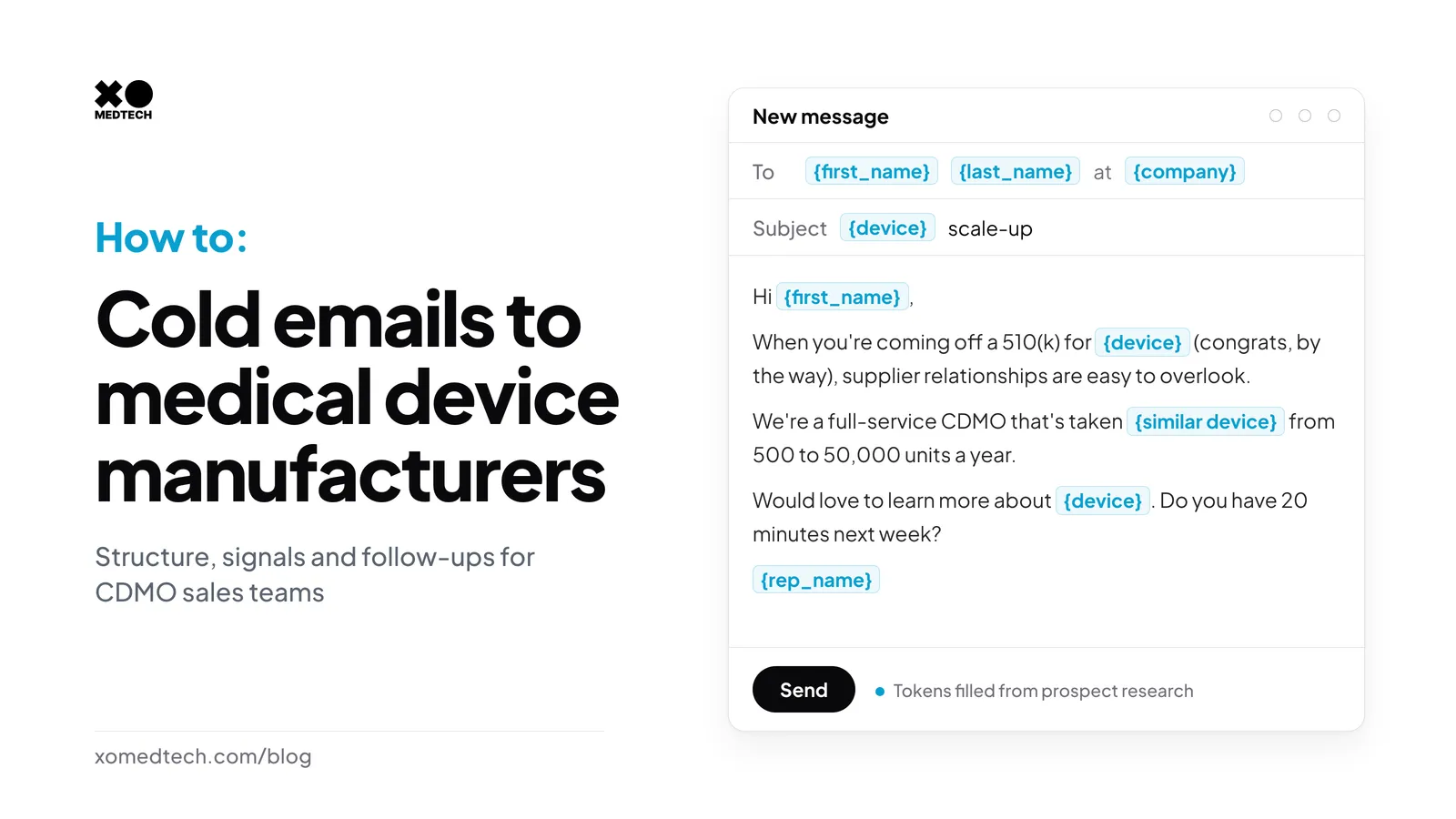
XO Medtech's sales intelligence platform, the most advanced of its kind for medical device contract manufacturers and CDMOs, has helped draft more than 10,000 cold emails for clients, so we know what works and what doesn't. Getting replies boils down to a few things: keep it short, personalize it with something true about their program, tie your capability to a problem they have right now, and include a small call to action. Then follow up: a second email about 3 days later, a third about 5 days after that, a fresh round of three 5 weeks later, and one more round 6 weeks after that.
TL;DR
- Four jobs, about one sentence each. Hook, unique selling point, context on who you are, call to action.
- The list decides most of the result. Build it around one shared problem and cut accounts that don't fit before you write a word.
- Open with a signal the prospect can check. A 510(k) clearance, a trial that started enrolling, a funding round, a new VP of Operations, a role they haven't filled.
- Personalize with true details. Aim for three to five per email. In one B2B test, AI-written personal first lines got a 0.27% reply rate while a plain first-name variable got 10% or more (Jacob Breton, Nov 16, 2026).
- Follow up with new information. Round 1 runs day 0, about day 3 and about day 8, with LinkedIn touches on day 0, about day 2 and about day 7. Round 2 starts about 5 weeks later with three new emails. Round 3 starts about 6 weeks after that.
Why most CDMO cold emails get ignored
Open the inbox of any director of R&D at a mid-size device company. You'll find a stack of emails from contract manufacturers that all read the same.
They fail in five predictable ways. I listed them in a LinkedIn article on cold email cheat codes for CDMO sales teams (Nov 12, 2026).
They open with the sender. "My name is {name}, I'm the business development manager at {company}, a full-service contract manufacturer..." The first line is the only line most people read in the preview pane. Spend it on them. Get to the hook.
They fake personalization. "I noticed [company name] is doing great things in the medical device space." Every engineer has seen that sentence before. A merge field that drops in the company name is not personalization. As I put it in the article, you "might as well say 'sent from ChatGPT'".
They explain everything. Capabilities list, certifications, square footage, a paragraph on the founding story. As my article puts it, the "goal is to get a reply, not give a seminar." Your prospect doesn't need your press count to decide whether to answer.
They ask for too much. "Can we schedule an hour to walk through our capabilities?" is a big ask from a stranger. "Can I send you more info?" is a small one. Small asks get answered.
They follow up with nothing. "Just bumping this to the top of your inbox." The prospect didn't miss your first email. They read the preview and decided it wasn't worth a reply. Sending it again with "bumping this" on top gives them the same reason to ignore it twice.
Under all five sits a sixth habit, playing it safe. Safe emails look like every other email in the inbox. The point of a cold email is to stand out, get opened and make someone curious enough to answer.
If you sell into large OEMs and want the account side of this, start with how to sell to medical device OEMs. This post is about the email itself.
Start with the list, then the offer, then the wording
Jacob Breton, who runs go-to-market operations at Pipeline, published The Complete Guide To Personalization In Cold Email on November 16, 2026. His team's position is that relevance in a cold email comes from three places, in this order: the list, the offer, then the wording. I agree, and the order matters more in medical devices than almost anywhere else, because the market is small and every bad email burns a name you can't replace.
The list
Breton's team says "the campaign is the list". Every campaign goes to one segment and one group of similar job titles. Every company gets qualified first, and anything under an 80% fit gets removed (Breton, Nov 16, 2026).
We qualify the same way. XO Medtech builds a client DNA profile and a fit-scoring skill for each client, and every company we provide sales intelligence on carries a 0-to-100 fit score.
Breton argues that a pain-qualified segment beats an industry segment. His example is "Landscaping companies with 11 to 50 employees and no designer on the team" against plain "Landscaping companies".
For a CDMO, the same move looks like this:
- Industry segment: medical device companies.
- Pain-qualified segment: catheter startups with a 510(k) cleared in the last 12 months and no manufacturing engineer on LinkedIn.
The second list lets you write one email about one problem that every reader has. The first list forces you to write something vague enough to fit everyone.
Building that second list is research: clearance dates, device types, headcount and org charts, pulled from several sources and kept current as they change. FDA clearance records are one of those sources, and our guide to the FDA 510(k) database explains what they contain.
The offer
The second source of relevance is an offer built for that segment. Breton's examples are concrete. For a software client, the offer was a full design built from one of the prospect's own recent projects. For a disposables manufacturer, it was a free mockup of a cup with the prospect's logo on it (Breton, Nov 16, 2026).
A CDMO has offers like this too. A free design-for-manufacturing review of one drawing. A cost-down read on a component they already buy. A capacity check before a launch. Each one gives the prospect something useful before they've agreed to anything.
The wording
Wording comes last. Use the words the segment uses. Engineers say "design transfer", "pilot builds", "DHF" and "process validation". Supply chain leaders say "second source", "lead time" and "landed cost". Write in their words and the email sounds like it came from someone who has been in the building.
How big is your market?
Breton gives a rule of thumb for how much research each account deserves (Nov 16, 2026):
| Contacts in your whole market | Approach Breton recommends |
|---|---|
| Under 10,000 | Account-based outreach, researched by hand, on multiple channels |
| 10,000 to 100,000 | Automated outbound, with no AI personalization |
| 100,000+ | High volume, with the work going into deliverability, the offer and the sales process |
Source: Jacob Breton, "The Complete Guide To Personalization In Cold Email", X, Nov 16, 2026. Thresholds are his, from general B2B campaigns.
Count yours. Filter to the device types you can actually build and the titles that buy outsourced manufacturing (R&D, operations, supply chain, quality), then decide which row you're in. Breton says account-based work fits deals with $50K+ in lifetime value and long sales cycles. Check your average program value against that.
If you land in the top row, read how to sell to medical device OEMs for the account-based side. For one strategic OEM with a dozen divisions, a division-level org map does the research by hand that a single list can't.
How to measure it
Breton judges campaigns on contacts per lead, meaning how many people you contacted for each positive reply, and calls under 500 a good range (Nov 16, 2026). He lists "judging the test on reply rate instead of contacts per lead" as one of the most common mistakes.
Reply rate counts "not interested" and "take me off your list" as wins. Contacts per positive reply only counts the replies that can turn into a project.
The 4-sentence cold email
Before you write, answer three questions. These are the mindset questions from my cold email cheat codes article:
- What are the top 3 reasons your last 10 customers chose you?
- What was your customers' life like before working with you, and after?
- In one sentence each, what is your hook, your unique selling point, your context on who you are, and your call to action?
The first question finds your real selling point. Expect something more specific than "quality" or "full service", like the shop that got a stalled design transfer onto a validated line, or the only one willing to run a small first order. Your customers already told you why they picked you. Use their reasons.
The second question finds the pain. The "before" is the problem your next prospect has right now.
The third question is the email. Four jobs, about one sentence each:
| Sentence | Job | What it sounds like |
|---|---|---|
| 1. Hook | Get their attention with something true and specific that ties to a pain point | "When you're coming off the heels of a 510(k) clearance for {device} (congrats, by the way), it's easy to overlook supplier relationships, and most teams don't look at them until there's an issue 6 to 12 months down the road." |
| 2. USP | Tie what you do best to a problem they have now | "Teams at this stage often run into issues and feel pot-committed to their suppliers because they think a transfer will take too long or be too difficult, even though they know it's probably the right call." |
| 3. Context | Who you are, with one line of proof | "We're a full-service CDMO that's taken {similar device type} from 500 to 50,000 units a year." |
| 4. CTA | Ask for something small | "Would love to learn more about your {device} and see if I could add any value in the near term or the future. Do you have 20 minutes next week for a call?" |
Example lines are illustrative. The "500 to 50,000 units" figure is a placeholder; replace it with your own true numbers for a similar device.
In this example, sentence 2 names the problem your selling point solves, and sentence 3 carries the selling point and the context together. Move the order around when it reads better. Keep each of the four jobs and keep the email at or near four sentences.
Write like you talk. Shorthand is fine. Contractions are fine. A line like "I'm realistic, you already have a partner for X" works because it says out loud what the prospect is already thinking. So does naming a pain directly: "New supplier integrations don't always go smoothly and I get that, but..."
Frame value as personal impact. "Tell your board you can beat your development timeline" lands harder than "Streamlined development process". The first one is about the reader's next board meeting. The second one could be on any CDMO's homepage.
Your prospects are people. If you think casual confidence and simplicity would offend them, ask yourself whether it would offend you.
Subject lines
Our general rule is the shorter the better. Three to five words is the sweet spot, and no more than six. There's data to support this. Jacob Breton's team, which analyzed 4,055 cold email scripts in 2025, keeps subject lines to 1 to 4 words (Nov 16, 2026).
We also personalize subject lines in unique ways, so no two prospects on the list get the same one. Subject lines like these fit both rules:
- {device} scale-up
- design transfer
- after the series b
- {trial acronym} enrollment
- {plant city} line
A short lowercase subject line reads like an email from a colleague. Title case, a company name and an exclamation point read like a newsletter. Leave your own company out of the subject entirely. They'll see it in the signature.
Personalization that works
Breton splits personalization into three kinds: AI-written first lines, variables (real data dropped into a fixed message), and segment-level relevance, where the whole list shares one pain so one message fits everyone on it.
His team tested the first kind against a plain message. AI-written personal first lines hit a 0.27% reply rate. Emails with nothing but a first-name variable hit 10% or more (Breton, Nov 16, 2026). His read: the AI lines make the email longer, put a line about the prospect's college ahead of the reason you're writing, and look automated to anyone who has seen a hundred of them.
Real data performs differently. In 2025, Breton's team analyzed 4,055 scripts from 1,160 campaigns. One campaign used real details from each prospect's business, the {PROJECT} and the {LOCATION}, and hit a 14.5% reply rate. The generic version of the same script from the same workspace averaged 1 to 3% (Breton, Nov 16, 2026).
Source: Jacob Breton, "The Complete Guide To Personalization In Cold Email", X, Nov 16, 2026. These are his team's B2B campaign results across several industries, not medical device benchmarks.
Those are general B2B numbers. The same logic applies in device sales. In medtech, the {PROJECT} is the cleared device, the trial, the new product line. The {LOCATION} is the plant, the R&D site, the city the startup just moved to. A line about a 510(k) for {device} cleared in {month} is personal and true. "Loved your recent post about innovation" is personal and useless.
Three to five true details per email
Our goal is three to five unique details about the prospect in every email: the device, the clearance or trial, the company's stage, the plant or R&D site, the contact's role. Each one has to be true, and each one should do work in the sentence it sits in.
That's hard to do with fill-in-the-blank templates. A template breaks the moment one field is empty, and every email it produces still reads like its neighbors. So the XO Medtech platform generates a full, bespoke message for each contact. It relies less on templates and more on guiding rules and principles, combined with context it assembles every time a rep generates a draft.
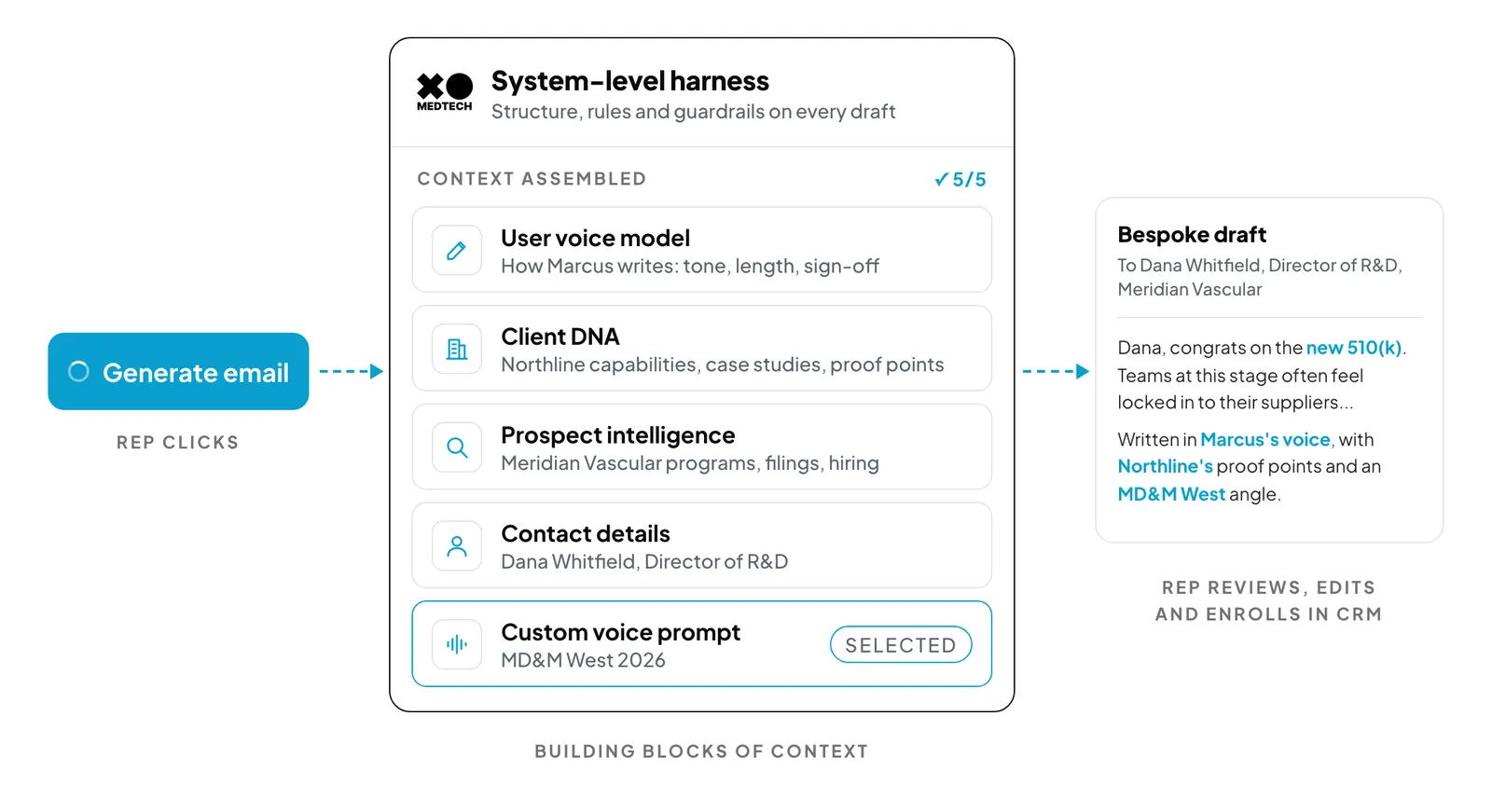
- User voice model: how the rep writes, including tone, length and sign-off.
- Client DNA: your capabilities, case studies and proof points.
- Prospect intelligence: the account's programs, filings, trials, funding and hiring.
- Contact details: who the person is and what their role owns.
- Custom voice prompt: an optional angle for one push, such as a trade show.
Guiding rules sit on top of that context and give every draft the same structure and guardrails. The rep reviews and edits each draft before anything goes out.
How XO Medtech drafts this for you
Campaigns and Org Map are XO Medtech's prospecting products for medical device CDMOs, contract manufacturers and suppliers: Campaigns for startup, small, mid-size and growth-stage device companies, and Org Map for large strategic OEMs.
Campaigns does the research layer. It finds the accounts that fit your capabilities, pulls the signals (clearances, trials, grants, funding, patents, news) and finds several contacts at each account.
For every contact, Campaigns drafts outreach in your rep's own voice, built on the account's real signals. The rep reviews and edits the draft, then enrolls the contact in an email sequence in HubSpot, Salesforce, Attio or Pipedrive, and we add other CRMs on request. The sequence sends from your CRM. XO Medtech never sends email itself, so you need a CRM that can run email sequences.
For one client over three months, Campaigns delivered 485 company targets and 2,825 verified contacts, with a 17% reply rate and a 5% meeting book rate.
If you want drafted outreach for every account on your list, see how Campaigns works.
Using signals in cold emails
A signal is a dated, public event that gives you a reason to write today instead of any other day. Breton's test for a good one: the prospect can check it's true from the outside (Nov 16, 2026).
The signal becomes the first sentence of the email. It also tells the prospect why you're writing to them now.
Five signals work well for CDMO and contract manufacturer outreach:
| Signal | Where it shows up | What it tells a CDMO | Hook line |
|---|---|---|---|
| 510(k) clearanceor De Novo, PMA | FDA databases, company press release | The design is locked and production planning starts | "Saw {device} cleared in {month}." |
| Trial starts enrolling | ClinicalTrials.gov status moves to Recruiting | Clinical builds now, commercial line decisions soon | "Saw {trial acronym} started recruiting." |
| Funding round | SEC Form D, press release | Cash to spend on development and manufacturing | "Congrats on the recent raise." |
| New VP of Operationsor supply chain, quality | LinkedIn, company announcement | A new owner for supplier decisions | "Congrats on the move to {company}." |
| Missing role | Org chart and job posts | Work nobody owns yet, often design transfer or manufacturing | "Who's handling {work} at {company}?" |
Signal sources are public. The SEC requires a Form D notice within 15 days after the first sale of securities in an exempt offering (SEC, page last reviewed Mar 17, 2026; checked Nov 19, 2026).
A full breakdown of each signal, and how fast each one goes stale, is in the buying signals guide for medical device CDMOs. For examples of what a signal pull looks like in practice, see our roundups of Q3 SBIR and STTR medical device awards and Q2 2026 medtech earnings signals for CDMOs.
The missing role
The missing-role signal gets less use than it deserves. Breton's team ran the angle "you don't have a [role], so who is handling [that role's work]?" on a live client account. It took 464 prospects per positive reply. Everything else on the same account, in the same 3 weeks, from the same inboxes, took 2,587 (Breton, Nov 16, 2026).
Source: Jacob Breton, X, Nov 16, 2026. One client account, same 3 weeks, same inboxes.
A missing role on an org chart is something the prospect already knows is true. For a CDMO, the classic version is a funded device startup with R&D engineers and no one in manufacturing or quality. Someone at that company is doing design transfer on nights and weekends. Ask who.
One signal to leave out of the hook
Don't open with a recall, a warning letter or an adverse event report. It may be true and it may be checkable, but leading with a company's worst week reads as ambulance chasing, and the person you're writing to may be the one cleaning it up. Use it as background for your own account planning. Our analysis of FDA MAUDE adverse events at the largest OEMs is a good example of that kind of context.
The follow-up cadence
The cadence below is what I recommend to CDMO sales teams: three rounds of three emails, with long rests between rounds and LinkedIn touches between the emails.
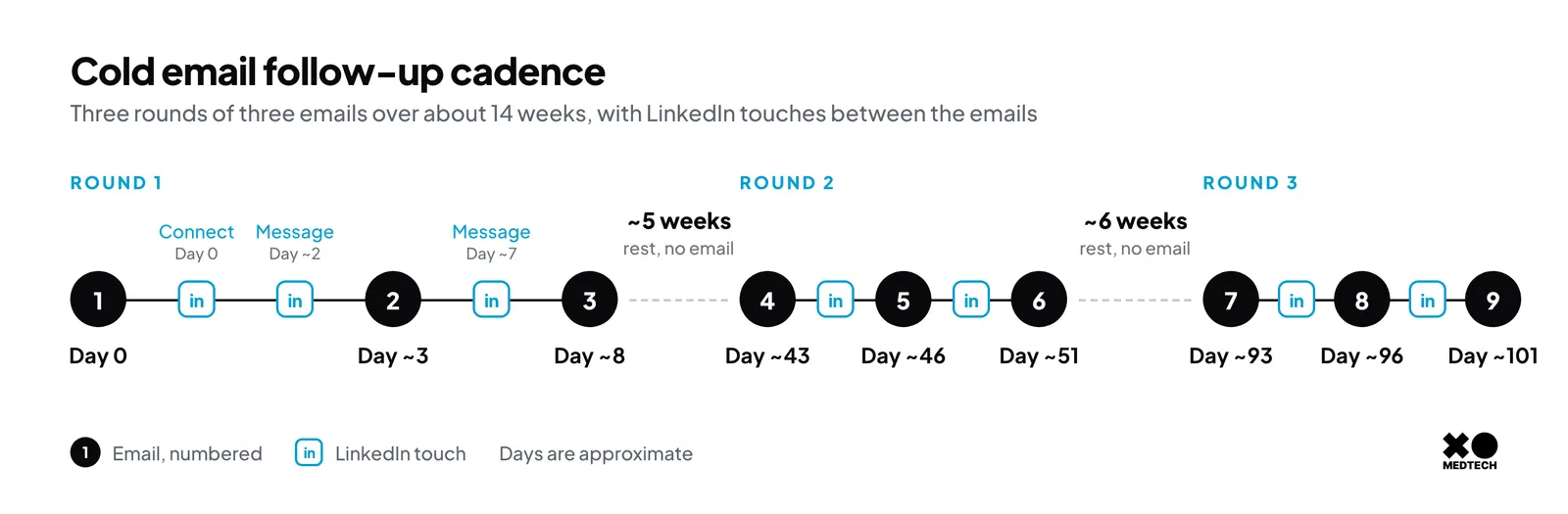
| Round | Touch | Day | Job of the touch |
|---|---|---|---|
| Round 1 | Email 1 | 0 | The 4-sentence email, built on a signal |
| Round 1 | 0 | A connection request, sent the same day as Email 1 | |
| Round 1 | ~2 | A short message | |
| Round 1 | Email 2 | ~3 | A new angle: a different pain, proof point or offer |
| Round 1 | ~7 | A short message | |
| Round 1 | Email 3 | ~8 | The easy out: a yes/no question or a referral ask |
| Rest | none | ~5 weeks | No email. Watch the account for a new signal |
| Round 2 | Emails 4 to 6 | ~43, ~46, ~51 | Three new emails on new information, same spacing, LinkedIn between them |
| Rest | none | ~6 weeks | No email |
| Round 3 | Emails 7 to 9 | ~93, ~96, ~101 | One more round of three, then stop |
Round 1 email timing (first follow-up about 3 days later, the second about 5 days after that) is from Spencer Jones, LinkedIn, Nov 12, 2026. Day counts for Rounds 2 and 3 assume each rest starts after the last email of the round before. In Round 1 the LinkedIn touches land on day 0, about day 2 and about day 7. Rounds 2 and 3 follow the same pattern.
The whole cadence runs about 14 weeks. Every email in it has to earn its place with something the prospect didn't know from the email before.
The rests matter as much as the emails. Five weeks is long enough that your name isn't fresh in the inbox, and long enough for something to change at the account: a clearance, a new hire, a quarter close. When it does, that change is the reason for Round 2.
Round 2 is also the time to widen the thread. Breton's system finds 3 to 5 decision makers per account (Nov 16, 2026). If the director of R&D went quiet in Round 1, Round 2 can go to the VP of Operations or the supply chain lead, with an email written for their job.
Every follow-up needs new information. "Bumping this" is a reminder that you exist. A new fact, a new proof point or a new question gives the prospect a fresh reason to answer. Keep follow-ups short. My article's rule is no "bumping this" and no super long follow-ups.
Email 2: the new angle
Email 2 lands about 3 days after Email 1. Reply in the same thread so the original sits underneath, then write two or three sentences that come at the problem from a different side.
If Email 1 was about scaling production, Email 2 can be about cost, lead time or a specific process. If Email 1 led with the 510(k), Email 2 can lead with something you know about their device category.
Subject: Re: {device} scale-up
One more thought on {device}: most {device category} teams underestimate how long process validation takes on the first commercial line. Happy to send the validation timeline we use, no call needed.
The offer to send something with "no call needed" is the small ask from my article.
Email 3: the easy out
Email 3 lands about 5 days after Email 2. Its job is to make replying easy, even if the answer is no.
Two ways to do that. Ask a yes/no question they can answer in one word. Or ask who the right person is. Breton's enterprise opener does the second one well: "{FIRST_NAME} - are you best to speak to for {SPECIALIZED TOPIC} at {COMPANY}? Or should I reach out to {RELEVANT TEAM MEMBER}?" (Nov 16, 2026).
Subject: Re: {device} scale-up
Is outsourced manufacturing for {device} on your plate this year, or should I ask {other name} on the ops side?
A referral reply is a good reply. It gives you a name and a warm opening line for the next email.
Do's and don'ts
This is the cheat sheet from my LinkedIn article on cold emails for medical device CDMO sales teams (Nov 12, 2026).
Do:
- Be conversational. Type like you talk, use shorthand.
- Personalize the subject lines in unique ways.
- Address obvious truths: "I'm realistic, you already have a partner for X."
- Frame value as personal impact. "Tell your board you can beat your development timeline" beats "Streamlined development process".
- Address their pain points: "New supplier integrations don't always go smoothly and I get that, but..."
- Send the first follow-up about 3 days later and the second about 5 days after that.
- Have a calendar link for scheduling in your signature or hyperlinked.
Don't:
- Start with your name, title and company in the first line. Get to the hook.
- Over-explain what your company does. The goal is a reply.
- Make it long. The target is at or below 4 sentences.
- Rely on [company name] personalization. You "might as well say 'sent from ChatGPT'".
- Make your ask huge. "Can I send you more info" beats "Can we meet for an hour?"
- Send "bumping this" or very long follow-ups.
- Play it safe every time. The point is to stand out, get opened and make them curious.
Tools for sending
You need three kinds of tools to run this, and they do different jobs.
A CRM with sequences. HubSpot, Salesforce, Attio and Pipedrive all let you enroll a contact in a sequence of timed emails. If your market is under Breton's 10,000-contact line, send from here. Your emails come from your real inbox, replies land in the CRM, and the account history stays in one place. Check which plan includes sequences: HubSpot lists them from Sales Hub Professional, Pipedrive from its Growth plan and Attio from its Pro plan (pricing pages checked Nov 19, 2026).
A dedicated cold email platform. These tools spread sends across several inboxes and domains, warm up new inboxes and handle spintax. They matter at volume, where deliverability is the main problem. If your market sits under Breton's 10,000-contact line, you may not need one, because every send there should be researched.
A research and drafting layer. This is where the list, the signals and the first draft come from: clearances, trials, funding, org charts, contact data, and an email built on top of them. Most teams do this step by hand in spreadsheets, and it's the step XO Medtech Campaigns does for you.
For a comparison of specific products in each category, see the best sales tools for medical device CDMO sales reps and the best sales intelligence platforms for medical device CDMOs. If you're weighing Zapyrus or LSI Compass against XO Medtech, our comparison of LSI Compass, Zapyrus and XO Medtech covers the differences.
Key takeaways
- A cold email to a medical device company should be about four sentences: hook, unique selling point, context on who you are, and a small ask.
- Relevance comes from the list first, the offer second and the wording third. Cut accounts that don't fit before you write.
- Open with a signal the prospect can verify: a 510(k), a trial, a raise, a new ops leader or a missing role. Leave recalls and warning letters out of the hook.
- Put three to five true details about the prospect in every email. In Breton's tests, AI-written first lines got 0.27% replies against 10% or more for a first-name-only email, so the details have to be real.
- Follow up in rounds of three (day 0, about day 3, about day 8) with LinkedIn touches between the emails, rest about 5 weeks, run Round 2, rest about 6 weeks, run Round 3. Every follow-up carries new information.
Related reading
Related articles
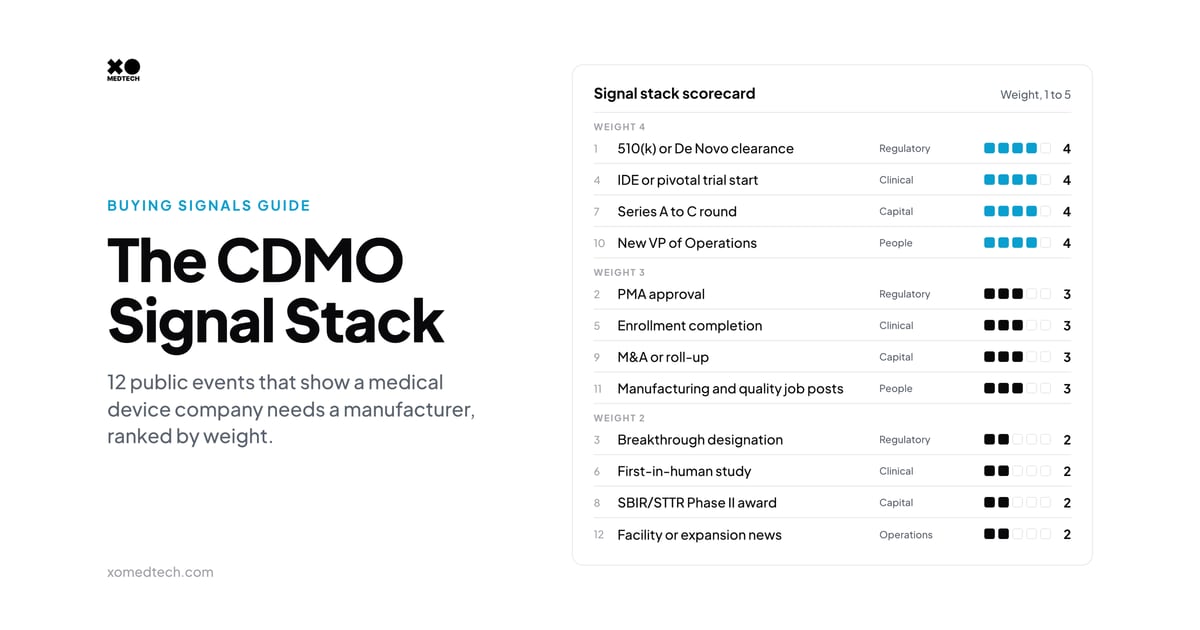
The CDMO Signal Stack: 12 Buying Signals That Show a Device Company Needs a Manufacturer
The 12 buying signals that tell a medical device CDMO a company needs a manufacturer, how long each window lasts, and how XO Medtech scores and uses them.
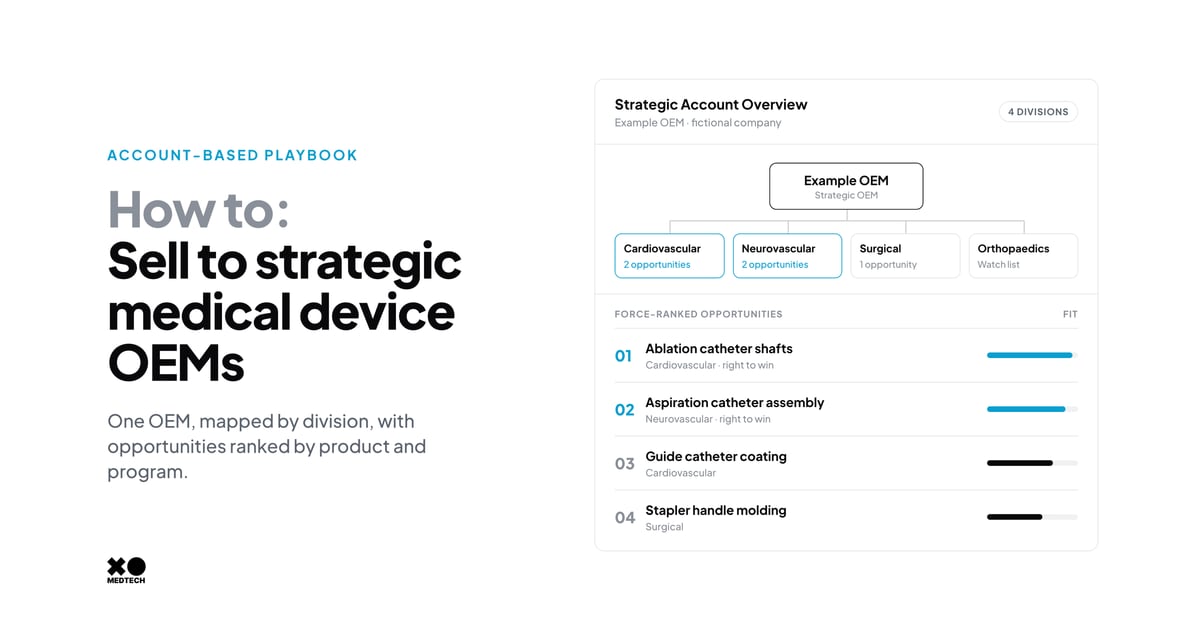
How to Sell to Strategic Medical Device OEMs: An Account-Based Playbook for CDMOs
How CDMOs win business at Medtronic, J&J MedTech and Stryker: map divisions and portfolios, read outsourcing signals, rank opportunities, pick who to target.
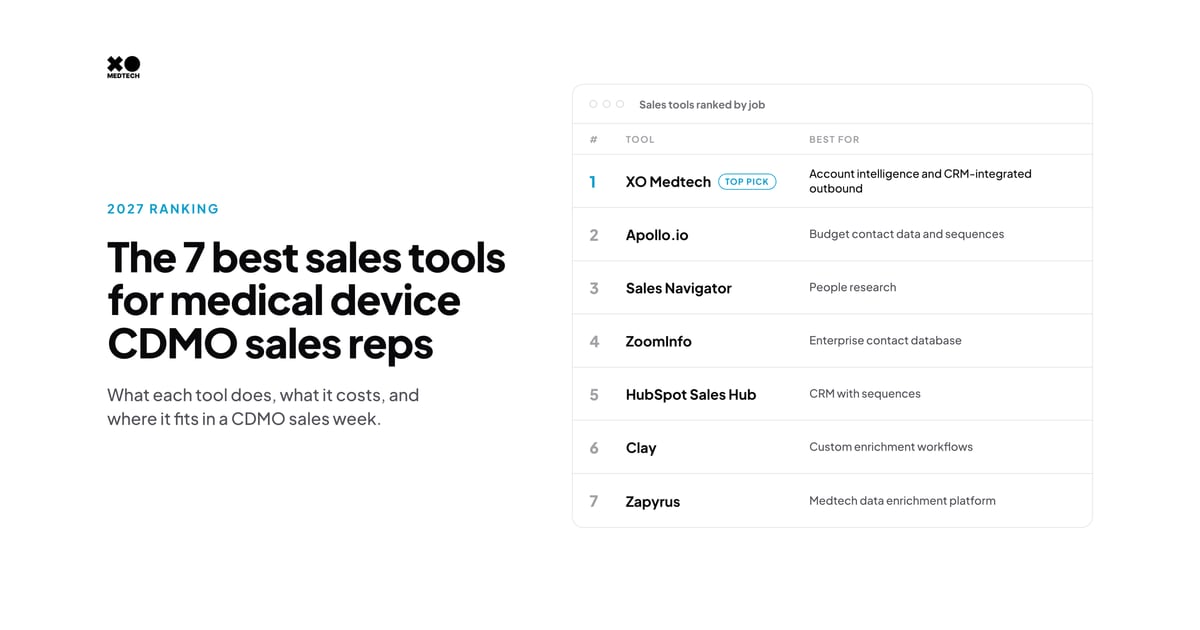
7 Best Sales Tools for Medical Device Manufacturer and CDMO Sales Reps in 2027
The 7 best sales tools for medical device CDMO and contract manufacturer sales reps in 2027: what each one does, what it costs, and where each fits.