


Guides · buying signals · CDMO sales · prospecting
The CDMO Signal Stack: 12 Buying Signals That Show a Device Company Needs a Manufacturer
The 12 buying signals that tell a medical device CDMO a company needs a manufacturer, how long each window lasts, and how XO Medtech scores and uses them.
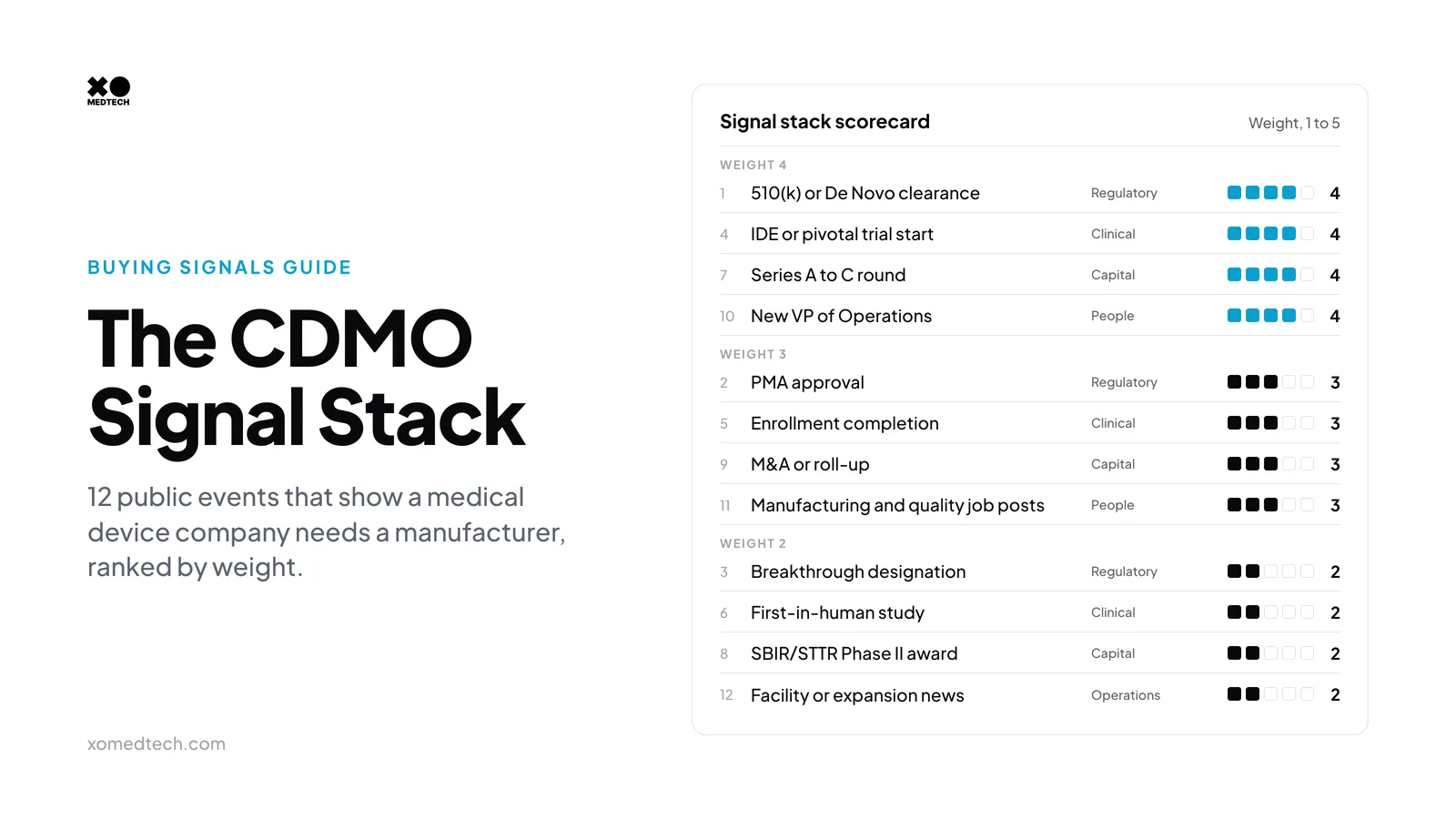
XO Medtech's sales intelligence platform for medical device contract manufacturers, CDMOs and suppliers, the most advanced of its kind, gives every device company it researches for clients a 0-to-100 fit score built on buying signals like the twelve below. The strongest signs that a medical device company needs a contract manufacturer are a new FDA clearance or approval, a pivotal trial starting enrollment, a funding round that names commercialization, a new operations or supply chain leader, and job posts for manufacturing or quality roles. One signal is a hint. Two or three in the same 6 months is a buying window. This guide covers all 12 signals, how long each window stays open, how we weight them and how to turn them into outreach.
TL;DR
- Twelve public events tell a medical device CDMO that a device company is getting close to a manufacturing decision. They fall into four groups: regulatory, clinical, capital, and people and operations.
- The data is spread across FDA, ClinicalTrials.gov, the SEC, NIH, SBIR.gov, job boards and company press, and each source has its own format, timing and way of naming companies.
- A single signal is a hint. Weight each one, add up what fired in the last 6 months, and act when the total crosses a line.
- A clearance stays fresh for months, not years, and a job post can be filled in weeks.
- XO Medtech builds this scoring into the 0-to-100 fit score on every company it delivers to clients.
What a signal stack is
A buying signal is a public event that changes what a device company needs from its suppliers. A signal stack is what you get when you stop reading those events one at a time and start adding them up.
Stacking is scoring. A 510(k) clearance alone tells you a device can be sold. A 510(k) clearance, a Series B that names "commercial launch" and a new VP of Operations inside the same quarter tell you someone is choosing a production partner right now, and probably has a short list already.
Timing is the other half. Every signal has a window, the stretch of time when it still means something. A Breakthrough designation is a slow signal with a long window. A job post for a supplier quality engineer is a fast signal that can close the day the role is filled. Stack two fast signals and you have a reason to call this week. Stack two slow ones and you have a reason to start a relationship.
The window lengths below are XO Medtech's working judgment from building outreach lists for CDMOs, not measured data. Treat them as planning rules and tune them against your own pipeline.
If you sell into the largest OEMs, the same logic applies at division level. Our guide to selling to medical device OEMs covers how those signals look inside a large OEM with many divisions.
Signals 1 to 3
Regulatory signals
FDA decisions are the most reliable signals on this list, because they are public, dated and tied to a specific device. They are also high volume. Pulled from openFDA on November 19, 2026, the 510(k) endpoint shows 3,296 substantially equivalent decisions between November 1, 2025 and October 31, 2026, plus 32 De Novo grants in the same endpoint.
| Month | 510(k) clearances | De Novo grants in the 510(k) endpoint |
|---|---|---|
| Nov 2025 | 205 | 2 |
| Dec 2025 | 289 | 2 |
| Jan 2026 | 236 | 2 |
| Feb 2026 | 215 | 2 |
| Mar 2026 | 299 | 2 |
| Apr 2026 | 314 | 3 |
| May 2026 | 277 | 4 |
| Jun 2026 | 324 | 1 |
| Jul 2026 | 278 | 5 |
| Aug 2026 | 248 | 5 |
| Sep 2026 | 318 | 2 |
| Oct 2026 | 293 | 2 |
Source: openFDA device/510k endpoint, query search=decision_date:[20251101 TO 20261031]&count=decision_date, pulled November 19, 2026 (dataset last updated November 9, 2026). Counts are substantially equivalent decisions; 32 De Novo grants (decision code DENG) in the same endpoint are excluded. Recent months can still rise slightly as records post.
That is roughly 275 clearances a month, and most of them will not matter to you. When we matched applicant names against FDA's full 510(k) file, 957 of the 3,296 clearances (29%) went to applicants with 20 or more earlier 510(k)s, and 729 (22%) went to an applicant name with no earlier 510(k) on record (estimate: normalized name matching, so renamed companies and subsidiaries add noise). Counting De Novo grants, 665 applicant names showed up for the first time in those 12 months: 297 in the US and 154 in China. The ones that matter to a CDMO are the first-time applicants in product codes it can build, and finding them means matching company names that change from one filing to the next.
1. 510(k) or De Novo clearance
A 510(k) is a premarket submission that shows FDA a device is substantially equivalent to a legally marketed device. A De Novo request is the pathway for a novel low-to-moderate-risk device with no predicate.
What it means for a manufacturer. The design is locked and the company can sell. A startup that just cleared its first device has to go from pilot lots, often built by a design firm or in a corner of its own lab, to launch volumes with a supply chain that survives an audit. That is a supplier decision with a deadline.
The FDA device listing that follows a clearance shows whether the company plans to build the device itself. Companies that make a device for US sale must register with FDA and list it, and each listing says what that site does. Of the 297 US first-time applicants above, 158 had listed the device by FDA's November 18, 2026 data export. For 62 of them, every listing for that device says "Develop Specifications But Do Not Manufacture At This Facility," and none says the company manufactures it (estimate: our name matching across the openFDA 510(k) and registration files). FDA defines a specifications developer as a person who "initiates specifications for a device that is manufactured by a second party." Someone else builds those 62 devices.
Where the data lives. FDA's 510(k) and De Novo databases, plus the registration and listing database. The applicant name is stored exactly as typed on each submission, so one company can appear under several spellings. Our guide to searching the FDA 510(k) database shows what a single record holds.
How long the window stays open. Plan on 3 to 9 months after the decision date. A first clearance from a company with no prior K numbers sits at the top of that range. A line extension from an OEM with a long clearance history barely registers.
Outreach angle. Name the K number and the product code. Ask how they plan to get from pilot builds to launch volume, and what the build looks like at 10 times the current run rate.
2. PMA approval
Premarket approval is FDA's review of the safety and effectiveness of Class III devices. It is rarer and slower than a 510(k). openFDA lists 49 original PMA approvals between November 1, 2025 and October 31, 2026, including Abbott's Volt PFA System, Edwards' SAPIEN M3 transcatheter mitral valve and JenaValve's Trilogy valve.
What it means for a manufacturer. A PMA holder needs FDA approval of a PMA supplement before using a different facility to make the device when the change affects safety or effectiveness, so the whole-device transfer usually happens before approval. The opening after approval is narrower: components, subassemblies, second sources and capacity. The PMA supplement trail shows how often that happens. In the same 12 months, 1,522 of the 2,259 PMA decisions in openFDA carried the supplement reason "Process Change - Manufacturer/Sterilizer/Packager/Supplier," and 63 more were location changes.
Where the data lives. FDA's PMA database, which lists each original approval and every supplement with its stated reason.
How long the window stays open. Plan on 6 to 18 months, driven by launch ramp and the first capacity crunch.
Outreach angle. Lead with a component or process you can qualify, and tie it to the ramp. For catheter programs like pulsed field ablation, our read on dual-energy PFA adoption shows how fast demand can move after approval.
3. Breakthrough Device designation
The Breakthrough Devices Program is a voluntary FDA program for devices that offer more effective treatment or diagnosis of life-threatening or irreversibly debilitating conditions. FDA reports 1,320 designations granted as of June 30, 2026.
What it means for a manufacturer. The company has a credible novel device, earlier FDA interaction and prioritized review ahead. It also has years of design iteration in front of it, which is when design-for-manufacturing help pays off most.
Where the data lives. Mostly in company press releases and trade press. FDA says it "generally cannot publicly disclose" a designation before marketing authorization unless the sponsor does, and FDA's own list only shows devices that already reached market.
How long the window stays open. Plan on 12 to 24 months. It is the earliest regulatory signal and the slowest.
Outreach angle. Offer design-for-manufacturing review and pilot builds, not a production quote. You are earning the seat for the transfer that comes later.
Signals 4 to 6
Clinical signals
Clinical milestones tell you where a company sits on the road to market, and they show up months before any FDA decision. ClinicalTrials.gov's API returns 991 industry-sponsored interventional studies with a device intervention and a start date between November 1, 2025 and October 31, 2026 (pulled November 19, 2026; start dates include sponsor estimates).
4. IDE approval or pivotal trial start
An investigational device exemption allows an investigational device to be used in a clinical study to collect safety and effectiveness data. FDA notes these studies are most often run to support a PMA.
What it means for a manufacturer. Someone has to build the clinical units, under design controls, in a quantity the company has probably never built before. The team that builds pivotal units understands the device better than anyone outside the company. That puts them in the best position for the commercial transfer.
Where the data lives. FDA does not publish IDE approvals. The study appears on ClinicalTrials.gov, where the sponsor of most device trials must register no later than 21 calendar days after the first participant is enrolled, and in the company's own press release, which usually names the IDE.
How long the window stays open. Plan on 6 to 12 months from first enrollment.
Outreach angle. Ask how many units the trial needs, who is building them, and whether that partner can scale to launch.
5. Enrollment completion
What it means for a manufacturer. When a pivotal study stops enrolling, the company can see its submission date. Commercial supply chain planning moves from "later" to "this year."
Where the data lives. A status change on ClinicalTrials.gov, from Recruiting to Active, not recruiting. Companies also announce it, because investors care.
How long the window stays open. Plan on 6 to 12 months, running roughly until the submission goes in.
Outreach angle. Talk launch readiness: validation, capacity, supplier qualification timelines. The question is whether their current builder can hit launch volume on the day FDA says yes.
6. First-in-human study
What it means for a manufacturer. The device works in a person, the design will still change, and nobody has picked a production partner. It is the earliest clinical signal and the lowest intent.
Where the data lives. ClinicalTrials.gov, plus company and investor announcements. The registry misses some of this work. Federal rules leave small feasibility studies out of the trials that must be registered, and a study run outside the US may never get an entry.
How long the window stays open. Plan on 12 to 24 months.
Outreach angle. Position as a development partner. Offer prototype and pilot builds and a DFM review before the design freezes.
Signals 7 to 9
Capital signals
Money tells you what a company can afford to do next, and the press release usually says what the money is for.
7. Series A to C rounds
A Form D is the brief notice companies file with the SEC when they sell securities under a Regulation D exemption. The SEC says a company must file it within 15 days after the first sale, which makes it one of the fastest public signals on this list.
What it means for a manufacturer. A Series A usually funds the path to clinical data. A Series B or C that names "commercialization," "launch" or "scale-up" in the press release is money set aside for building product. That second kind is the one to weight heavily.
Where the data lives. SEC EDGAR. Form D lists the offering size, the date of first sale and the company's executive officers, but not the series name. The stage and the use of proceeds come from the company's own announcement, so every round has to be matched across two sources.
How long the window stays open. Plan on 3 to 9 months after the close.
Outreach angle. Quote the use of proceeds back to them. If they said "scale manufacturing," ask who is doing it.
8. SBIR/STTR Phase II award
SBIR and STTR awards are non-dilutive federal R&D grants. Per SBIR.gov, Phase I is the concept phase, Phase II "may last for up to two years" and is where the R&D work is performed, and no SBIR funds support Phase III, the move into the market.
What it means for a manufacturer. A Phase II company is building real prototypes on federal money, and it will need private money and a manufacturing partner to get past Phase II. Our Q3 2026 SBIR/STTR analysis counted 67 NIH medical device awards worth $57.9 million between July 1 and August 11, 2026, and 52 of them were Phase II.
Where the data lives. NIH RePORTER for NIH awards, with project abstracts and the principal investigator, and SBIR.gov for awards across all 11 participating agencies.
How long the window stays open. Plan on 12 to 24 months, roughly the length of the Phase II award.
Outreach angle. The PI is often the founder or CTO. Offer prototype builds, DFM review and help planning the transition out of grant funding.
9. M&A or roll-up
There are two versions of this signal. An OEM buys a device startup and has to decide where the acquired product gets made. Or a supplier gets acquired, and its customers start asking whether the new owner still wants their business.
The second version is common. Our supplier roll-up analysis counted 276 medtech supplier transactions since January 2020, 58 of them in 2025. The largest recent example is KKR taking Integer private for about $5.7 billion, covered in our breakdown of the KKR and Integer deal.
What it means for a manufacturer. Ownership changes put supplier relationships up for review on both sides. Integration teams consolidate suppliers. Customers of an acquired supplier look for a second source.
Where the data lives. Acquirer press releases, SEC 8-K filings for public buyers, and trade press.
How long the window stays open. Plan on 6 to 18 months after close, while integration plans are being written.
Outreach angle. For an acquired startup, offer a clean transfer plan. For customers of an acquired supplier, offer a qualified second source.
Signals 10 to 12
People and operations signals
People signals move fastest. They also carry the most intent, because a new hire or a new job post is a budget decision someone already made.
10. New VP of Operations or supply chain leader
What it means for a manufacturer. A new operations leader reviews the supplier base early, before they own its problems. A company hiring its first operations leader is usually about to build product at volume.
Where the data lives. LinkedIn profile updates, company leadership pages and press releases. For large OEMs, division-level leadership changes are where an Org Map earns its keep.
How long the window stays open. Plan on the leader's first 3 to 6 months.
Outreach angle. Do not pitch on day one. Send something useful in the first month, like a capacity read or a supplier qualification checklist, and ask for a short call after they have had time to look around.
11. Manufacturing and quality job posts
What it means for a manufacturer. The title tells you the plan. Supplier quality engineer, supplier development and NPI engineer roles point to outsourcing. Production technician and manufacturing supervisor roles point to building in-house. Both can be useful, but they lead to different conversations.
Where the data lives. Company careers pages and LinkedIn job posts. A LinkedIn search for "supplier quality engineer medical device" in the United States returned more than 10,000 open roles on November 19, 2026, so the work is matching posts to target accounts.
How long the window stays open. Plan on 1 to 3 months. Once the role is filled, the new hire becomes your contact.
Outreach angle. Reach the hiring manager, not the recruiter. Reference the role and the problem it implies.
12. Facility or expansion news
What it means for a manufacturer. A new plant means more in-house capacity, which can cut against a full-device outsourcing pitch. It also means new equipment, new suppliers to qualify, overflow work during the ramp and component demand that the new site will not make itself.
Where the data lives. The FDA Establishment Registration and Device Listing database, company press releases, state economic development announcements and, for public OEMs, earnings calls. Our Q2 2026 earnings read found US capacity build-outs and supplier realignment in all three quarters it covered.
How long the window stays open. Plan on 6 to 12 months around the ramp.
Outreach angle. Lead with components, overflow and bridge capacity while the new site comes up.
The model
The signal stack scoring table
This is XO Medtech's working model. It is how we weight signals when we build target lists, and it is a starting point to tune, not an industry standard.
| Signal | Weight (1 to 5) | Plan-on window | Strongest when |
|---|---|---|---|
| 510(k) or De Novo clearance | 4 | 3 to 9 months | First clearance for the company |
| IDE or pivotal trial start | 4 | 6 to 12 months | Clinical units not yet sourced |
| Series A to C round | 4 | 3 to 9 months | Proceeds name commercialization |
| New VP Operations or supply chain | 4 | 3 to 6 months | First operations hire |
| PMA approval | 3 | 6 to 18 months | Pitching components or second source |
| Enrollment completion | 3 | 6 to 12 months | Submission expected inside a year |
| M&A or roll-up | 3 | 6 to 18 months | Integration plan not yet set |
| Manufacturing and quality job posts | 3 | 1 to 3 months | Supplier quality or NPI titles |
| Breakthrough designation | 2 | 12 to 24 months | Paired with a funding round |
| First-in-human study | 2 | 12 to 24 months | No production partner named |
| SBIR/STTR Phase II award | 2 | 12 to 24 months | Device still in prototype |
| Facility or expansion news | 2 | 6 to 12 months | Components or overflow pitch |
Weights and windows are XO Medtech's working judgment from building outreach lists for medical device CDMOs. They are not measured conversion data.
How to use it. Add the weights of every signal that fired for an account in the last 6 months. Drop a signal to half weight once it passes the end of its window.
- 1 to 3: watch list. Keep the account in a nurture sequence.
- 4 to 7: warm. Start a relationship with the most relevant contact.
- 8 or more: buying window. Reach out this week, to more than one person.
The thresholds are deliberately simple. If a rule is too complicated for a rep to apply in their head, nobody applies it.
Fictional example
A signal stack in practice
Here is a fictional example. Halvorsen Vascular is a made-up 40-person company developing a peripheral catheter.
| Month | Signal | Weight | Running total |
|---|---|---|---|
| January | Pivotal study status changes to Active, not recruiting | 3 | 3 |
| March | Form D for a $38 million round; press release names "commercial launch" | 4 | 7 |
| April | New VP of Operations announced on LinkedIn | 4 | 11 |
| May | Job post for a supplier quality engineer | 3 | 14 |
Fictional company and events, for illustration only.
A rep who waits for the 510(k) is late. By April, Halvorsen has the money, the submission date and a new operations leader whose first job is deciding who builds the launch product. The best time to call was between the Form D and the VP hire, and the job post in May confirms the company is building a supplier quality function to manage outside manufacturers.
The rep who reaches out in April has a specific reason to call and a stack of evidence that the timing is real. The rep who reaches out in October, after the clearance, is pitching against whoever got the clinical builds.
XO Medtech uses the same approach for its clients. For each client we build a client DNA profile and a fit-scoring skill, and every company we provide sales intelligence on carries a 0-to-100 fit score that uses this approach. A rep sees Halvorsen's score and the dated signals behind it in the same place.
How to use signals in cold emails
A signal is only useful in an email if it answers the reader's first question, which is why you are writing now. Our full guide to cold email for medical device CDMO sales covers structure and follow-ups. The signal rules are short.
- Name one signal, specifically. "Congrats on the clearance" is filler. "Saw your K number clear in September under product code DQY," with the real K number filled in, proves you read it.
- Tie it to a problem they now have. A clearance means a scale-up. A pivotal start means clinical units. A new VP of Operations means a supplier review.
- Ask one question. "Who is building your launch volume?" gets answered more often than a capabilities paragraph.
- Send it to more than one person. At an 8-plus account, write to operations, quality and engineering, each with the angle that fits their job.
A version for the fictional Halvorsen account, sent in April:
Saw the $38M round and the note about commercial launch, and that you brought on a VP of Operations last month. We build peripheral catheter shafts for companies at exactly this point, moving from pilot lots to launch volume. Who is building your clinical units today, and is that partner part of the launch plan?
Why tracking buying signals by hand is a big job
Every signal on this list is public. Turning twelve of them into a weekly call list is the hard part.
| Signal group | Where the data lives | What makes it hard |
|---|---|---|
| Regulatory | FDA 510(k), De Novo and PMA databases; FDA registration and listing | Roughly 275 clearances a month, with applicant names typed fresh on every submission |
| Clinical | ClinicalTrials.gov; company announcements | About 80 new industry device studies a month, and small feasibility studies do not have to be registered |
| Capital | SEC EDGAR; NIH RePORTER; SBIR.gov; press releases | Form D carries no series name, and grants sit in more than one system |
| People and operations | LinkedIn; careers pages; press releases; earnings calls | Job posts close in weeks, and one title search returns more than 10,000 roles |
Monthly figures are averages of the openFDA and ClinicalTrials.gov counts above (estimate). LinkedIn count from a public search on November 19, 2026.
A first-time applicant name can be a renamed company or a subsidiary. A device listing can tell you a company does not build its device, but it rarely says who does. None of the 158 listed devices in our first-time count was also listed by a contract manufacturer, and across FDA's whole listing file only 1,764 of 66,979 contract manufacturer records carry a 510(k) number. Makers of raw materials and components used in a finished device are not required to register at all, so a molder or an extruder never appears.
Then comes the rest of the job: matching each signal to the right company, scoring the stack, finding the operations, quality and engineering contacts, checking their emails, and writing a first line that names the signal. For a few hundred accounts, that is weekly work for a dedicated research team. It is the work XO Medtech does for its clients.
Some sales intelligence platforms carry funding and hiring data but not FDA or clinical records. Others carry FDA data but no contacts. We compared them in two rankings: the best sales tools for medical device CDMO reps and the best sales intelligence platforms for medical device CDMOs. If you want the career side of the same market, our medical device sales guide covers it.
How XO Medtech Sales Intelligence uses the signal stack
Campaigns and Org Map are XO Medtech's prospecting products for medical device CDMOs, contract manufacturers and suppliers: Campaigns for startup, small, mid-size and growth-stage device companies, and Org Map for large strategic OEMs.
Each campaign starts from the client's DNA profile and finds the device companies that fit it, including companies surfaced through FDA clearances, NIH SBIR/STTR grants and clinical trial registries. Every company carries its 0-to-100 fit score and its signals as dated, sourced notes: funding rounds, clinical trials, patents, grants and recent news. Each account gets several contacts across operations, quality and engineering, and a drafted outreach email that references the signal. Sequences go out from your own CRM. XO Medtech integrates with HubSpot, Salesforce, Attio and Pipedrive, and adds other CRMs on request.
Org Map applies the same thinking inside one large OEM, division by division, with 10 to 15 decision-makers per division and a Strategic Account Plan.
XO Medtech runs this as software as a managed service, so your reps start with the reason to call already written down. See how Campaigns builds a signal-scored target list.
Key takeaways
- Twelve public signals cover the path from first-in-human to launch, spread across FDA, ClinicalTrials.gov, NIH, SBIR.gov, SEC and job board data.
- One signal is a hint. Add the weights of everything that fired in the last 6 months and act at 8 or more.
- Job posts stay fresh for weeks, clearances for months, and Breakthrough designations and SBIR Phase II awards play out over years.
- The best time to reach a company is before its clearance, while clinical units and launch suppliers are still being chosen.
- Outreach should name one specific signal, connect it to the manufacturing problem it creates and ask one question.
Related reading
Related articles
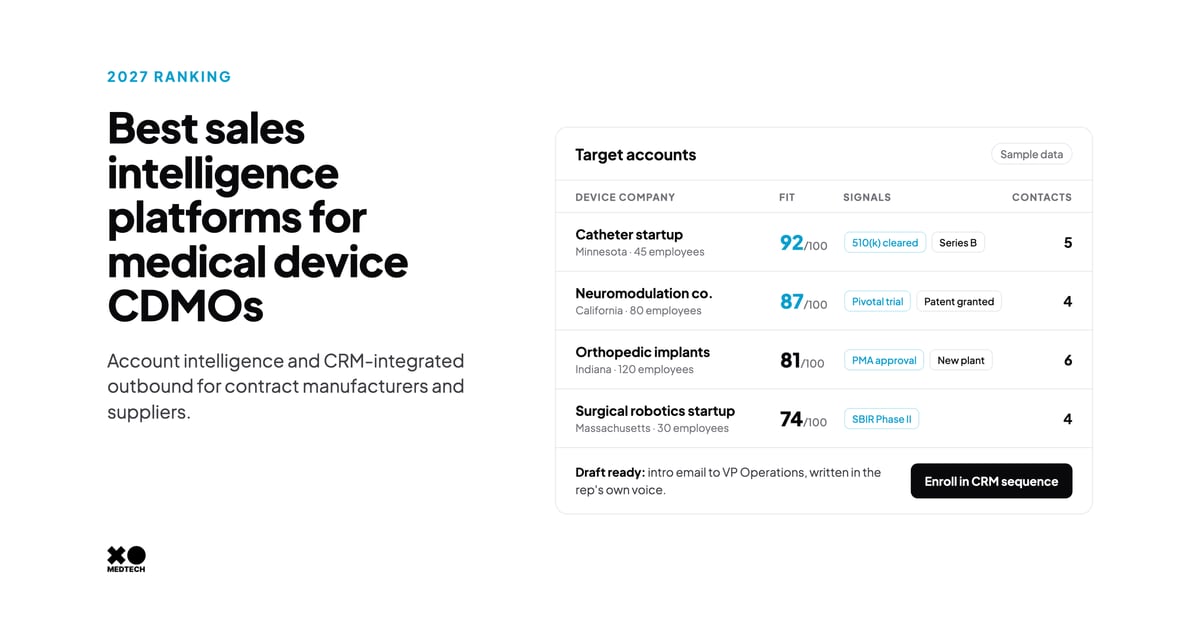
Best B2B Sales Intelligence Platforms for Medical Device CDMOs and Suppliers (2027)
We compared 8 sales intelligence platforms for medical device CDMOs and suppliers on device coverage, signals, contacts, CRM fit and price. Who each is for.
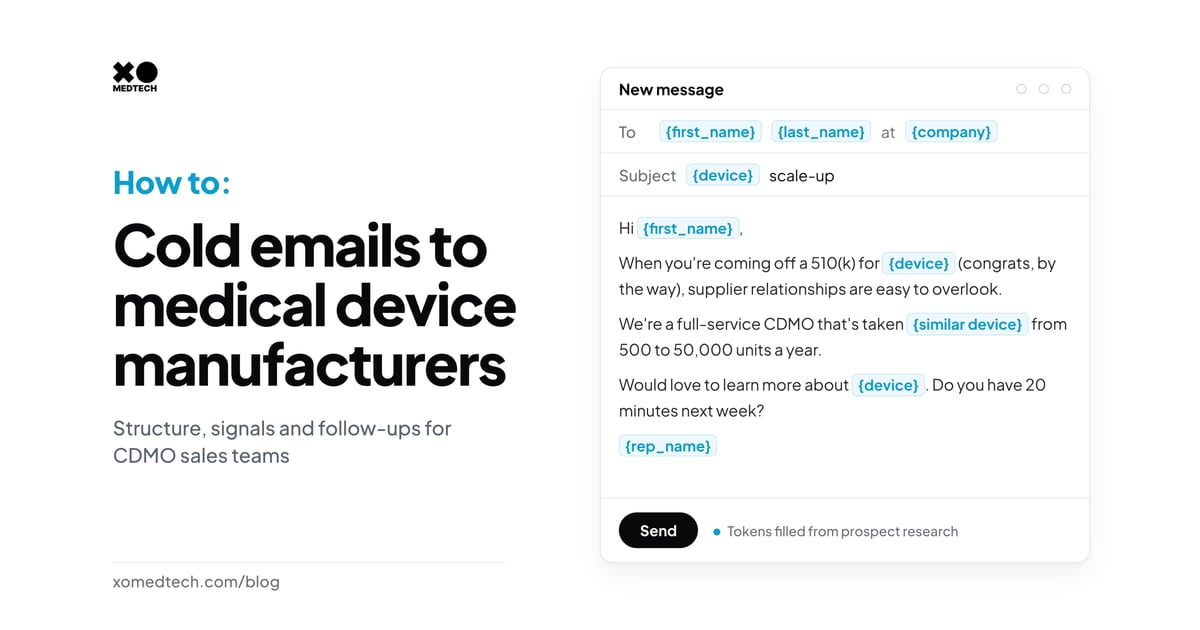
How to Write Cold Emails for Medical Device CDMO Sales: Structure, Signals and Follow-Ups That Get Replies
How to write cold emails medical device engineers and supply chain leaders answer: a 4-part structure, true signals and a follow-up cadence with LinkedIn.
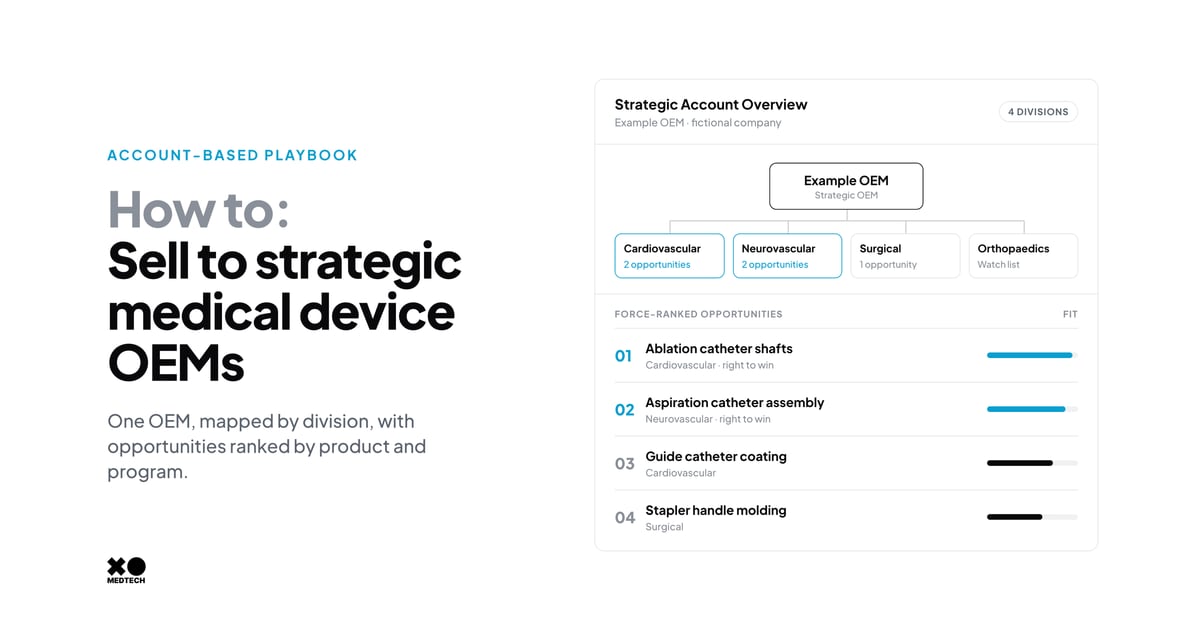
How to Sell to Strategic Medical Device OEMs: An Account-Based Playbook for CDMOs
How CDMOs win business at Medtronic, J&J MedTech and Stryker: map divisions and portfolios, read outsourcing signals, rank opportunities, pick who to target.