Analysis · Medtech M&A · CDMO
KKR's $5.7B blockbuster acquisition of Integer: the largest CDMO take-private deal ever
KKR is acquiring Integer for $5.7B, the largest public take-private of a medtech CDMO on record. The deal, both companies, and what private equity does next.
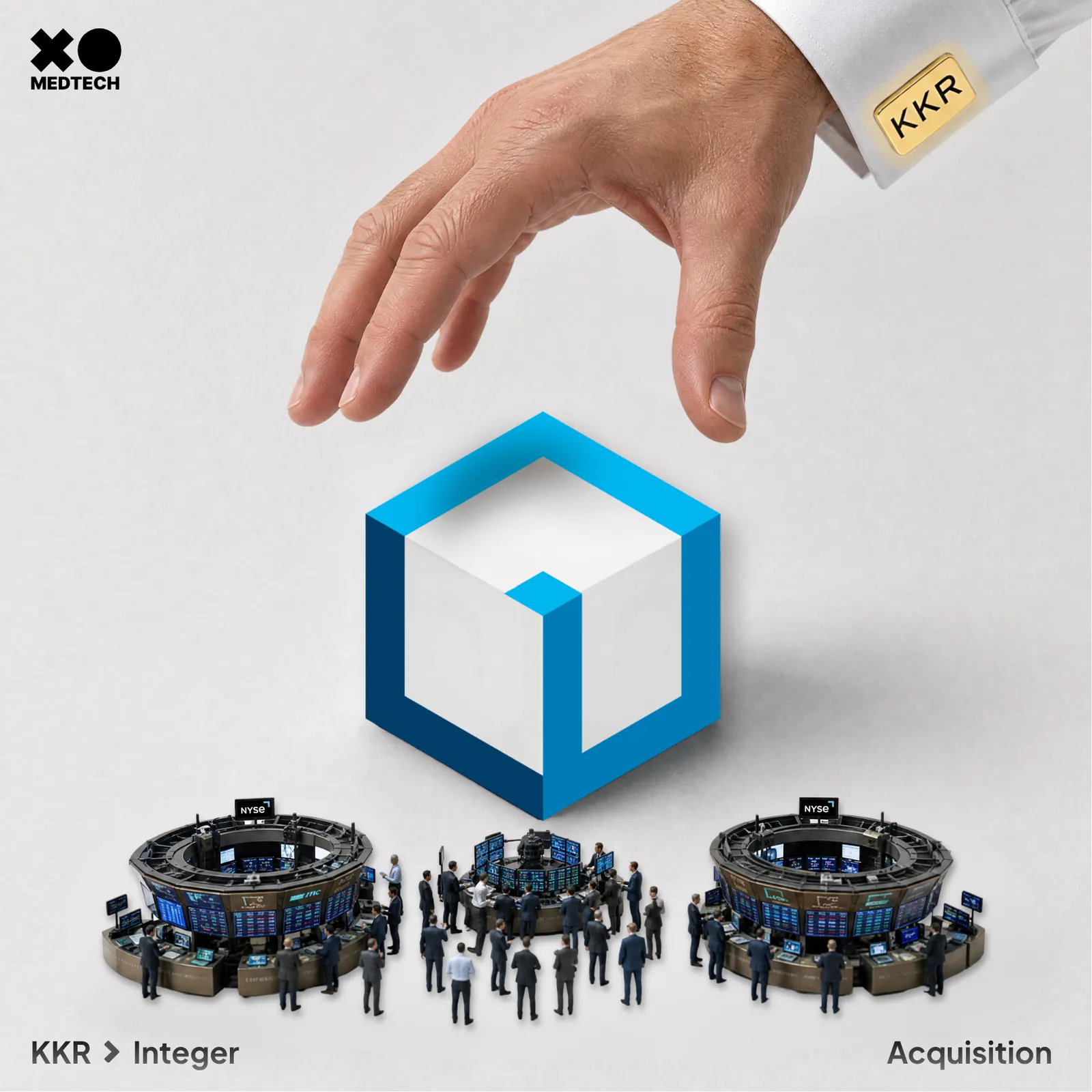
KKR is taking Integer Holdings private for about $5.7 billion. It is the largest take-private of a publicly traded medical device CDMO on record, and the gap to second place is not close.
The whole deal in six lines, before the detail:
- $5.7 billion enterprise value. All cash. Announced August 3, 2026.
- $127.00 per share. A 51.8% premium to where Integer traded the day before it put itself in play.
- Roughly $4.3 billion of equity plus Integer's assumed debt gets you to the $5.7 billion.
- Closing by year end, subject to a stockholder vote and regulators. Then Integer leaves the NYSE.
- 11,000 associates and a global manufacturing footprint move under one financial owner.
- The buyer is not a tourist. KKR had stood up a separate medtech manufacturing platform, Allyntra, weeks earlier.
Here is the scale, in one picture. Integer is the largest reported medtech CDMO deal by a wide margin, and the only completed public take-private among them.
| Deal | Year | ~Value | Structure |
|---|---|---|---|
| Integer / KKR | 2026 | $5.7B | Completed public take-private |
| Viant | 2024 | ~$3.0B | Indicative sale process, did not close |
| Resonetics | 2021 | ~$2.25B | Minority recapitalization (valuation) |
| Teleflex Medical OEM | 2025 (announced) | $1.5B | Corporate carve-out, closed 2026 |
These are not directly comparable. Integer is a completed public take-private. Viant's ~$3B was an indicative 2024 sale process that did not close at that figure. Resonetics' ~$2.25B was a minority recapitalization valuation. The Teleflex OEM unit was a $1.5B corporate carve-out (announced 2025, closed 2026). Integer stands alone as a completed public take-private, and the largest figure by a wide margin.
The deal
What KKR is actually buying
Integer Holdings (NYSE: ITGR) is one of the largest medical device contract development and manufacturing organizations in the world. It builds cardiovascular, neuromodulation, and cardiac rhythm management devices for the OEMs whose names end up on the box. In FY2025 it did $1.854 billion in revenue, up 8%, and $402.3 million in adjusted EBITDA, up 11.6%. That puts the headline price at roughly 14 times last year's adjusted EBITDA.
The mechanics are clean. This is an all-cash offer from an affiliate of funds managed by KKR, investing through its core private equity strategy, financed with a mix of KKR equity and committed debt. There is no financing contingency. Integer's board approved it unanimously and is recommending stockholders vote yes. The deal followed a formal strategic review that Integer announced on April 30, which functioned as a public market check before signing.
The premium is measured against Integer's April 29 close, the day before the strategic review went public. Against the most recent close, the premium was only about 5%, because the stock had already run up on takeover speculation. The honest number is the pre-review one: 51.8%.
Deal terms per the KKR/Integer announcement (GlobeNewswire, Aug 3, 2026) and Integer's FY2025 results. The ~14x EBITDA multiple is computed from the $5.7B enterprise value and $402.3M FY2025 adjusted EBITDA. Equity value of ~$4.3B per WSJ; the balance to $5.7B is assumed net debt.
No listed medtech contract manufacturer has ever been taken private at this size. The nearest comparables were different in structure, and none was a completed public take-private.
How rare is this, really
Private equity buying medtech is not new. Buying a public medtech CDMO of this size is. Over the prior year the sector saw a run of sponsor-led deals: Blackstone and TPG took Hologic private for $18.3 billion, American Industrial Partners took Avanos private for $1.27 billion, and Montagu and Kohlberg carved Teleflex's Medical OEM unit out for $1.5 billion. But Hologic and Avanos are device makers, not contract manufacturers. The pure-CDMO deals that came before Integer were smaller, and most were private-to-private, one sponsor selling to another.
| Target | Year | ~Value | Buyer / structure |
|---|---|---|---|
| Integer Holdingspublic CDMO | ~$5.7B | 2026 | KKR, completed public take-private |
| Viant Medicalindicative sale process | ~$3B | 2024 | Water Street + JLL explored an exit; did not close at this figure |
| Resoneticsminority recapitalization | ~$2.25B | 2021 | Carlyle joins GTCR; a valuation, not a full buyout |
| Teleflex Medical OEMcorporate carve-out | $1.5B | 2025 | Montagu + Kohlberg; announced 2025, closed 2026 |
| Vention Advanced Technologiescarve-out | $705M | 2017 | Nordson, strategic buyer |
Years are announcement years unless noted. Viant's ~$3B was an indicative 2024 sale process that did not complete; Resonetics' ~$2.25B was a minority recapitalization valuation, not a full acquisition. Integer is the only completed public take-private of a pure medtech contract manufacturer in this group.
For scale on the buyer side, Reuters put the Integer deal among KKR's biggest healthcare bets since its $9.9 billion take-private of Envision Healthcare in 2018. This is a serious check, not a bolt-on.
The players
Now meet the two groups
One is a 50-year-old buyout firm that helped invent the leveraged buyout. The other is the company Wilson Greatbatch built out of the pacemaker battery. They could not have more different origin stories. Here is each one, fast.
KKR, in one screen
KKR is a $796 billion global investment firm, founded in 1976 by Jerome Kohlberg and cousins Henry Kravis and George Roberts, three Bear Stearns bankers who left to do buyouts full time. It went public on the NYSE in 2010 and now runs money across private equity, credit, infrastructure, real estate, and insurance. It also runs a dedicated Health Care Strategic Growth strategy, though the Integer deal is being made through KKR's core private-equity strategy, a separate pool of capital.
The firm's history is a tour through the biggest deals of each era. A punch list:
- Practically invented the modern LBO. The founders were doing "bootstrap" buyouts at Bear Stearns before they left.
- RJR Nabisco. The 1989 deal was the largest buyout in history and stayed that way for 17 years.
- It has been in devices before. KKR was part of the consortium that bought orthopedics maker Biomet in 2007 for about $11.3 billion.
- It does big healthcare take-privates. Envision Healthcare, $9.9 billion, 2018.
- It is leaning into medtech manufacturing right now. More on that below.
| Year | Milestone | Value |
|---|---|---|
| 1976 | Founded as Kohlberg Kravis Roberts, ~$120K starting capital | |
| 1989 | RJR Nabisco LBO, the largest ever at the time | $25B |
| 2007 | Part of the consortium that buys Biomet, orthopedic devices | $11.3B |
| 2010 | Goes public on the NYSE | |
| 2018 | Takes Envision Healthcare private | $9.9B |
| 2023 | Invests in Precipart, a precision medtech components maker | |
| 2026 | Launches Allyntra (Jul), then agrees to buy Integer (Aug) | $5.7B |
Note the last line. On July 9, 2026, about three and a half weeks before the Integer announcement, KKR launched Allyntra, a precision-engineered solutions platform for medtech built on its 2023 investment in Precipart, and staffed it with veterans from MMT and Cirtec. Ali Satvat, KKR's global head of healthcare strategic growth, runs that effort. But the two sit in different buckets: Allyntra was established through KKR's Health Care Strategic Growth strategy, while Integer is being acquired through the core private-equity strategy. Both reflect a broader KKR interest in medtech manufacturing. KKR has not said the two businesses will be combined, and they are separate strategies with different capital pools and return profiles. Read it as conviction in the category, not a declared roll-up.
Integer: the pacemaker company that never stopped buying
Integer's story starts on a lab bench in Buffalo. A punch list first:
- 1958. Wilson Greatbatch demonstrates his implantable pacemaker design in an animal. The Chardack-Greatbatch device is implanted in a human in 1960, two years after the first human implant of an Elmqvist-designed pacemaker in Sweden.
- 1970. He founds the company, later Wilson Greatbatch Ltd., to make the lithium battery that powers the device.
- 2000. IPO on the NYSE under ticker GB, at $16 per share, raising around $80 million. Prior owner: DLJ Merchant Banking.
- 2016. After the transformational Lake Region Medical deal, Greatbatch renames itself Integer Holdings and moves to ticker ITGR.
- Today. Headquartered in Plano, Texas, with roughly 33 facilities: 21 in the US and 12 across eight other countries. $1.854 billion in revenue. 11,000 associates. One of the largest device CDMOs on the planet.
That scale is spread across a real global footprint. The US map, plus the countries KKR now owns manufacturing in.
| US state | Integer presence |
|---|---|
| NY | Manufacturing |
| MN | Manufacturing |
| TX | HQ |
| FL | Manufacturing |
| PA | Manufacturing |
| VA | Manufacturing |
| GA | Manufacturing |
Per Integer's 2025 annual filing: 33 facilities total, 21 in the US and 12 across eight countries. Markers show Integer's principal disclosed US states; the US total includes additional sites not individually mapped.
But the punch list hides the real story, which is that Integer is a roll-up. It grew from a battery maker into a full-line device CDMO by buying capability, year after year, for two decades. The company history and the acquisition history are almost two different timelines, so here they are separately.
| Year | Milestone | |
|---|---|---|
| 1958 | Greatbatch demonstrates his implantable pacemaker design in an animal; human implant follows in 1960 | |
| 1970 | Wilson Greatbatch Ltd. founded around the lithium pacemaker battery | |
| 2000 | IPO on the NYSE as ticker GB | $16/share |
| 2005 | Renamed Greatbatch, Inc. | |
| 2015 | Acquires Lake Region Medical, triggering the Integer rebrand | $1.73B |
| 2016 | Spins off Nuvectra; renames itself Integer Holdings, ticker ITGR | |
| 2024 | Divests non-medical Electrochem to Ultralife, going pure-medical | $50M |
| 2026 | Agrees to be taken private by KKR | $5.7B |
The acquisitions are where the CDMO was actually built. Here is a selection of them. Each circle is a deal, sized by value. Watch them get bigger over time.
| Year | Target | ~Value | What it added |
|---|---|---|---|
| 2004 | NanoGram Devices | $45M | Nano-enhanced implantable batteries |
| 2007 | Enpath Medical | ~$102M | Introducers and lead delivery systems |
| 2007 | Quan Emerteq | $55M | Single-use device contract manufacturing |
| 2008 | Precimed | ~$125M | Entry into orthopedics |
| 2011 | Micro Power Electronics | $60M | Custom battery packs, portable-medical power |
| 2012 | NeuroNexus | n/d | Neural-interface electrodes |
| 2015 | Lake Region Medical | ~$1.73B | Catheters, guidewires, vascular; triggered the Integer rebrand |
| 2021 | Oscor | $220M | Structural heart, steerable sheaths, EP |
| 2022 | Aran / Connemara | ~€120M | Implantable textiles and biomaterials |
| 2023 | InNeuroCo | ~$44.5M | Complex neurovascular catheters (Oct 2023) |
| 2024 | Pulse Technologies | ~$140M | Complex micro-machining (closed Jan 2024) |
| 2025 | Precision Coating | ~$152M | Proprietary device coatings |
| 2025 | VSi Parylene | ~$28M | Parylene conformal coating |
| 2025 | Biocoat | ~$15M | Hydrophilic coatings (Dec 2025) |
A selection, not a complete list. Circle area is proportional to disclosed deal value. Lake Region Medical (2015) is the one that changed the company's name. n/d means the value was not disclosed.
The pattern is the important part. Integer did not build a coatings capability or a micro-machining capability from scratch. It bought Precision Coating, VSi Parylene, and Pulse Technologies and bolted them on. That is the exact muscle a private equity owner wants to see, because it is the muscle a private equity owner intends to use.
The pharma CDMO world already ran this movie. Take it private, bolt on capability, move up the value chain, sell to a strategic for a multiple of what you paid.
What happens after a CDMO goes private
Integer is the biggest medtech CDMO take-private, so there is no perfect medtech comp for what comes next. But there is a near-perfect one next door, in pharma, where CDMOs are bigger and the cycles have fully played out. The playbook is well documented, and it is worth knowing what it looks like before you assume KKR will simply hold and coast.
Start with Catalent, the cleanest full arc in the business. Blackstone carved it out of Cardinal Health in 2007 for about $3.3 billion. It sat private, then went public in 2014, then ran a string of acquisitions up the value chain: Cook Pharmica for $950 million in biologics, Paragon Bioservices for $1.2 billion in gene therapy, MaSTherCell in cell therapy. In December 2024, Novo Holdings bought the whole thing for roughly $16.5 billion. That is a fivefold rise in enterprise value from the carve-out, though Blackstone had fully exited its ownership by 2016, well before the Novo sale.
| Milestone | Year | ~Enterprise value | Note |
|---|---|---|---|
| Blackstone carves out of Cardinal Health | 2007 | $3.3B | Becomes Catalent |
| IPO on the NYSE | 2014 | ~$4.3B | Market cap ~$2.4B plus ~$1.9B net debt |
| Novo Holdings acquires | 2024 | $16.5B | ~5x the 2007 entry EV |
Approximate enterprise value at each milestone. The 2014 point is EV at IPO (market cap ~$2.4B plus ~$1.9B net debt). Enterprise value rose roughly fivefold from carve-out to the 2024 Novo sale, but Blackstone had exited by 2016 and did not capture that full arc.
Patheon is the same shape, faster. JLL Partners took it private and merged it with DSM's pharma unit in 2013, added biologics through Gallus, took it public again in 2016 for a reported 3.5x return, and then sold it to Thermo Fisher in 2017 for about $7.2 billion. Cambrex is the deal in flight: Permira took it private for $2.4 billion in 2019 at a 47% premium, kept bolting on formulation and testing businesses, and by 2025 was reportedly running a sale process targeting around $4 billion.
The through-line across all three is a specific set of moves.
Bolt on capability, fast
The private window is for buying the pieces that are hard to build. Catalent bought its way from softgels into gene therapy in under a decade. Integer has already shown it acquires coatings, micro-machining, and biomaterials rather than building them.
Move up the value chain
Sponsors push CDMOs toward higher-margin, stickier work: biologics and cell therapy in pharma, complex catheters and active implantables in devices. Higher complexity means higher switching costs and better multiples at exit.
Invest through the private years
Out of the quarterly spotlight, the owner can spend on capacity, automation, and integration without defending the margin hit to public investors. KKR is explicitly promising capital for capacity, technology, and talent.
Sell to a strategic, or re-list
The exit is usually a strategic buyer paying up for a scaled, full-service platform, or a return to the public markets at a re-rated multiple. Thermo Fisher bought Patheon. Novo bought Catalent. Someone will want a bigger Integer.
Did it work for the owners? On the evidence, yes. JLL reportedly made about 3.5x on Patheon before the strategic premium on top, and Permira is sitting on a reported double on Cambrex. Catalent's enterprise value rose roughly fivefold from the 2007 carve-out to the 2024 Novo sale, though Blackstone exited by 2016 and did not capture that full arc. These are not cautionary tales. They are the reason KKR is writing this check.
The XO take
What this means for the rest of the field
The single largest medtech CDMO just left the public markets, and it did so weeks after KKR stood up a separate medtech manufacturing platform through a different fund. Whether or not those businesses ever connect, the signal is the same: KKR is not making a passive bet on medtech manufacturing.
That does two things to the market. First, it takes the biggest independent, publicly accountable CDMO and turns it into a private acquirer with a mandate to consolidate. The company that spent 20 years buying Oscor, Aran, Pulse, and Precision Coating is now backed by a firm that does this for a living, with a balance sheet that dwarfs anything Integer could reach as a public company. Expect the bolt-on pace to go up, not down.
Second, it puts every mid-market supplier on a clock. If you are a $20 million to $100 million contract manufacturer with a real, differentiated capability, you are now a target for a better-funded, more motivated buyer. The pharma CDMO cycle tells you which capabilities get bought first: the ones that are hard to build and that move the customer up the value chain. Here is my best guess at what Integer hunts next, steering clear of what it just bought (coatings, micro-machining, textiles).
Deeper nitinol and shape-memory scale
Integer already runs real nitinol capability, from heat-setting and wire forming to tube drawing, braiding, and electropolishing. What it lacks is a standalone, vertically integrated nitinol platform at the scale of a specialized nitinol CDMO, in a segment consolidating fast (Quasar bought a dedicated nitinol center in 2026). Buying that scale is the play.
Drug-device combination and drug delivery
Combination products carry higher regulatory value and far higher switching costs. Integer builds the device and the electronics; adding drug-coating and drug-delivery capability moves it into the stickiest, best-reimbursed corner of the market.
Active-implant electronics and sensing
Integer already owns the power, feedthrough, and CRM heritage. The step up is full miniaturized electronics, sensors, and connectivity for smart implants, the capability OEMs increasingly want a single partner to own end to end.
The biggest CDMO take-private ever is not really about Integer. It is a signal about where the whole outsourced medtech supply base is heading. Private, consolidated, and moving fast.