AI · Claude for Manufacturing · CDMO · Medtech Manufacturing
Claude for Manufacturing: How Medical Device CDMOs and Contract Manufacturers Can Use It
How medical device contract manufacturers, CDMOs and suppliers can use Anthropic's new Claude for Manufacturing: draft quotes and NCRs, with human review.
Short answer
Claude for Manufacturing is a plugin from Anthropic that bundles 17 skills for quoting, quality, production reporting, maintenance, supplier sourcing and design. It has four main connectors: Microsoft 365, Oracle NetSuite or Infor M3 (you run one ERP, so that's the "or"), and Autodesk Fusion. Anything else, like your QMS or maintenance system, can feed it through file exports. Anthropic announced it on November 12, 2026.
It is built to draft, not to decide. Every skill ends with a person reviewing the output, and Anthropic says the plugin does not operate equipment. Claude does the first pass. Your expert makes the call.
Now the catch, because it matters if you make medical devices: this is a general manufacturing tool, not a medtech one. I read through the plugin files and found references to ISO 9001, AS9100 and IATF 16949, and no mention of ISO 13485 or FDA's Quality Management System Regulation (QMSR). That doesn't rule it out. It means your quality team has to bring its own controlled templates, validate the software for its intended use, and keep every output under human review.
If you're a contract manufacturer or CDMO and you haven't hopped on the Claude train yet, consider this your bright red flashing sign. The rest of this post is what's in it, how it connects, two workflows worth a look, and what to check before you let it near a quality system.
What is Claude for Manufacturing?
Claude for Manufacturing is a plugin for Claude, Anthropic's AI assistant. A plugin packages instructions, called skills, that tell Claude how to do a specific job. Anthropic describes the plugin as skills "for work from pricing a new job to diagnosing a stopped machine," running on a manufacturer's own records through connectors. Think of a skill as a written playbook for one job, like pricing a new part or writing up a nonconformance.
Three points from Anthropic's launch materials matter most.
- It starts from your records. The skills read from your ERP, drawings, procedures and exports instead of asking you to build a new data platform first.
- Skills chain together. Some skills do one task. Others run several in order, such as turning an inspection failure into an NCR and then an 8D, and they stop where a person needs to look.
- People stay in control. Anthropic's Enterprise GTM leader Lauren Collett told Manufacturing Dive that "a person is signing off on every draft," and that Claude is doing "that first pass."
Anthropic's pitch, in Collett's words, is "things like getting more quotes out, making harder pricing decisions, stopping repeat defects [and] getting machines running sooner." I'd boil that down to more quotes out the door and less time lost to the internal toil of gathering information. Anthropic also cites a 2025 Manufacturing Leadership Council survey in which 79% of manufacturers said they enter data manually. The plugin's job is to do the gathering so your estimator can focus on the price and your quality engineer on the fix.
I talk to a lot of CDMO leaders, and I can't tell you how many of them want help with exactly these problems.
The plugin's code is public in Anthropic's `claude-plugins-official` repository on GitHub under an Apache-2.0 license. The README labels it a "reference implementation" that is not actively maintained and not accepting contributions. In practice, that means plants are expected to adapt it, not just install it. More on that below, because it's the part I'm most excited about.
What skills are in Claude for Manufacturing?
The plugin has 17 skills: 12 that do one job and 5 chains that run several in order. Anthropic describes them as covering sales, quality, operations, supply chain, design and setup. I grouped them by the workflow they serve, which comes out as six areas of work (quoting, quality, production reporting, maintenance, supplier sourcing and design) plus two setup skills. Descriptions are condensed from the skill files in Anthropic's repository.
Quality: NCR, CAPA and 8D
| Skill | What it does |
|---|---|
| `ncr-writeup` | Writes the nonconformance report. Cites the specific requirement violated, sizes the suspect scope, locates parts across locations, and searches prior NCRs and CAPAs to say whether the last fix held. Drafts a customer escape notification when parts are at a customer. |
| `root-cause-capa` | Puts sensor, inspection, maintenance and ticket data on one verified timeline, runs pattern checks in code (SPC drift, clustering by lot, shift, operator, machine, tool change), and proposes ranked candidate causes with evidence for and against. Drafts the 8D. |
| `inspection-to-capa` (chain) | Runs `ncr-writeup` then `root-cause-capa`, and produces the customer pack behind a redaction diff. |
RFQ and quoting
| Skill | What it does |
|---|---|
| `customer-inquiry-intake` | Reads an RFQ in any shape (PDF drawings, spreadsheet, portal export, photo of a marked-up print, long email thread) into one intake form where every field traces to a file and page. Checks what the plant can build, drafts questions back, and gives a provisional bid or no-bid. |
| `quote-build` | Builds a make-to-order quote with every number traced. Material at the price paid on a named purchase order, machine hours per operation with a labelled basis, setup re-amortized at each quantity break, and margin on its own line. |
| `rfq-to-quote` (chain) | Runs intake, data consolidation, an estimating model in Fusion where connected, and the quote. Four approval gates. |
Production reporting
| Skill | What it does |
|---|---|
| `data-consolidate` | Joins exports and connector data into one dataset on part number, work order, sales order, lot, asset and supplier. Sorts every key that fails to match into one of eight mismatch classes and proposes a fix. Applies nothing without a yes. |
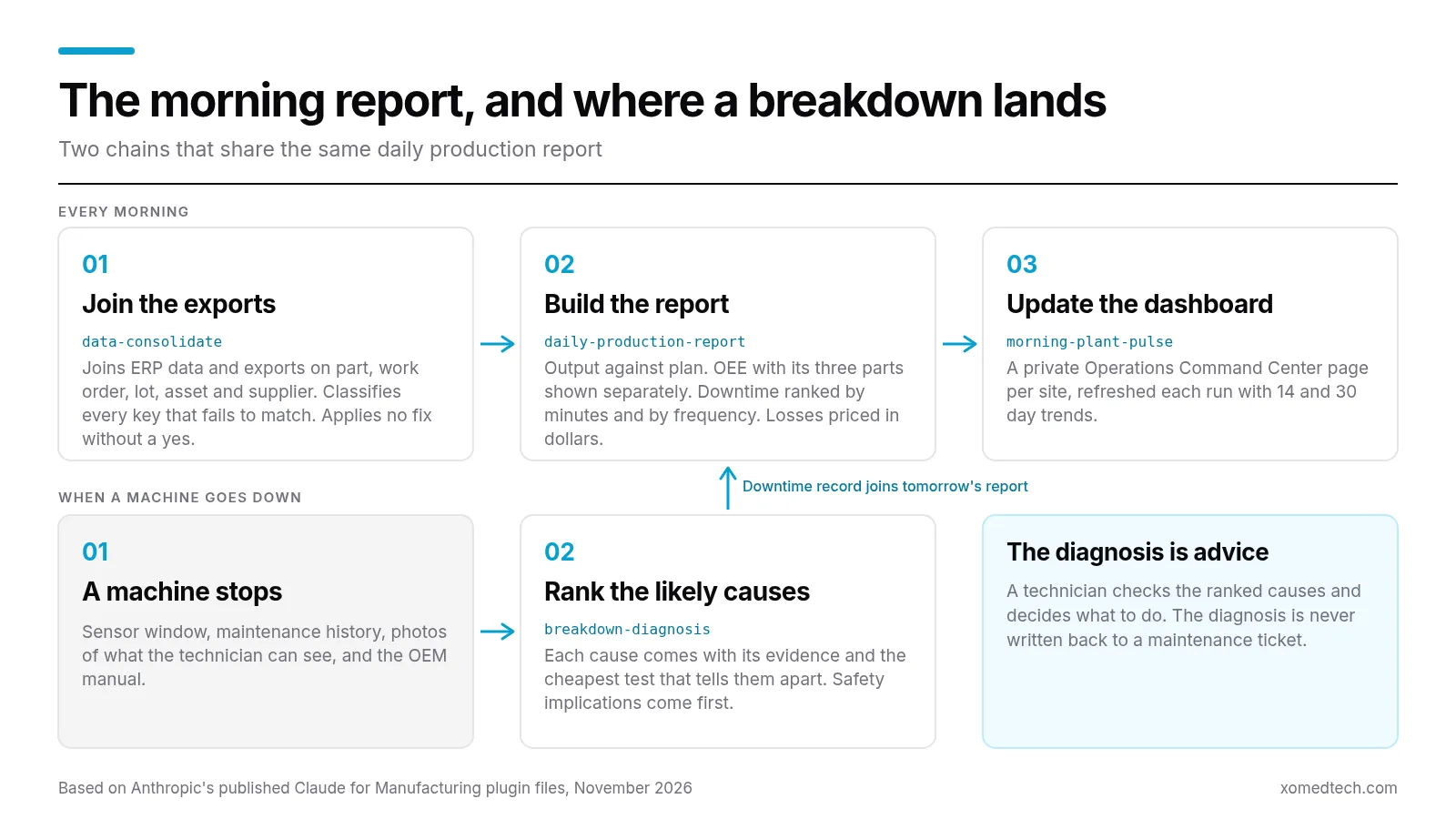
| `daily-production-report` | Builds the morning report: output against plan, OEE with its three parts shown separately, downtime ranked by minutes and by frequency, scrap and downtime priced in dollars, and exceptions needing a decision. |
| `morning-plant-pulse` (chain) | Runs the two skills above on a schedule, then updates a private Operations Command Center dashboard with 14 and 30 day trends. |
Maintenance
| Skill | What it does |
|---|---|
| `breakdown-diagnosis` | Reads the sensor window before a failure, the maintenance history including technicians' free-text notes, photos and the manufacturer's troubleshooting tree. Ranks likely causes with the cheapest test to tell them apart, and surfaces safety implications first. |
| `breakdown-to-next-report` (chain) | Runs the diagnosis, then folds it and its downtime into the next morning's report. |
Supplier management
| Skill | What it does |
|---|---|
| `supplier-quote-request` | Builds the supplier RFQ package at the verified drawing revision, with quality clauses and a response format that makes bids comparable. Flags unapproved and single-source suppliers, drafts one email per supplier for the buyer to send, and compares returned bids per quantity break. Hard stops on a revision mismatch or restricted technical data. |
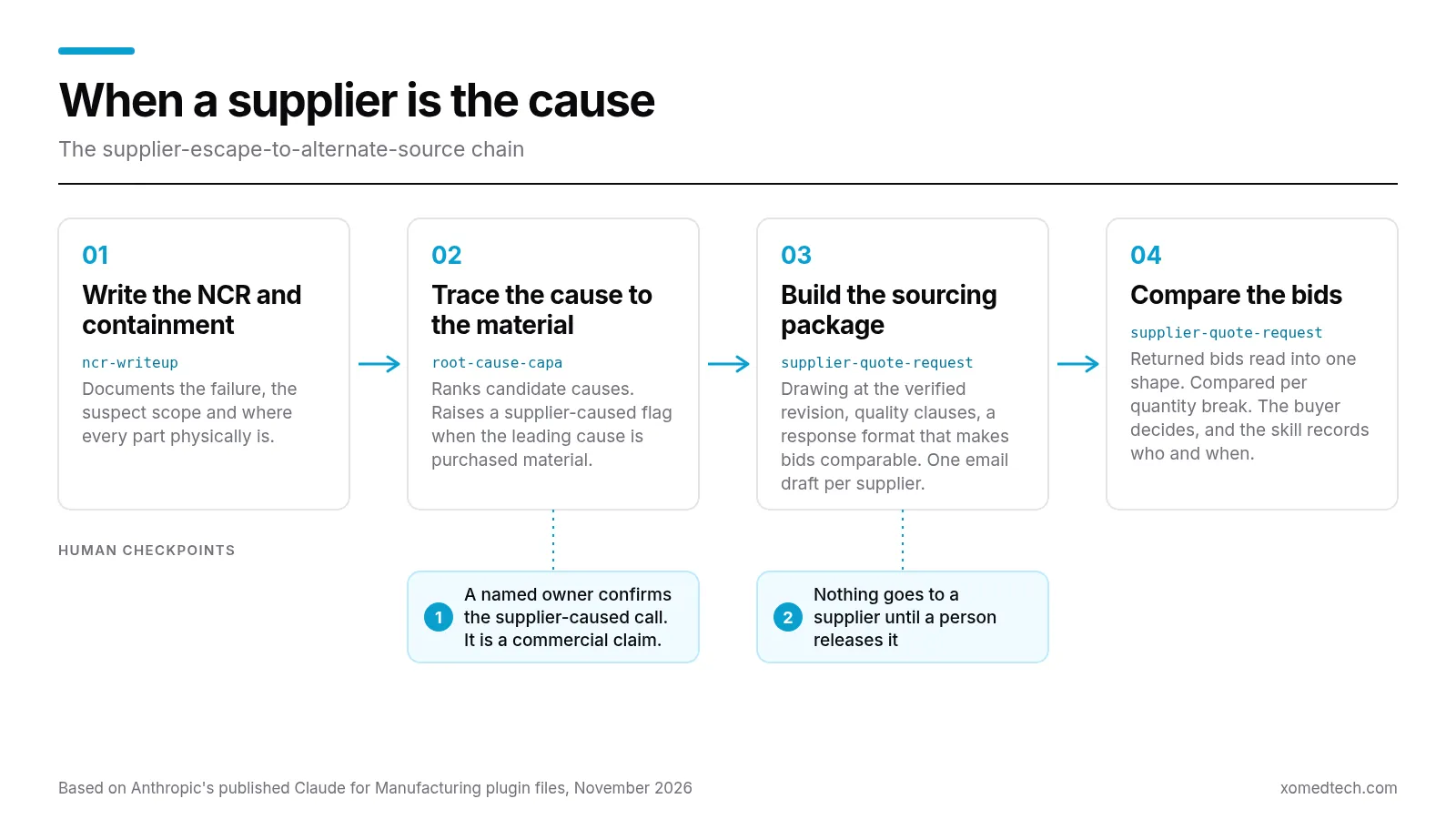
| `supplier-escape-to-alternate-source` (chain) | Runs from an NCR traced to purchased material through root cause to an alternate-source RFQ. |
Design
| Skill | What it does |
|---|---|
| `design-space-explore` | Generates CAD variants in Autodesk Fusion by changing parameters on your existing model. Never designs from scratch, never overwrites the base model, and confirms the variant count before it generates anything. |
| `trade-study-report` | Turns a filled-in trade study matrix into a scored comparison and decision memo, with a sensitivity analysis every time. Disqualifies options that violate a hard constraint instead of scoring them low. |
Setup and connections
| Skill | What it does |
|---|---|
| `onboarding` | Asks which ERP, CAD, CMMS and document system you use, tests the four connectors, takes a bulk drop of your documents, and reports which skills are limited by anything missing. |
| `custom-connector` | Connects a system with no vendor connector by working down a seven-step ladder, from a vendor MCP server to a scheduled export. Credentials never enter the conversation. |
Notice how many of those descriptions end the same way: with a person approving something. That's the design, and it's the part I'd keep intact no matter how much you customize.
Which connectors does Claude for Manufacturing use, and what does each one do?
There are four main connectors the plugin is designed to use, and they do different jobs.
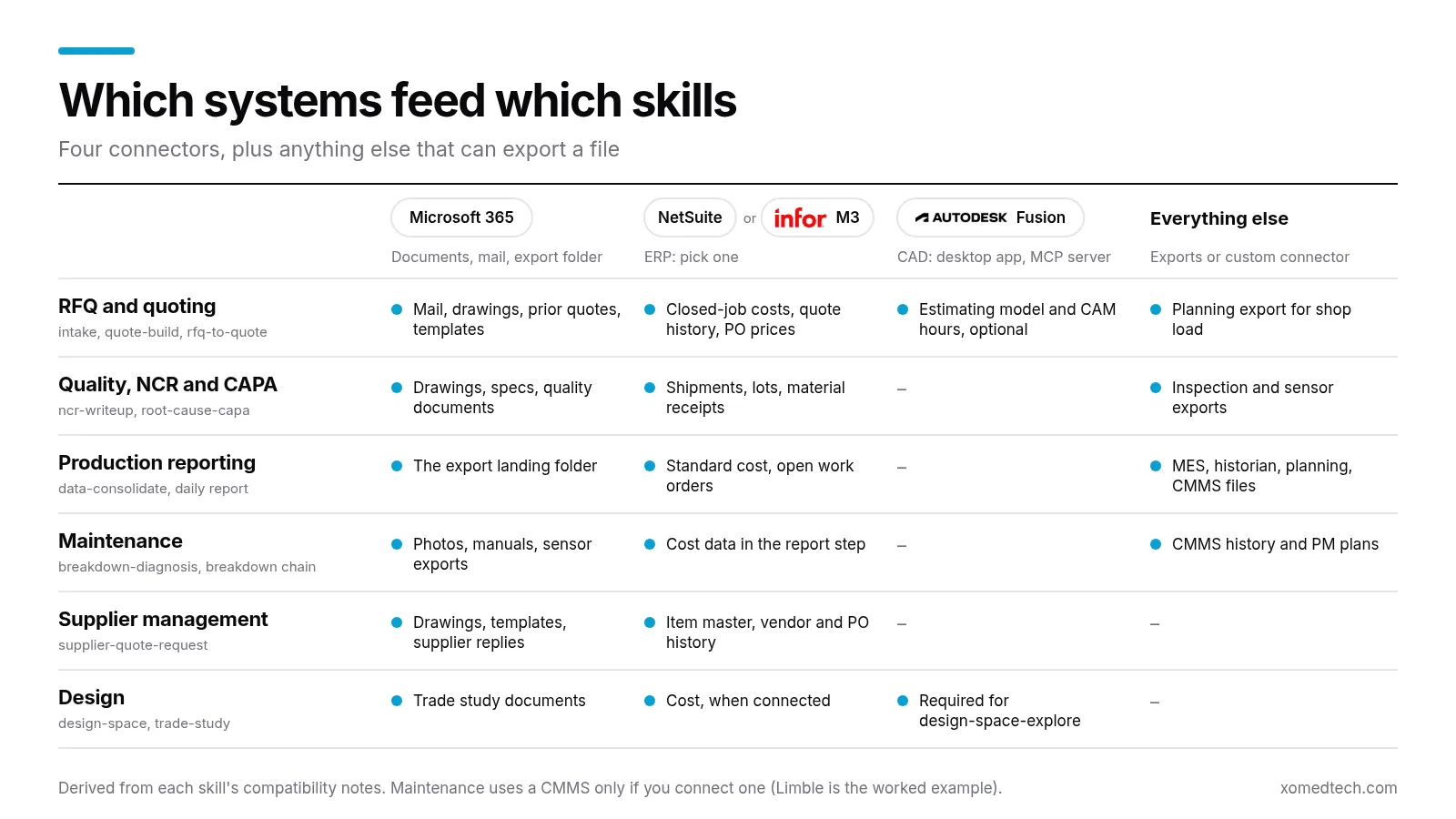
| Connector | What Claude uses it for | Setup, per the plugin README |
|---|---|---|
| Microsoft 365 | Your documents, drawings and email: procedures, supplier emails, templates and exported reports in shared folders and inboxes. Also the landing folder for exports from systems with no connector. | Enable the Microsoft 365 connector in Claude. Read-only by default. |
| Oracle NetSuite (ERP) | Orders, inventory, production steps, job costs, purchase orders, vendor records. This is what lets a quote price new work against actual closed-job costs. | Enable the NetSuite connector in Claude's connector settings. |
| Infor M3 (ERP) | Look up purchase orders and stock before acting. Anthropic describes Infor's separate plugin as the one that can make changes in Infor. | Add your company's Infor M3 MCP server as a custom connector, using the address from your Infor administrator. The plugin only reads from it. |
| Autodesk Fusion (CAD/CAM) | Generating design variants from an existing model, and CAM-derived machine hours for quotes. | Runs locally. In the Fusion desktop app, enable the Fusion MCP Server under Preferences, General, API. Fusion must be open with a document. |
A plant runs one ERP, so NetSuite and M3 are alternatives. Two details are easy to miss:
- Fusion is the only connector the plugin declares itself. The other three are enabled in Claude. That likely explains why the plugin directory listing shows "1 connector" while Anthropic's announcement says four. Nobody's wrong; they're counting different things.
- Infor M3 has limits. The README says M3 gives the plugin no standard cost, quote history or routings, so skills fall back to other inputs and say so in the output. If job costing from your ERP is the point, check what your ERP actually returns.
What about my QMS and maintenance system?
Here's the catch. Most medtech plants also run a QMS platform, an MES, a CMMS and a document control system. None of those are among the four. That is not a dealbreaker. Anthropic says you can still use the plugin by saving regular exports from those systems to Microsoft 365, and Claude works from the files. The README describes scheduled exports as "the designed path, not a fallback."
For a system you want to connect more tightly, the `custom-connector` skill works through options in order and stops at the first one that works. That includes the system's own connector, where the vendor publishes one. The README's worked example for maintenance systems is Limble, which publishes its own MCP server. If your vendor doesn't have one, exports still get you most of the way.
Without any connector at all, everything except `design-space-explore` still runs, according to the README. That skill needs a live Fusion connection and has no file-only path.
How does an RFQ-to-quote workflow work?
This is the chain most relevant to a CDMO's commercial team, and honestly the one I'd start with. An RFQ lands. Claude reads the drawings, lists what's missing, pulls cost history from your past jobs or your ERP, and drafts the quote with every number traced. Then your estimator reviews it and polishes it for release. It runs four steps with four stops for the estimator.
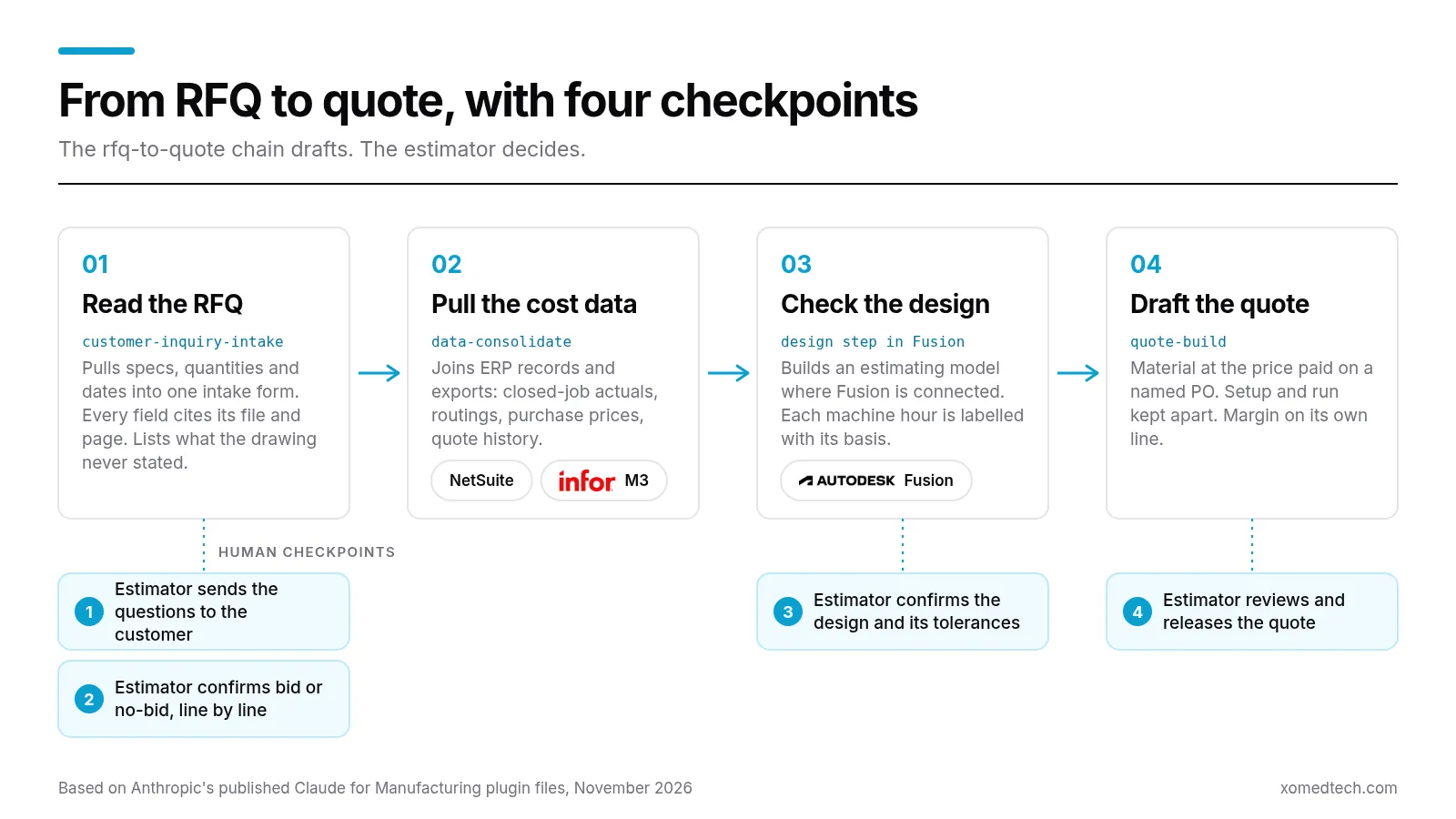
1. Read the RFQ. `customer-inquiry-intake` builds the intake form and lists what the drawing never stated, separately from what it stated two different ways. It drafts the questions back to the customer. Gate 1: the estimator sends them. Nothing goes to a customer without that. 2. Decide bid or no-bid. The chain checks the job against what the plant can build and recommends. Gate 2: the estimator confirms or declines, line by line. 3. Pull cost data and check the design. `data-consolidate` brings in closed-job actuals, routings and purchase prices. Where Fusion is connected, the chain builds an internal estimating model and labels the basis of each machine hour. Gate 3: the estimator confirms the design. 4. Draft the quote. `quote-build` checks the promised date against shop load and shows its cost basis. Gate 4: the estimator reviews and releases.
For a medtech contract manufacturer, the practical value is traceability. Every field points back to a file and page, which helps when a customer questions a quote or a requirement changes. The skill's own rules are cautious: it never infers a tolerance from a drawing and never asserts a no-bid as a decision. I like a tool that knows what it doesn't know.
How does an inspection-to-CAPA workflow work?
This is the chain that will matter most to quality teams, and the one where the regulatory questions are sharpest. A part fails. Claude writes the NCR, checks whether you've seen this failure before, ranks the likely causes, and drafts the 8D. Your quality engineer reviews it, edits it, and signs.
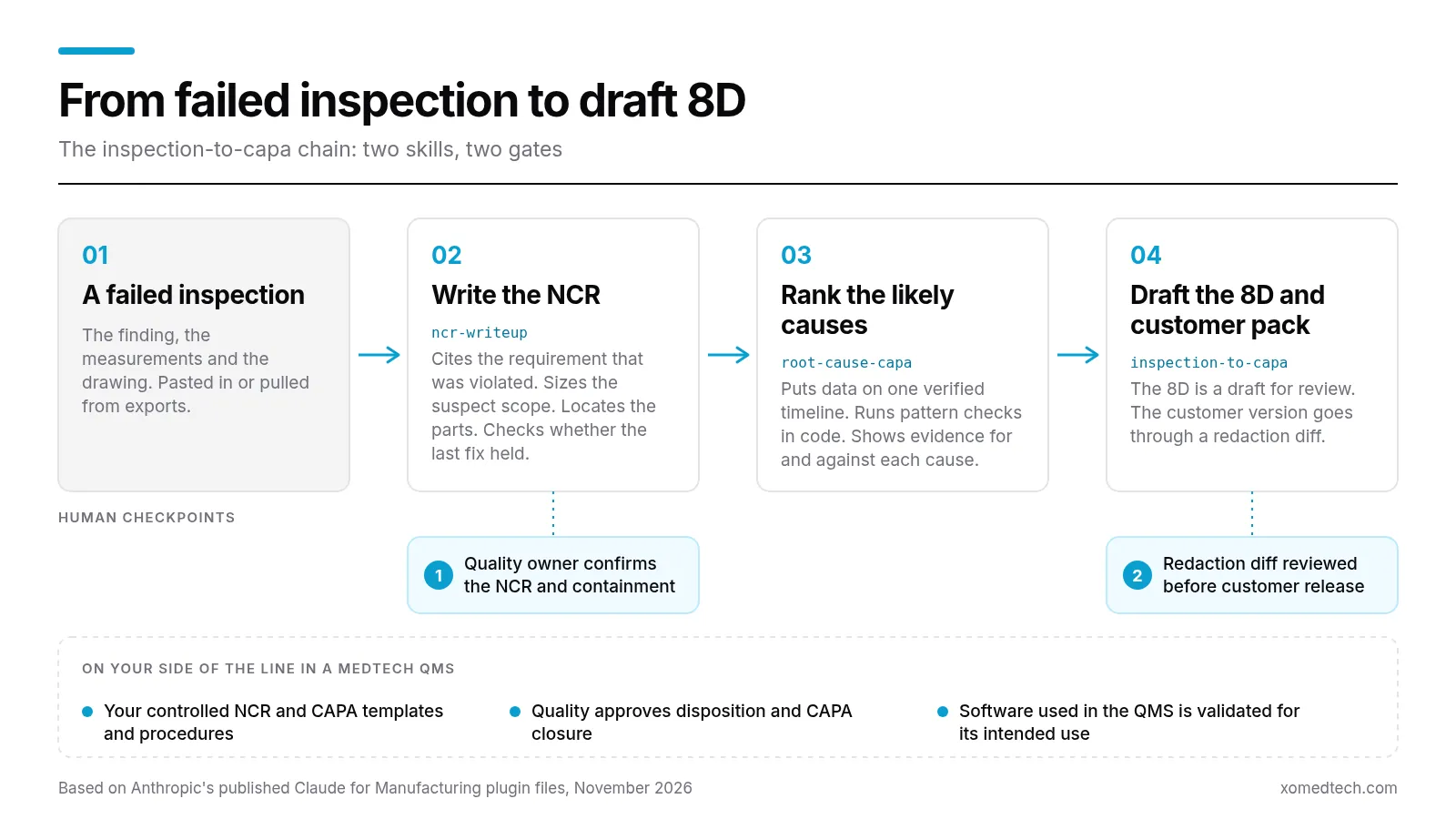
The flow is:
1. A quality engineer shares a failed inspection. 2. `ncr-writeup` writes the NCR against the requirement violated, cited to its document and location, and checks prior NCRs for the same failure. Gate 1: the quality owner confirms the NCR and containment plan. 3. `root-cause-capa` aligns data on one timeline, runs pattern checks, and ranks candidate causes. The skill description says it "never produces a single unqualified verdict." 4. The chain drafts the 8D and a customer-facing pack. Gate 2: nothing customer-facing leaves without a person reviewing the redaction diff.
Anthropic's own sample 8D on its manufacturing page shows the posture. It is marked "ROOT CAUSE NOT VALIDATED," ranks three candidate causes with evidence for and against each, and notes that because the inspection gauge's calibration was unverified, "measurement validity is unconfirmed." That is the right instinct for a quality system, and it is also a reminder that the output is a starting point.
Two related chains are worth knowing. When a nonconformance traces to purchased material, `supplier-escape-to-alternate-source` carries it into an alternate-source RFQ. A named human owner has to confirm the supplier-caused call first, because it is a commercial claim, and nothing goes to a supplier until a person releases it.
And for production and maintenance teams, `morning-plant-pulse` and `breakdown-to-next-report` produce the daily report and feed a machine's diagnosis into it.
How does it fit ISO 13485 and FDA QMSR requirements?
This is the part Anthropic's materials do not address, so it is the part to plan for. To be clear: this isn't specifically for medtech manufacturing, and what follows is general background, not regulatory advice. Confirm specifics with your regulatory and quality leadership.
The regulatory frame changed this year. FDA's Quality Management System Regulation took effect on February 2, 2026. It amends 21 CFR Part 820 and incorporates ISO 13485:2016 by reference. FDA eliminated the separate record names from the old regulation. The device master record's contents now sit in the medical device file (ISO 13485 clause 4.2.3), and the device history record's contents now sit in the record for each device or batch (clause 7.5.1). Many companies still use DMR and DHR internally, and the underlying documentation and traceability obligations remain.
Where the plugin's outputs land in that frame:
- NCRs and CAPAs. ISO 13485 covers nonconforming product (clause 8.3) and corrective and preventive action (clauses 8.5.2 and 8.5.3). A Claude-drafted NCR or 8D is a draft input to your controlled process. The plugin states that the NCR uses the plant's or the customer's controlled template, not a house style, so load yours during setup. An 8D is also not automatically your CAPA record. Your procedure defines what a CAPA is, who approves it and what effectiveness evidence closes it.
- Supplier controls. Purchasing is clause 7.4. `supplier-quote-request` flags unapproved and single-source suppliers against the approved supplier list, which is useful, but the list itself and your evaluation criteria remain yours.
- Device records. Claude can search past NCRs and read lot and receipt data from your ERP. It does not replace the batch or device record, and the plugin says it writes nothing to a system of record without approval.
- Software used in the QMS. ISO 13485 clause 4.1.6 requires documented validation of software used in the quality management system, before initial use and after changes, in proportion to risk. FDA's guidance on computer software assurance, updated in February 2026, describes a risk-based way to do that. A plugin that drafts quality records and quotes is a candidate for that process. How much rigor it needs depends on what it can affect and whether a person reviews every output, so document that reasoning.
- Electronic records. If drafts, approvals or sign-offs become electronic records in your system, ask your regulatory team how 21 CFR Part 11 applies to your setup.
What the plugin does well for this audience. It cites sources for figures, labels what it could not confirm, refuses to correlate data across clocks it could not align, and stops for human approval at defined gates. Those habits fit a regulated environment.
What it does not do. It is not a validated QMS, it is not a medical device quality system, and Anthropic does not claim it satisfies ISO 13485 or QMSR. AI output can be wrong. In regulated work, a qualified person must verify it before it becomes a record, goes to a customer, or changes a process.
What should a medical device contract manufacturer check before using it?
A short pre-flight list:
1. Plan and admin access. Anthropic's pages say the plugin is available on paid plans. Its announcement says to install on Team or Enterprise plans. Confirm yours with Anthropic, and confirm your IT department has greenlit connector use before anyone connects anything. 2. Data scope. Decide which customer drawings, specifications and records Claude may read. Contract manufacturers often hold customer-confidential and export-controlled data. The supplier-RFQ skill stops on restricted technical data, but your policy comes first. 3. Write permissions. Anthropic says owners on Team and Enterprise plans can require approval before a connector changes anything, or block changes. The README describes the NetSuite connection as read and write and the M3 connection as read-only, so check what your admin has enabled. 4. Templates. Load your controlled NCR, 8D, quote and RFQ templates before relying on any output. 5. Validation plan. Decide the intended use, the risk, and how you will test and record it, per ISO 13485 clause 4.1.6 and FDA's software assurance guidance. 6. A pilot process you already measure. Anthropic suggests starting with one process, such as quoting or quality. Compare Claude's draft quote or NCR against what your team produced, and track corrections.
What can't Claude for Manufacturing do?
- It does not operate equipment. Anthropic says so directly. A separate research preview, the Model Hardware Standard, covers how AI might work with equipment in the future.
- It is not medtech-specific. The skills assume manufacturers that quote each job and write NCRs and 8Ds, which fits contract manufacturers well. Anthropic says process manufacturers fit "partly, today."
- It does not connect natively to most medtech systems. QMS platforms, MES and document control systems run through exports or a custom connector.
- It is a reference implementation. Expect to adapt it, and expect the repository itself to change.
How do you get started?
Start small. Pick one process you already measure, like quoting or CAPAs, learn and adapt as you go, and don't try to boil the ocean.
The mechanics are simple. Anthropic's instruction is to install the plugin from the Claude plugin directory and say "Set us up." The `onboarding` skill then asks which systems you use, tests the connectors, takes a drop of your documents, and reports which skills cannot fully run yet. Anthropic is also hosting a technical webinar on the plugin on November 17, 2026, at 11:00 a.m. ET.
If you don't have an elite Claude user on your team, find someone who is to help guide you. The difference between a team that plays with this and a team that gets value from it is usually one person who knows how to shape the prompts, the templates and the review steps.
And customization is where it gets interesting. Anthropic calls the skills "a starting point" that organizations can build on, and says teams can change the quoting and quality skills to match their batch records and procedures. That means you can make the plugin fit and mesh with your process style and data sources, instead of bending your process to fit a template. At XO Medtech, we've seen that work well for clients with other plugins and skills. I'm particularly excited about what that means for medtech contract manufacturers, because your processes are the part nobody else can write for you.
The CDMOs that figure this out first will move at light speed. The ones that don't will still have their people copying data between spreadsheets.
Frequently asked questions
What is Claude for Manufacturing?
Claude for Manufacturing is a plugin from Anthropic with 17 skills for quoting, quality (NCRs, 8Ds and CAPA), production reporting, maintenance, supplier sourcing and design. It works through four main connectors (Microsoft 365, Oracle NetSuite or Infor M3, and Autodesk Fusion), and it is built so a person reviews every draft.
Is Claude for Manufacturing built for medical device manufacturers?
No. It is a general manufacturing plugin. Its files reference standards such as ISO 9001, AS9100 and IATF 16949, and I found no reference to ISO 13485 or FDA QMSR. Medical device contract manufacturers can adapt it, but they need to load their own controlled templates and validate the software for its intended use.
Which connectors does Claude for Manufacturing support?
Four: Autodesk Fusion, Infor (M3), Microsoft 365 and Oracle NetSuite. A plant connects one ERP, either NetSuite or Infor M3. QMS and maintenance systems are not on the list; they work through file exports or a custom connector.
Does Claude for Manufacturing work without connectors?
Mostly. According to the plugin README, every skill except design-space-explore runs from files and scheduled exports with no connector. Design exploration needs a live Autodesk Fusion connection.
Does Claude for Manufacturing write NCRs and 8Ds?
Yes, as drafts. The ncr-writeup skill writes the nonconformance report against the requirement violated and checks prior NCRs. The root-cause-capa skill ranks likely causes and drafts the 8D. A quality engineer reviews, edits and signs. An 8D is not automatically your CAPA record.
Can Claude for Manufacturing change records in our ERP?
Anthropic's marketing pages say Claude drafts documents and does not write to systems of record. Infor separately offers its own plugin that can make changes in Infor after a user approves. Because the README describes the NetSuite connection as read and write, check with your administrator what is enabled and require approval for any change.
Can a medical device CDMO use Claude for Manufacturing in an ISO 13485 quality system?
It can be used as a drafting aid, but the controls stay with you. Software used in the QMS has to be validated in proportion to risk (ISO 13485 clause 4.1.6). Outputs such as NCRs, 8Ds and quotes need qualified human review before they become records or leave the building. Confirm the approach with your quality and regulatory leaders.
Does Claude for Manufacturing operate machines?
No. Anthropic says the plugin drafts documents for people to review and does not run production control or operate equipment.
How much does Claude for Manufacturing cost?
I could not confirm plugin-specific pricing in Anthropic's launch materials. They say the plugin is available on paid plans, and enterprise buyers can contact Anthropic's sales team.
Sources
- Anthropic, "Introducing Claude for Manufacturing," November 12, 2026: <https://claude.com/resources/articles/claude-for-manufacturing>
- Anthropic, Claude for Manufacturing solutions page: <https://claude.com/solutions/manufacturing>
- Manufacturing Dive, "Anthropic launches 'Claude for Manufacturing,'" November 12, 2026: <https://www.manufacturingdive.com/news/anthropic-launches-claude-for-manufacturing/874303/>
- Anthropic plugin source, `claude-plugins-official/plugins/claude-for-manufacturing` (README, skill files, `.mcp.json`): <https://github.com/anthropics/claude-plugins-official/tree/main/plugins/claude-for-manufacturing>
- Claude plugin directory listing: <https://claude.com/marketplace/plugins/claude-for-manufacturing>
- Anthropic, Model Hardware Standard research preview, August 27, 2026: <https://www.anthropic.com/news/model-hardware-standard-research-preview>
- FDA, Quality Management System Regulation (QMSR): <https://www.fda.gov/medical-devices/postmarket-requirements-devices/quality-management-system-regulation-qmsr>
- Federal Register, Medical Devices; Quality System Regulation Amendments, February 2, 2024: <https://www.federalregister.gov/documents/2024/02/02/2024-01709/medical-devices-quality-system-regulation-amendments>
- FDA, Computer Software Assurance for Production and Quality Management System Software (February 2026): <https://www.fda.gov/regulatory-information/search-fda-guidance-documents/computer-software-assurance-production-and-quality-management-system-software>
Want to talk about AI on your commercial team?
If you're thinking about where AI fits on your commercial team, from RFQs and quoting to follow-up and pipeline, message me. I'm happy to compare notes.
This article is general information, not legal, regulatory or quality advice. Product details come from Anthropic's published materials as of November 13, 2026 and may change. Logos and product names belong to their owners.